Longitudinal Phenotypic Trajectories in GNAO1-Related Disorders: Defining Disease Progression and Clinical Profiles - Report - MDSpire

Longitudinal Analysis of Phenotypic Changes in GNAO1-Associated Disorders: Characterizing Disease Progression and Clinical Features

  • By

  • Jana Domínguez-Carral

  • Ana María Domínguez Cobo

  • Sol Balsells

  • Anna Aguilar-Ros

  • Chu-Ting Chang

  • William G. Ludlam

  • Kathryn Yang

  • Katerina Bernardi

  • Micaela Chinigioli

  • Ainara Salazar-Villacorta

  • Veronica Di Pisa

  • Nuria Lamagrande-Casanova

  • Elena González-Alguacil

  • Beatriz De la Casa-Fages

  • Akihisa Okumura

  • Josefina Rodríguez

  • Ayush Agarwal

  • Daniela Muñoz-Chesta

  • Carolina Reynoso-Osnayo

  • Amy Lin

  • Brahim Tabarki

  • Jobaida Parvin

  • Adolfo Alberto Gallo

  • Andreia Forno

  • Fabian Maass

  • Johnny Montiel Blanco

  • Salomé Nasif

  • Elizabeth Jennions

  • Jorge Luis Ramón-Gómez

  • Helene Verhelst

  • Juan José Nieto Barceló

  • Dunja Čokolić Petrović

  • Luz Victoria García Ruiz

  • Christoph van Riesen

  • Paulo Rego Sousa

  • Maria del Pilar Massaro Sanchez

  • Husnea Ara Khan

  • Wejdan Hakami

  • Jennifer Friedman

  • Iván Espinoza-Quinteros

  • Monica Troncoso

  • Divyani Garg

  • Micaela Pauni

  • Hirokazu Kurahashi

  • María Concepción Miranda-Herrero

  • Anna Duat-Rodriguez

  • Luca Soliani

  • Manju A. Kurian

  • Angeles Schteinschnaider

  • Siddharth Srivastava

  • Darius Ebrahimi-Fakhari

  • Kirill A. Martemyanov

  • Juan Darío Ortigoza-Escobar

  • July 1, 2026

Share

Clinical Report: Longitudinal Analysis of Phenotypic Changes in GNAO1-Associated Disorders

Overview

This study analyzes the clinical characteristics and disease progression of 66 individuals with GNAO1-related disorders, focusing on a subset of 21 patients assessed over four years.

Background

GNAO1-related disorders encompass a spectrum of phenotypes, including developmental and epileptic encephalopathy, characterized by significant neurological impairments. Understanding the clinical variability and progression of these disorders is important due to the genetic and phenotypic heterogeneity observed in affected individuals.

Data Highlights

No numerical or trial data was provided in the source material.

Key Findings

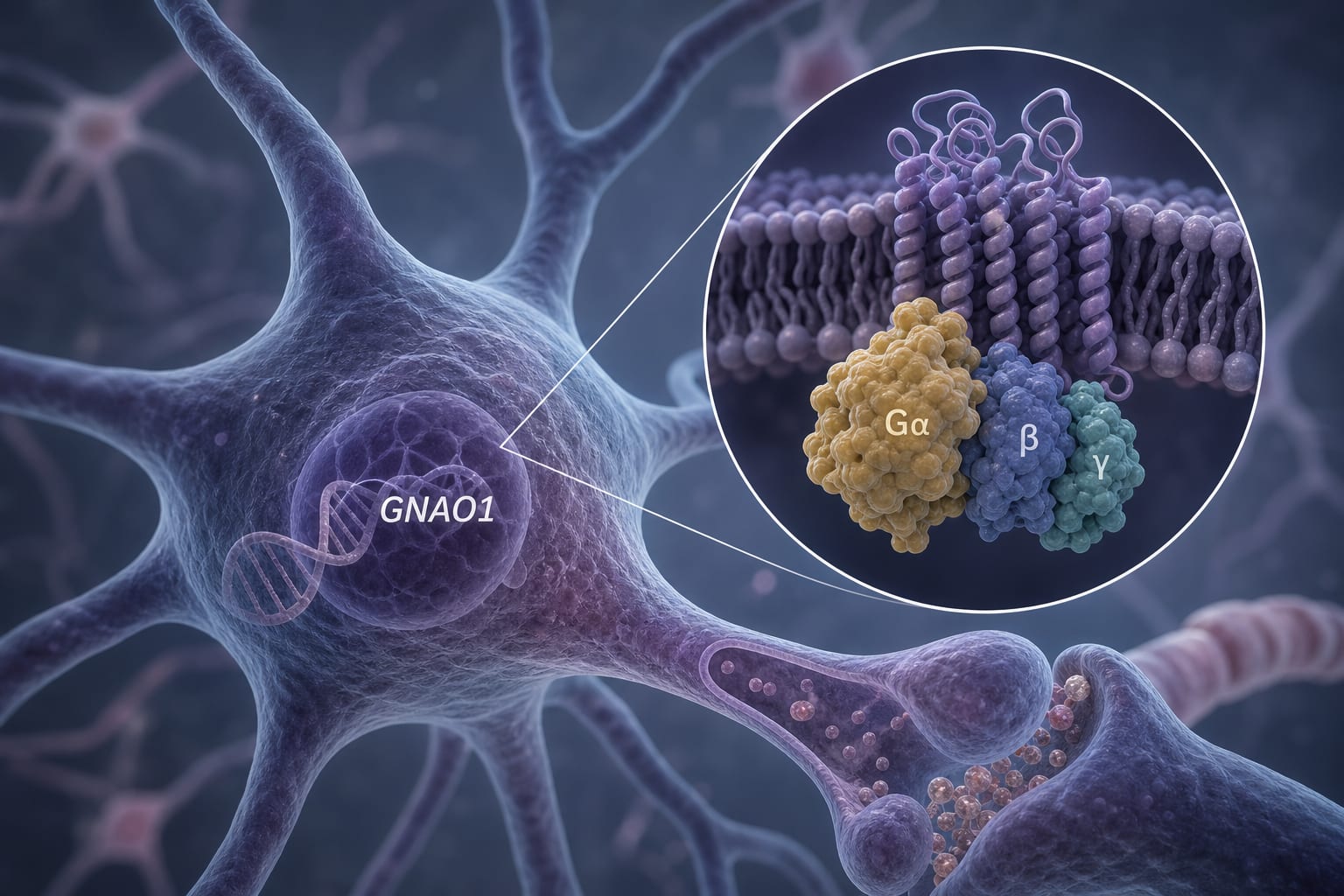
  • GNAO1 gene variants lead to diverse clinical presentations, including DEE-17 and NEDIM.
  • Approximately 282 individuals with GNAO1-RD have been reported, with over 150 distinct variants identified.
  • Pathogenic variants disrupt Gαo signaling, affecting disease severity and clinical outcomes.
  • The GNAO1-RD severity score allows for categorization of patients into severity-based subgroups.
  • Longitudinal assessment reveals phenotypic trajectories over a four-year follow-up period.

Clinical Implications

Clinicians should consider the GNAO1-RD severity score for understanding the clinical variability in affected patients.

Conclusion

This longitudinal analysis provides insights into GNAO1-related disorders.

Related Resources & Content

  1. Nakamura et al, OMIM, 2013 -- GNAO1 gene and DEE-17
  2. Brain — The Broadened Clinical and Genetic Landscape of Disorders Associated with DYNC1H1
  3. Brain — Genetic and Clinical Overview of Optic Atrophy in 826 Families: Findings from 50 Nuclear Genes
  4. Brain — Reply: Age at onset of genetic disease and genetic dependent stage: evidence from cases with SCN1A variants
  5. Pediatric Cardiology — Cardiovascular Complications and Treatment Guidelines for Ogden Syndrome
  6. GNAO1-Related Disorder
  7. Checking your browser - reCAPTCHA

Original Source(s)

Related Content