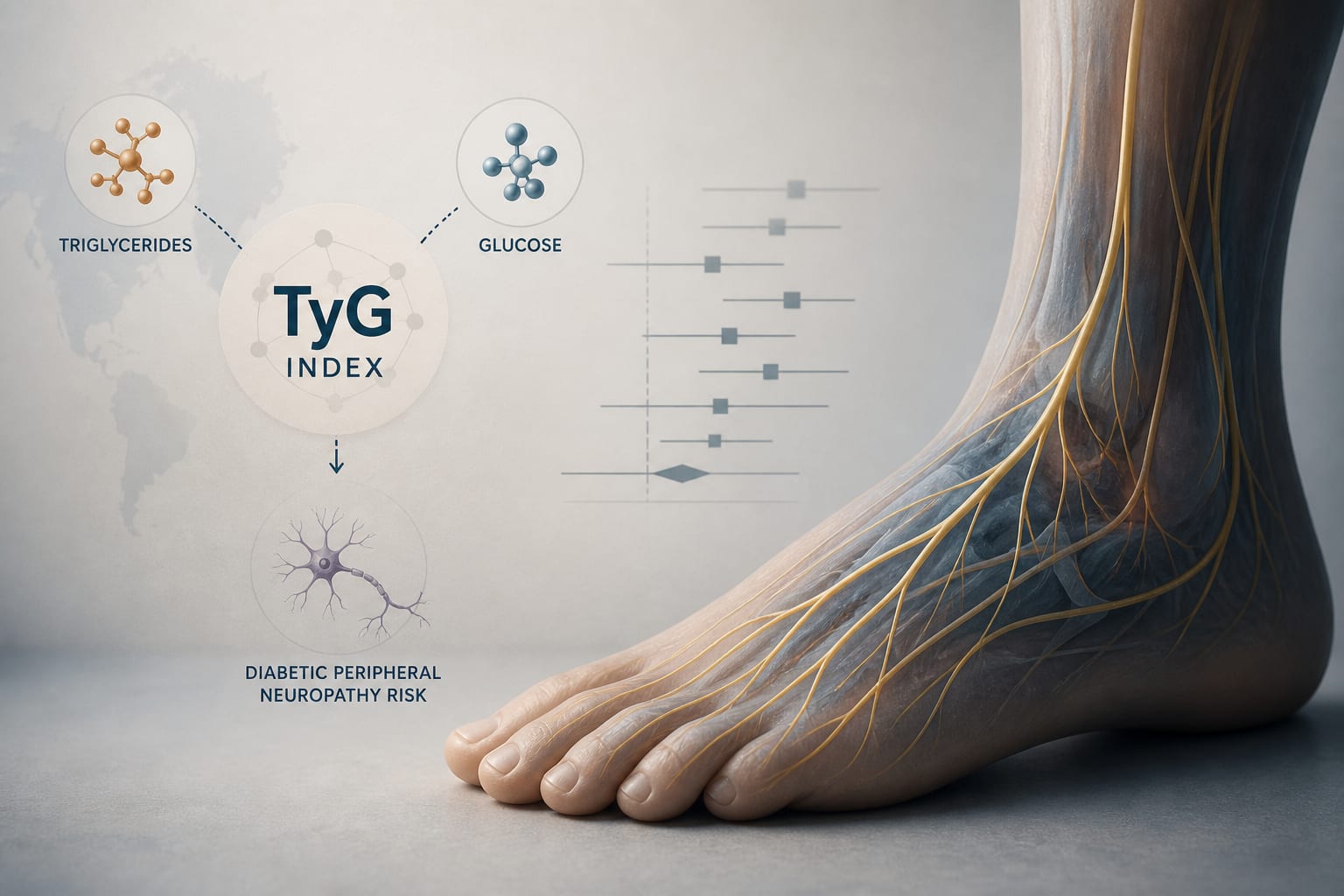
The association between the triglyceride-glucose index and diabetic peripheral neuropathy: a systematic review and meta-analysis - Report - MDSpire
Coming Soon: Introducing MDSpire News. Learn more
Conexiant’s news site is now MDSpire News. Learn more

Examining the Link Between the Triglyceride-Glucose Index and Diabetic Peripheral Neuropathy: A Comprehensive Review and Meta-Analysis

  • By

  • Xin Gu

  • Maoying Wei

  • Chan Wu

  • Aijing Li

  • Anning Sun

  • Jingyi Guo

  • Haoshuo Wang

  • Churan Wang

  • Yincheng Li

  • Qingyi Zhu

  • Yanbing Gong

  • September 4, 2026

Share

Clinical Report: Examining the Link Between the Triglyceride-Glucose Index and Diabetic Peripheral Neuropathy

Overview

This systematic review and meta-analysis evaluated the association between the triglyceride-glucose (TyG) index and diabetic peripheral neuropathy (DPN) risk in patients with type 2 diabetes mellitus (T2DM). Results indicated that elevated TyG index values correlate with increased DPN risk, with a pooled odds ratio of 2.614 (95% CI: 1.788-3.821, P < 0.0001).

Background

Diabetic peripheral neuropathy (DPN) is a prevalent complication of type 2 diabetes, affecting approximately 30% of individuals with the condition. Early detection and management of DPN are crucial to prevent severe outcomes such as foot ulcers and amputations.

Data Highlights

MeasurePooled Odds Ratio (OR)Pooled Hazard Ratio (HR)Confidence Interval (CI)P-value
TyG Index2.6141.24895% CI: 1.788-3.821P < 0.0001
95% CI: 1.003-1.553P = 0.0471

Key Findings

  • Fourteen studies with 32,281 participants were included in the analysis.
  • Higher TyG index values were significantly associated with increased DPN risk.
  • Pooled odds ratio for the association was 2.614 (95% CI: 1.788-3.821).
  • Pooled hazard ratio was 1.248 (95% CI: 1.003-1.553).
  • The association was consistent across various subgroups, except for the non-China subgroup.

Clinical Implications

The findings suggest that the TyG index may be a useful marker for assessing DPN risk in patients with T2DM. Clinicians should consider incorporating TyG index evaluations into routine assessments for diabetic patients to enhance early detection of DPN.

Conclusion

Elevated TyG index values are associated with a higher risk of DPN among patients with T2DM. Further research is warranted to clarify the nature of this relationship.

Related Resources & Content

  1. Frontiers in Endocrinology, 2026 -- The Association Between the Triglyceride-Glucose Index and Diabetic Peripheral Neuropathy: A Systematic Review and Meta-Analysis
  2. Frontiers in Cardiovascular Medicine — Association of triglyceride glucose index with cardiovascular autonomic neuropathy in type 2 diabetes mellitus
  3. Frontiers in Immunology — Association of the triglyceride-glucose index with the severity and short-term prognosis of Guillain-Barré syndrome
  4. Frontiers in Cardiovascular Medicine — The modifying effect of diabetes on the association between triglyceride to high-density lipoprotein cholesterol ratio and cardiovascular risk: a systematic review and meta-analysis
  5. Frontiers in Medicine — Association of the triglyceride–glucose index with albuminuria: a systematic review and meta-analysis
  6. ADA Standards of Care in Diabetes—2026
  7. DCCT and EDIC Studies in Type 1 Diabetes: Lessons for Diabetic Neuropathy Regarding Metabolic Memory and Natural History - PMC
  8. Frontiers | The Association Between the Triglyceride-Glucose Index and Diabetic Peripheral Neuropathy: A Systematic Review and Meta-Analysis

Original Source(s)

Related Content