Oncolytic virotherapy counteracts the selection of IFN-unresponsive cancer cells post-immunotherapy but is limited by the emergence of dedifferentiated cancer cells - Report - MDSpire

Oncolytic virotherapy counteracts the selection of IFN-unresponsive cancer cells post-immunotherapy but is limited by the emergence of dedifferentiated cancer cells

  • By

  • Susan Gellert

  • Bastian Kruse

  • Johannes Peters

  • Susanne Bonifatius

  • Thomas Tüting

  • Anthony C. Buzzai

  • June 22, 2026

  • 0 min

Share

Oncolytic Virotherapy Mitigates Selection of IFN-Resistant Tumor Cells

Overview

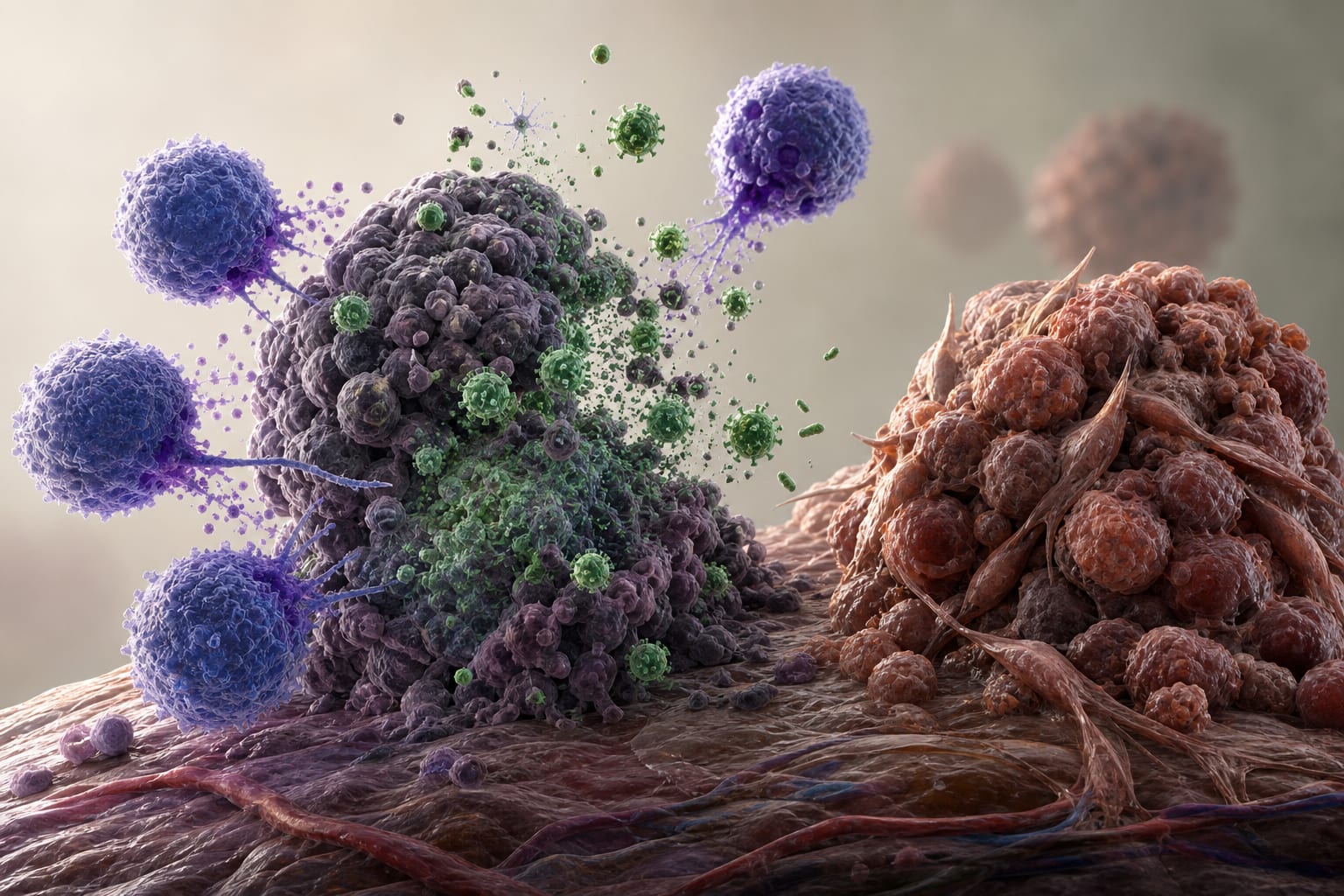
This study investigates the impact of oncolytic virotherapy on tumor cells that have developed resistance to immunotherapy through the loss of interferon (IFN) signaling. Findings indicate that while oncolytic virotherapy can target IFN-unresponsive tumor cells, dedifferentiated tumor cells may emerge.

Background

The emergence of tumor cells resistant to immunotherapy poses significant challenges in cancer treatment. Interferon (IFN) signaling is crucial for immune response, and its disruption allows tumor cells to evade immune surveillance.

Data Highlights

No numerical data provided in the source material.

Key Findings

  • Loss of IFN signaling enables tumor cells to evade immune surveillance.
  • Oncolytic virotherapy can specifically target and eliminate IFN-unresponsive tumor cells.
  • Dedifferentiated tumor cells can re-emerge, resisting both immune and viral control.
  • Natural Killer (NK) cells effectively eliminate IFN-unresponsive subclones in vivo.
  • Sequential immuno-virotherapy impacts the evolutionary dynamics of tumor cell populations.

Clinical Implications

The findings indicate that oncolytic virotherapy may be effective against certain resistant tumor cells, but the emergence of dedifferentiated cells presents a challenge.

Conclusion

This study highlights the complex interplay between tumor cell resistance mechanisms and therapeutic strategies.

Related Resources & Content

  1. NCI, Melanoma Treatment (PDQ®), 2025 -- Current guidance and approvals
  2. Journal for ImmunoTherapy of Cancer, Final analyses of OPTiM, 2025 -- Trial data on T-VEC
  3. The ASCO Post — Oncolytic Virus Triggers Immune System Against Glioblastoma Cells
  4. The ASCO Post — Oncolytic Virus Triggers Immune System Against Glioblastoma Cells
  5. The ASCO Post — Oncolytic Virus Triggers Immune System Against Glioblastoma Cells
  6. The ASCO Post — Intralesional Injections Trigger Immune Responses in Melanoma Related Articles
  7. Oncolytic Virus Triggers Immune System Against Glioblastoma Cells
  8. Melanoma Treatment (PDQ®) - NCI
  9. Final analyses of OPTiM: a randomized phase III trial of talimogene laherparepvec versus granulocyte-macrophage colony-stimulating factor in unresectable stage III–IV melanoma | Journal for ImmunoTherapy of Cancer
  10. Frontiers | Overcoming resistance to PD-1 and CTLA-4 blockade mechanisms and therapeutic strategies

Original Source(s)

Related Content