Medium-sized follicle proportion on the trigger day may be associated with higher live birth rate in fresh embryo transfer cycles among low-prognosis patients: a retrospective cohort study - Report - MDSpire
Advertisement
Medium-sized follicle proportion on the trigger day may be associated with higher live birth rate in fresh embryo transfer cycles among low-prognosis patients: a retrospective cohort study
Association of Medium-Sized Follicle Ratios on Trigger Day with Increased Live Birth Rates
Overview
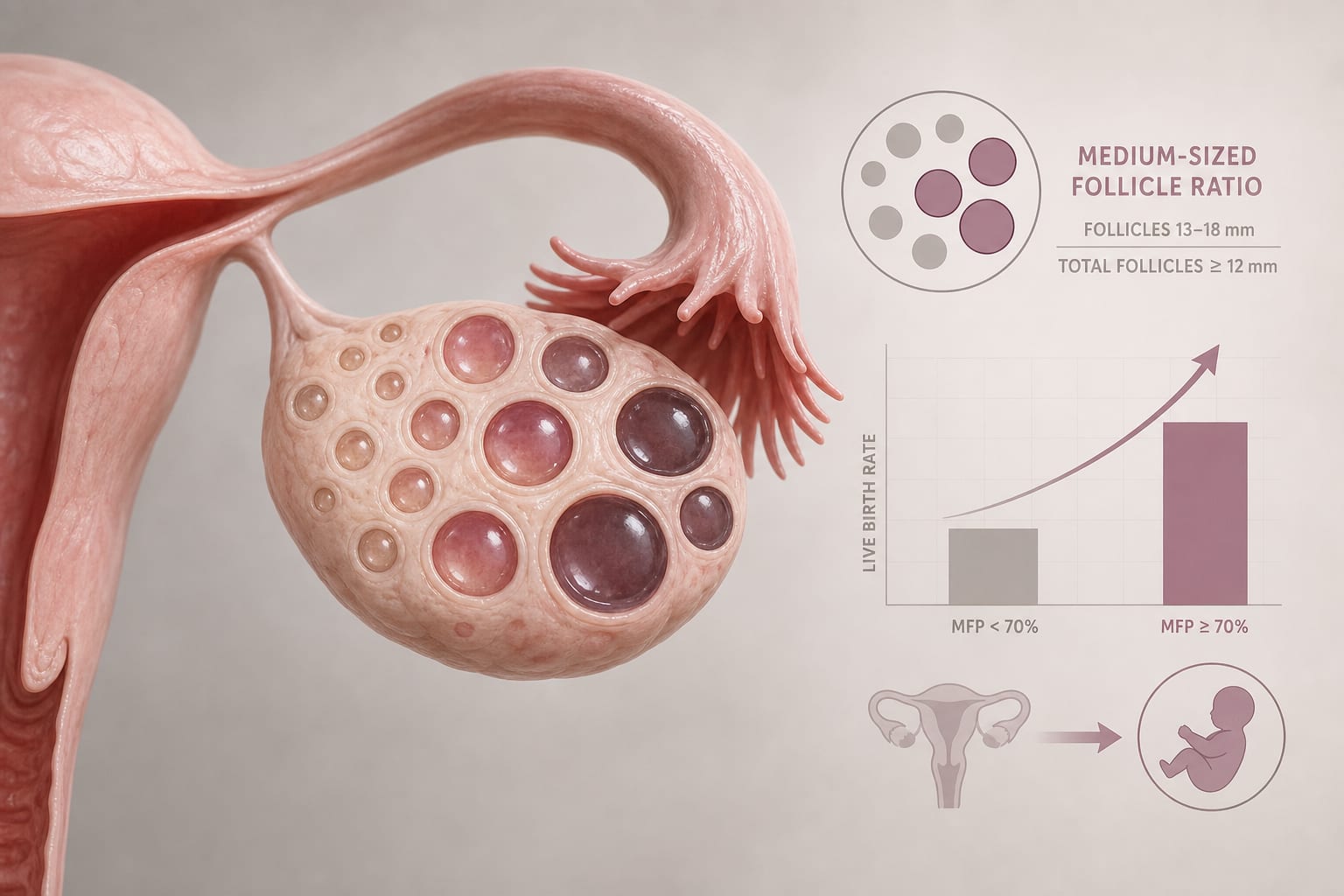
This study investigates the impact of medium-sized follicle proportions on pregnancy outcomes in low-prognosis patients undergoing fresh embryo transfers. A significant association was found between higher medium-sized follicle ratios and increased live birth rates.
Background
The management of low-prognosis patients in IVF is complex, as they often exhibit poor ovarian response and diminished ovarian reserve. Understanding factors that influence live birth rates in this population is crucial for optimizing treatment strategies. This study focuses on the role of medium-sized follicles in improving outcomes during fresh embryo transfers.
Data Highlights
MFP Group
Live Birth Rate (%)
P-value
MFP < 70%
20.75
0.003
MFP ≥ 70%
31.88
Key Findings
The live birth rate was significantly lower in the MFP < 70% group compared to the MFP ≥ 70% group (20.75% vs 31.88%, P = 0.003).
In patients aged ≤ 35 years, the live birth rate was 28.18% in the MFP < 70% group versus 43.28% in the MFP ≥ 70% group (P = 0.0148).
For patients aged > 35 years, the live birth rate was 14.50% in the MFP < 70% group compared to 23.66% in the MFP ≥ 70% group (P = 0.0444).
The MFP < 70% group required a higher GnRH-antagonist dose (0.91 ± 0.44 mg vs 0.78 ± 0.43 mg, P < 0.0001) and longer duration (3.61 ± 1.57 days vs 3.11 ± 1.55 days, P < 0.0001).
No significant difference in live birth rates was observed in frozen-thawed embryo transfer cycles between the two groups.
Multivariate logistic regression confirmed that MFP was positively associated with live births in fresh transfers.
Clinical Implications
Monitoring medium-sized follicle ratios may be relevant in predicting live birth outcomes for low-prognosis patients undergoing fresh embryo transfers.
Conclusion
This study highlights the association of medium-sized follicle development with live birth rates for low-prognosis patients during fresh embryo transfers.