Interplay between MASLD, obesity and type 2 diabetes: epidemiology, shared pathways and clinical implications - Report - MDSpire

Interplay between MASLD, obesity and type 2 diabetes: epidemiology, shared pathways and clinical implications

  • By

  • Kenneth Tachi

  • Adwoa Agyei-Nkansah

  • Yacoba Atiase

  • Bright Forkuo

  • Victoria Akosua Agyen-Frimpong

  • July 2, 2026

  • 0 min

Share

Clinical Report: The Relationship Among MASLD, Obesity, and Type 2 Diabetes

Background

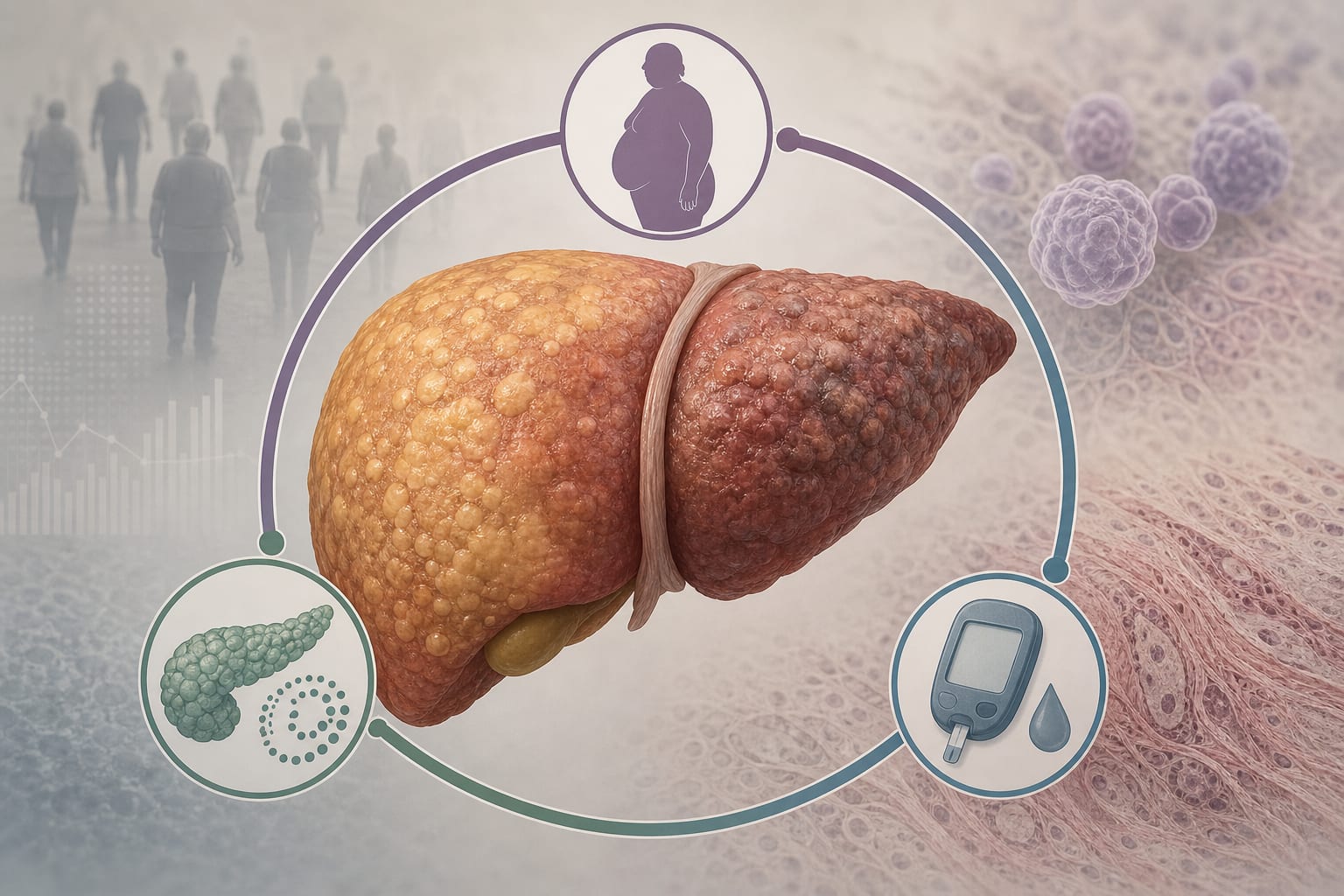
MASLD, obesity, and T2DM are prevalent global health issues that often coexist and exacerbate each other's progression. The triad significantly increases the risk of major adverse cardiovascular events, with cardiovascular disease being the leading cause of mortality in affected populations.

Data Highlights

Prevalences: MASLD (29%-38%), Obesity (16%-20%), T2DM (10%-11%).

Key Findings

  • MASLD is the most prevalent chronic liver disease worldwide.
  • Individuals with MASLD have a 1.4–1.7 fold higher risk of major adverse cardiovascular events compared to those without.
  • Approximately 68.8% of individuals with type 2 diabetes also have MASLD.
  • The coexistence of MASLD, obesity, and T2DM accelerates disease progression and increases cardiometabolic risks.
  • Integrated screening strategies are essential for identifying advanced hepatic fibrosis in this population.

Clinical Implications

Healthcare professionals should be aware of the interconnected nature of MASLD, obesity, and T2DM.

Conclusion

The interplay between MASLD, obesity, and T2DM necessitates a comprehensive approach to patient care, focusing on their shared mechanisms and risks. Enhanced awareness and integrated management strategies are vital for addressing this growing health concern.
Related Resources & Content

  1. Frontiers in Epidemiology, 2026 -- The MASLD spectrum: an emerging epidemic of cardiometabolic and extra-hepatic dimensions
  2. The Journal of Clinical Endocrinology & Metabolism, 2025 -- Raising Awareness and Improving Diagnosis of Steatotic Liver Disease Among Adolescents
  3. Frontiers in Endocrinology, 2026 -- The interplay between genetic and lifestyle obesity-related risk factors could be an important reason for the increasing epidemic of diabetes mellitus
  4. AASLD -- AASLD Announces Update to Metabolic Dysfunction‐Associated Steatotic Liver Disease (MASLD) Practice Guidance
  5. American Gastroenterological Association -- Introducing AGA’s new MASLD clinical care pathway
  6. American Diabetes Association -- The American Diabetes Association Releases “Standards of Care in Diabetes—2026”
  7. BMJ Paediatrics Open — Paediatric metabolic dysfunction-associated steatotic liver disease (MASLD): a growing health concern in the age of childhood obesity
  8. AASLD Announces Update to Metabolic Dysfunction‐Associated Steatotic Liver Disease (MASLD) Practice Guidance | AASLD
  9. Introducing AGA’s new MASLD clinical care pathway – American Gastroenterological Association
  10. The American Diabetes Association Releases “Standards of Care in Diabetes—2026” | American Diabetes Association
  11. Approval Letter_215256Orig1s024ltr.pdf
  12. ESSENCE phase 3 trial of semaglutide showed significant improvements at 72 weeks in adults with MASH, published in NEJM
  13. FDA Approves First Treatment for Patients with Liver Scarring Due to Fatty Liver Disease | FDA
  14. Tirzepatide for Metabolic Dysfunction–Associated Steatohepatitis with Liver Fibrosis | New England Journal of Medicine

Original Source(s)

Related Content