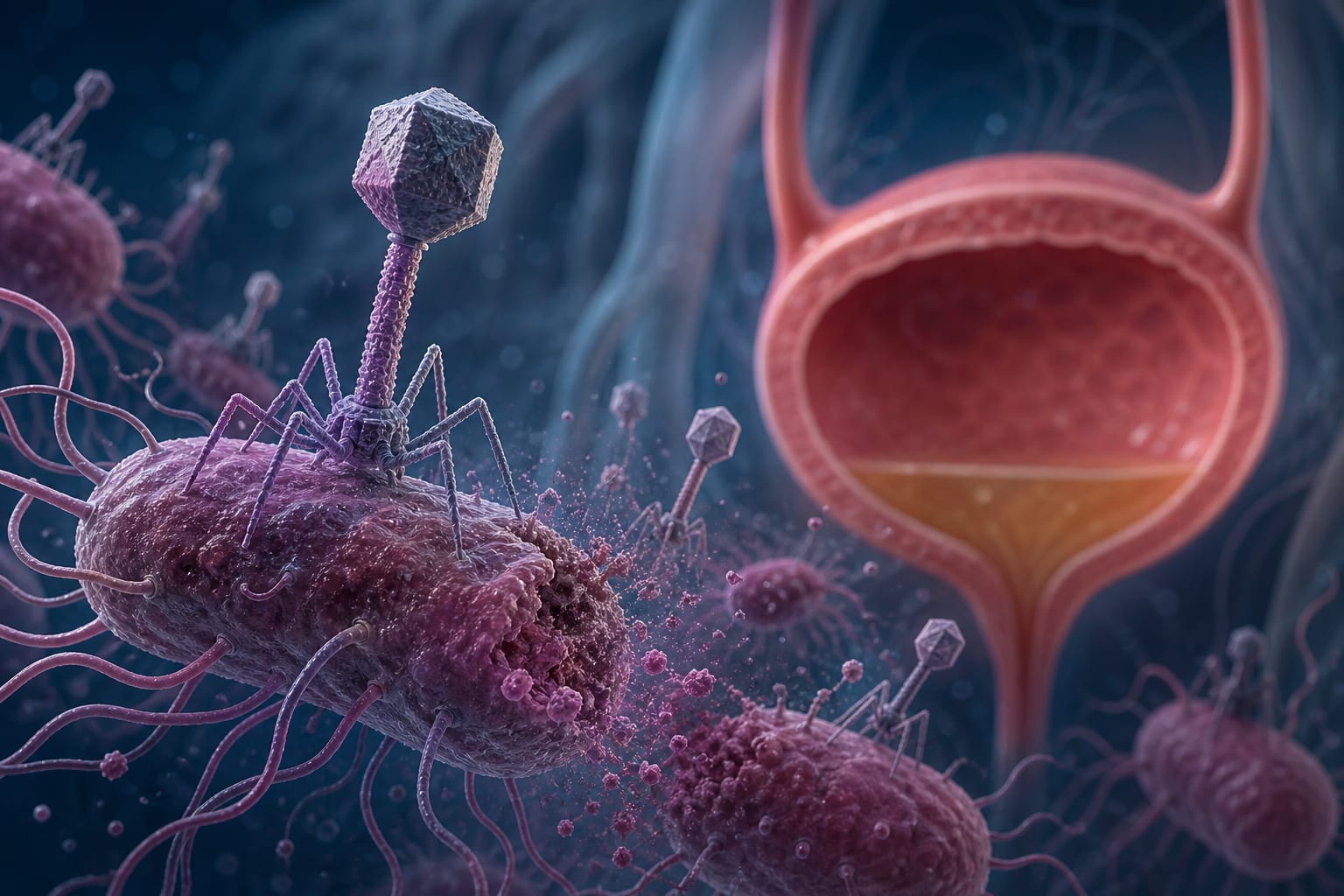
This laboratory study identified and characterized three lytic bacteriophages targeting a multidrug-resistant Klebsiella pneumoniae strain from a patient with neurogenic bladder and recurrent urinary tract infection. Researchers tested the phages against 79 clinical isolates and compared their activity against the original strain in laboratory broth and human urine. Activity was generally stronger and more sustained in urine, supporting further evaluation. The study did not test phage treatment in patients.
Background
Urinary tract infections (UTIs) affect millions of people worldwide and are a major reason for antibiotic prescriptions. Klebsiella pneumoniae causes many UTIs in patients with underlying risk factors, including neurogenic bladder. Multidrug-resistant (MDR) K. pneumoniae is an increasing concern and is classified by the World Health Organization as a critical priority pathogen.
Objective
To isolate and characterize phages targeting an MDR K. pneumoniae strain from a patient with neurogenic bladder and recurrent UTI, and assess their activity in human urine.
Approach
Researchers characterized three phages, tested their host range against 79 clinical K. pneumoniae UTI isolates, and compared their activity against the original clinical strain in laboratory broth and human urine.
Data Highlights
Three genetically distinct lytic phages were identified.
Two had narrow host ranges; the third infected 29% of the 79 tested isolates.
Bacterial growth after phage exposure was measured for up to 46 hours in broth and human urine.
Key Findings
No lysogeny-associated, antibiotic-resistance, or bacterial virulence genes were identified in the phage genomes.
Lytic activity was generally stronger and more sustained in human urine than in laboratory broth.
Phage-resistant bacteria emerged during laboratory testing.
Interpretation
Activity in urine supports further investigation of these phages as potential treatments for MDR K. pneumoniae UTI. The results do not demonstrate a treatment benefit in patients.
Clinical Implications
The findings support evaluating phages under conditions that resemble the infection site. The authors identify in vivo modeling, dosing, timing, and integration with antibiotics as areas requiring further study. This study does not recommend phage therapy as a clinical treatment.
Limitations
The phages were assessed in laboratory assays, not in an in vivo UTI model or in patients. Their effectiveness as treatments remains unestablished.
Conclusion
The three phages are candidates for further therapeutic evaluation. Their activity in human urine does not establish that they can treat recurrent MDR K. pneumoniae UTI.
Related Resources & Content
The following publication details appear in the supplied paper or its reference list:
Calin R, Bernabeu Vilaplana B, Gédéon J, et al. “Lytic bacteriophages active in urine against multidrug-resistant clinically derived Klebsiella pneumoniae causing urinary tract infection.” International Journal of Infectious Diseases. 2026;172:108966.
World Health Organization. “WHO bacterial priority pathogens list 2024: bacterial pathogens of public health importance, to guide research, development, and strategies to prevent and control antimicrobial resistance.” World Health Organization. 2024.
Pirnay J-P, Djebara S, Steurs G, et al. “Personalized bacteriophage therapy outcomes for 100 consecutive cases: a multicentre, multinational, retrospective observational study.” Nature Microbiology. 2024;9:1434–1453.
Bao J, Wu N, Zeng Y, et al. “Non-active antibiotic and bacteriophage synergism to successfully treat recurrent urinary tract infection caused by extensively drug-resistant Klebsiella pneumoniae.” Emerging Microbes & Infections. 2020;9:771–774.
Leitner L, Ujmajuridze A, Chanishvili N, et al. “Intravesical bacteriophages for treating urinary tract infections in patients undergoing transurethral resection of the prostate: a randomised, placebo-controlled, double-blind clinical trial.” The Lancet Infectious Diseases. 2021;21:427–436.
Le Bris J, Chen N, Supandy A, Rendueles O, Van Tyne D. “Phage therapy for Klebsiella pneumoniae: understanding bacteria–phage interactions for therapeutic innovations.” PLOS Pathogens. 2025;21:e1012971.