Unmasking the “targetless” illusion: branched clonal evolution of TERT and KIT in acral melanoma revealed by sequential multi-site biopsies- a case report - Report - MDSpire
Advertisement
Unmasking the “targetless” illusion: branched clonal evolution of TERT and KIT in acral melanoma revealed by sequential multi-site biopsies- a case report
Clinical Report: Branched Clonal Evolution of TERT and KIT in Acral Melanoma
Overview
Revise to emphasize the implications of genetic heterogeneity and resistance mechanisms.
Background
Acral melanoma is a rare and aggressive form of melanoma that often presents with unique genetic alterations. Understanding the clonal evolution and mutational landscape is crucial for developing effective targeted therapies. This report emphasizes the importance of serial biopsies in capturing the evolving genetic profile of tumors, which can inform treatment strategies.
Data Highlights
No numerical data available in the article.
Key Findings
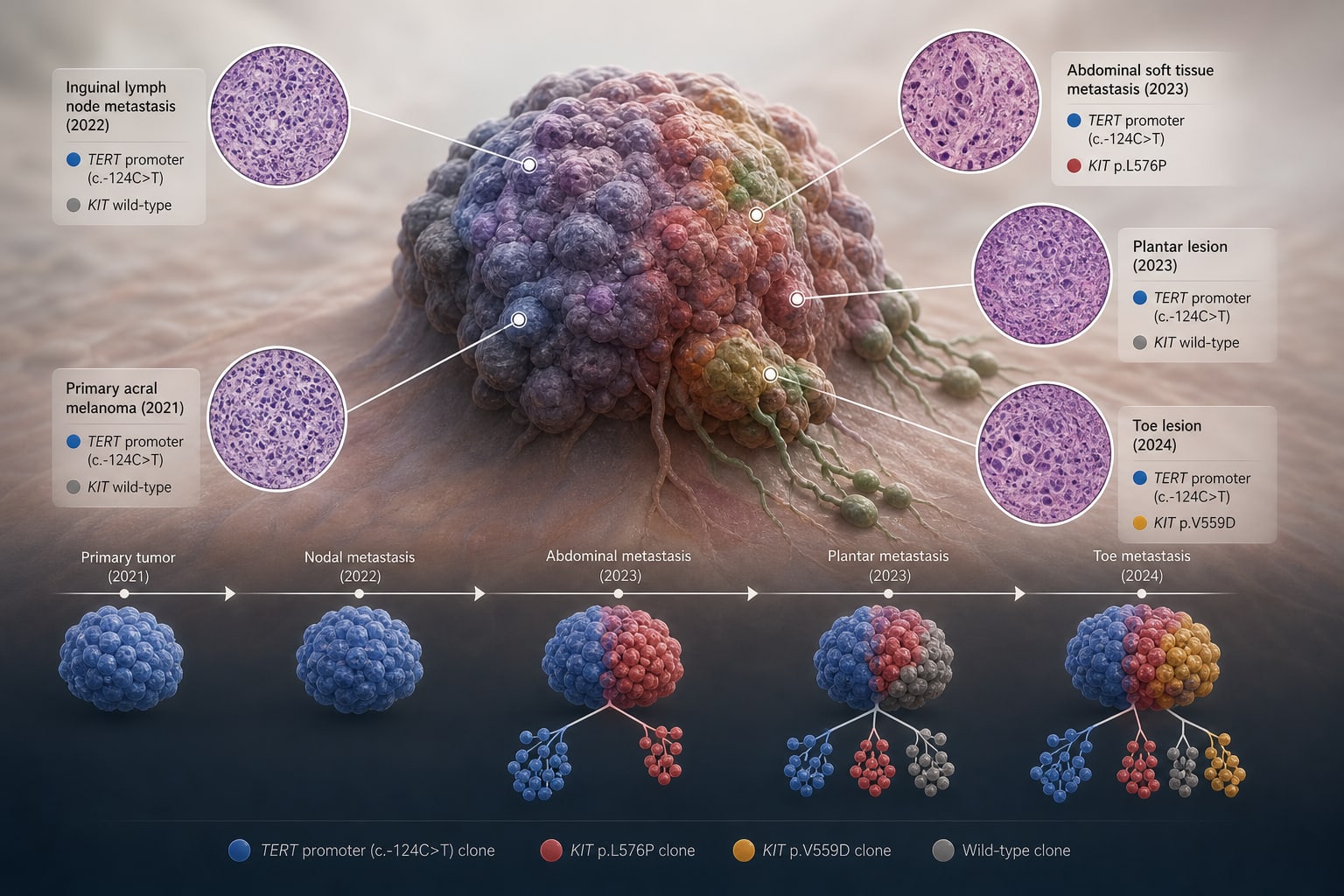
The patient exhibited a TERT promoter mutation (c.-124C>T) and no KIT mutation at initial testing.
A subsequent biopsy revealed a rare KIT exon 18 mutation (p.Ala829Pro) alongside concurrent TERT mutations.
Retrospective analysis showed that TERT and KIT mutations coexisted in a subclonal pattern in the primary lesion.
The variant allele frequency of KIT increased significantly in advanced cutaneous metastasis, indicating allelic imbalance.
The KIT p.Ala829Pro mutation demonstrated inherent resistance to imatinib, contributing to treatment failure.
This case underscores the spatial and temporal heterogeneity of acral melanoma.
Clinical Implications
Clinicians should consider the potential for clonal evolution in melanoma when interpreting genetic testing results. Serial biopsies may be necessary to accurately assess the mutational landscape and guide treatment decisions, particularly in cases of therapeutic resistance.
Conclusion
This case highlights the complexity of acral melanoma's genetic landscape and the critical role of ongoing genetic assessment in managing treatment-resistant disease.