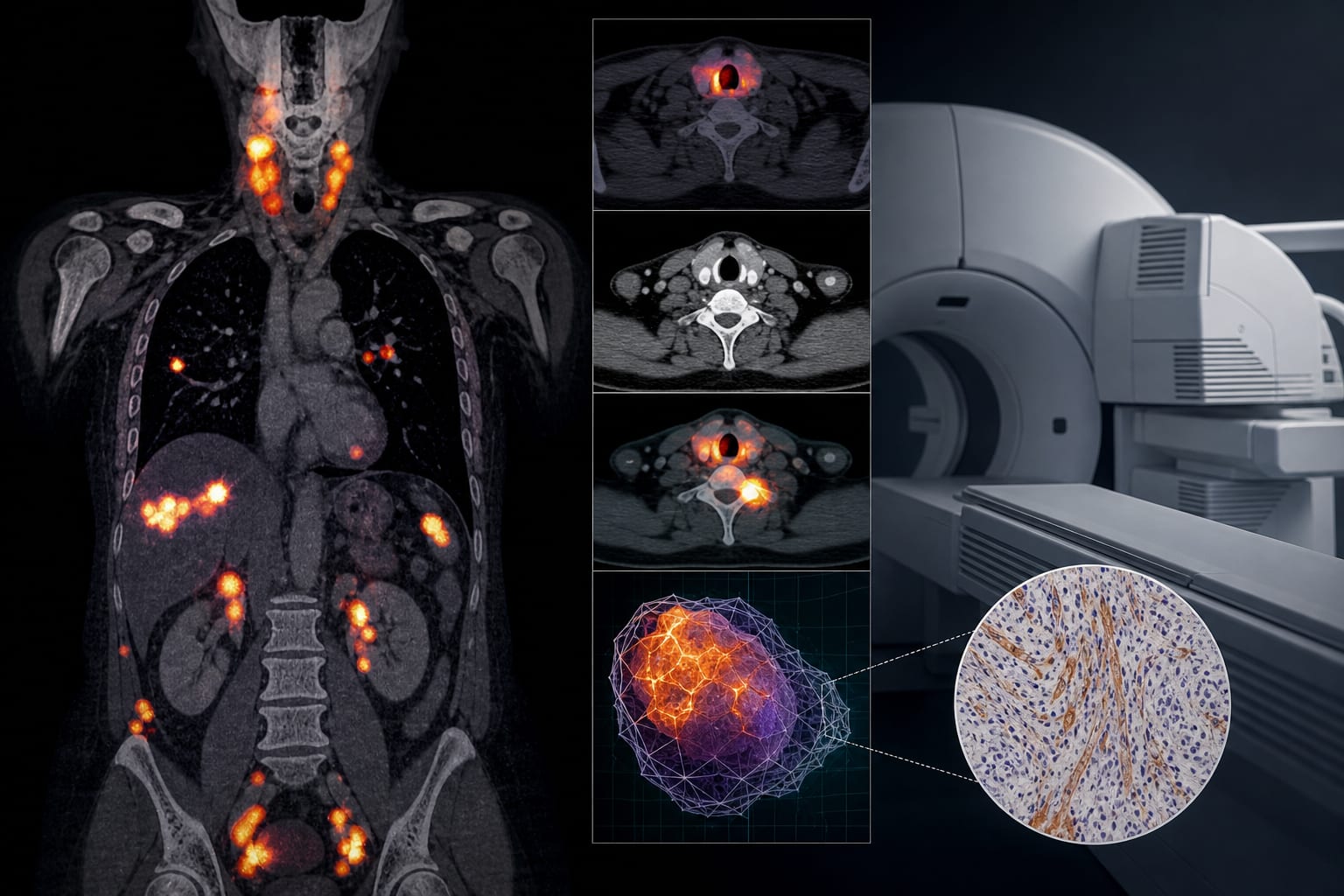
99mTc-FAPI-YQ3 SPECT/CT for characterizing FAPI uptake phenotypes and metabolic-stromal heterogeneity in advanced differentiated thyroid carcinoma: a prospective single-center imaging-radiomics study - Report - MDSpire

99mTc-FAPI-YQ3 SPECT/CT for characterizing FAPI uptake phenotypes and metabolic-stromal heterogeneity in advanced differentiated thyroid carcinoma: a prospective single-center imaging-radiomics study

  • By

  • Peng Zhou

  • Pengjun Zhang

  • Yang Luo

  • Liang Shi

  • Jun Wang

  • Xiaochen Yao

  • Tao Qian

  • Jianhua Wang

  • Yueqing Gu

  • Feng Wang

  • July 16, 2026

Share

Clinical Report: Characterization of FAPI Uptake Patterns in Advanced DTC

Overview

This study evaluates the use of 99mTc-FAPI-YQ3 SPECT/CT in characterizing FAPI uptake and metabolic-stromal diversity in advanced differentiated thyroid carcinoma (DTC). Further validation is necessary.

Background

Advanced differentiated thyroid carcinoma (DTC) poses significant treatment challenges, particularly in cases that are radioactive iodine (RAI)-refractory. The ability to accurately characterize tumor biology and heterogeneity is crucial for guiding treatment decisions. Molecular imaging techniques, such as FAPI-targeted imaging, may enhance the understanding of tumor microenvironments and improve patient management.

Data Highlights

ParameterValue
Mean TBR of 99mTc-FAPI-YQ36.8 +/- 2.3
Mean lesion diameter2.69 +/- 1.35 cm
Concordant FDG-positive/FAPI-positive lesions54/103 (52.4%)
FDG-positive/FAPI-negative lesions44/103 (42.7%)
FDG-negative/FAPI-positive lesions5/103 (4.9%)
High detection rates for thyroid-bed lesions19/21
Moderate detection of lymph-node lesions18/29
Limited detection of pulmonary lesions10/40

Key Findings

  • 99mTc-FAPI-YQ3 SPECT/CT demonstrated a mean tumor-to-background ratio (TBR) of 6.8.
  • Out of 103 lesions, 52.4% were concordant FDG-positive/FAPI-positive.
  • High detection rates were observed for thyroid-bed lesions (90.5%) and bone lesions (87.5%).
  • The logistic-regression model for exploratory radiomics analysis showed AUC values of 0.951 in the training set.
  • No FDG-negative/FAPI-negative lesions were found in the study.

Clinical Implications

The use of 99mTc-FAPI-YQ3 SPECT/CT may provide insights into the metabolic-stromal characteristics of advanced DTC.

Conclusion

Further studies are required for validation of 99mTc-FAPI-YQ3 SPECT/CT in evaluating FAPI uptake in advanced DTC.

Related Resources & Content

  1. American Thyroid Association, ATA Guidelines & Statements, 2023 -- Professional Guidelines
  2. SNMMI, SNMMI procedure standard/EANM practice guideline for nuclear medicine evaluation and therapy of differentiated thyroid cancer, 2022 -- Joint DTC Guidelines
  3. Frontiers in Endocrinology — Comparison of 68Ga-FAPI and 18F-DOPA PET/CT in patients with medullary thyroid cancer
  4. European Radiology — Role of Dual-Tracer PET/CT with [68Ga]FAPI-04 and [18F]FDG in the Initial Assessment of Gastric Cancer
  5. The ASCO Post — Molecular Imaging May Improve the Staging and Treatment of Pancreatic Ductal Adenocarcinoma
  6. European Radiology — Assessing the Diagnostic Accuracy of [18F]ALF-NOTA-FAPI-04 PET/CT in Gastric Cancer Compared to [18F]FDG PET/CT: A Comparative Analysis
  7. Comparison of 68Ga-FAPI and 18F-DOPA PET/CT in patients with medullary thyroid cancer
  8. Role of Dual-Tracer PET/CT with [68Ga]FAPI-04 and [18F]FDG in the Initial Assessment of Gastric Cancer
  9. Molecular Imaging May Improve the Staging and Treatment of Pancreatic Ductal Adenocarcinoma
  10. ATA Guidelines & Statements | American Thyroid Association
  11. SNMMI procedure standard/EANM practice guideline for nuclear medicine evaluation and therapy of differentiated thyroid cancer
  12. GUEST | SNMMI

Original Source(s)

Related Content