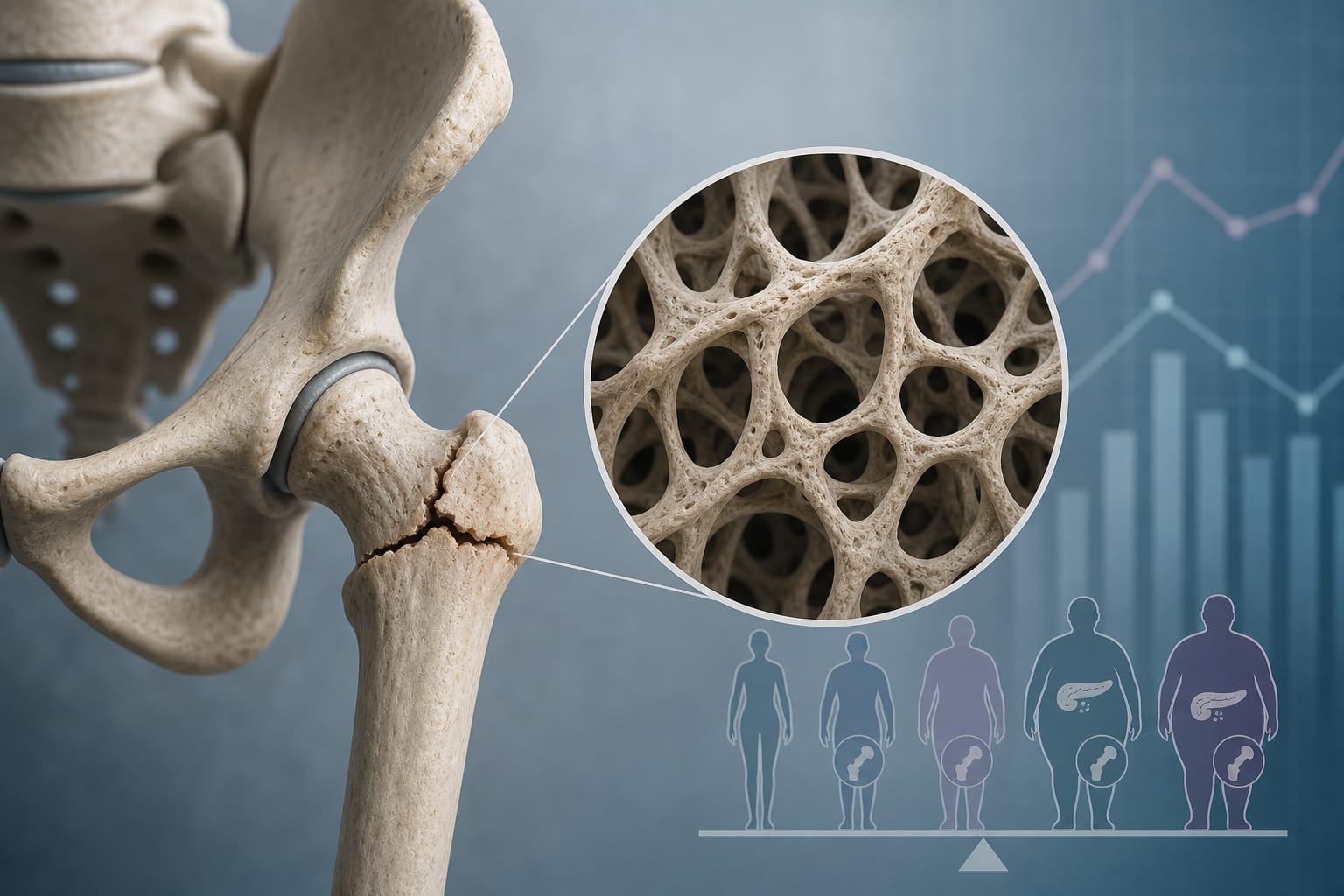
Mild Hyponatremia Does Not Affect Trabecular Bone Microarchitecture Despite Bone Mass Reduction
Overview
This study found that mild hyponatremia is independently associated with reduced bone mineral density (BMD) at the total hip but does not correlate with deterioration of trabecular bone microarchitecture as measured by trabecular bone score (TBS). No significant differences in TBS or lumbar spine BMD were observed between hyponatremic and normonatremic subjects.
Background
Hyponatremia, defined as serum sodium below 135 mmol/L, is a common electrolyte disorder linked to increased morbidity, mortality, osteoporosis, and fracture risk. Experimental models demonstrate that hyponatremia promotes bone resorption through osteoclast activation and bone mass loss. While BMD reductions in hyponatremia are documented, the impact on bone quality and microarchitecture, particularly assessed noninvasively by TBS, remains unclear. Understanding these effects is important as fracture risk may be influenced by bone quality beyond BMD.
Data Highlights
Parameter
Hyponatremic (n=163)
Normonatremic (n=4041)
P-value
TBS
1.308 ± 0.145
1.311 ± 0.141
0.806
BMD T-score Total Hip
−0.70 ± 1.46
−0.13 ± 1.32
<0.001
BMD T-score Femoral Neck
−1.11 ± 1.26
−0.72 ± 1.14
0.004
BMD T-score Lumbar Spine
−0.27 ± 1.63
−0.31 ± 1.51
0.772
Key Findings
Mild hyponatremia (90.8% of cases) does not significantly alter trabecular bone microarchitecture as measured by TBS (P = 0.806).
Hyponatremic subjects exhibit significantly lower BMD T-scores at the total hip (P < 0.001) and femoral neck (P = 0.004) compared to normonatremic controls.
No significant difference in lumbar spine BMD T-scores was observed between groups (P = 0.772).
After adjusting for confounders, hyponatremia remains an independent predictor of lower total hip BMD (β = −0.20, 95% CI: −0.39 to −0.02, P = 0.029).
The association between hyponatremia and femoral neck BMD loses significance after adjustment (P = 0.308).
No association was found between hyponatremia and lumbar spine BMD or TBS after adjustment (P = 0.236 and P = 0.346, respectively).
Clinical Implications
Clinicians should recognize that mild hyponatremia is linked to reduced bone mass, particularly at the total hip, which may increase fracture risk. However, trabecular bone microarchitecture assessed by TBS appears preserved in mild hyponatremia, suggesting that bone quality deterioration may not be a primary mechanism in these patients. Monitoring and managing bone density in hyponatremic patients remains important to mitigate osteoporosis-related complications.
Conclusion
Mild hyponatremia independently correlates with decreased bone mineral density at the total hip but does not impair trabecular bone microarchitecture as measured by TBS. These findings highlight the complexity of bone changes in hyponatremia and underscore the need for further research on fracture risk mechanisms.
References
Verbalis et al 2010 -- Hyponatremia and Bone Loss in Animal Models
NHANES 2005-2008 -- National Health and Nutrition Examination Survey Data
Researchers urge caution in interpreting joint replacement predictors, noting that surgery reflects access and decision-making as well as disease biology.