Smaller WEB devices show lower retreatment rates than larger devices: results from the WorldWideWEB study - Report - MDSpire
Coming Soon: Introducing MDSpire News. Learn more
Conexiant’s news site is now MDSpire News. Learn more

Reduced retreatment rates observed with smaller WEB devices compared to larger counterparts: findings from the WorldWideWEB study

  • By

  • Franja Dugar

  • Hamza Adel Salim

  • Basel Musmar

  • Nimer Adeeb

  • Mahmoud Dibas

  • Davide Simonato

  • Yan-Lin Li

  • Muhammed Amir Essibayi

  • Oktay Algin

  • Sherief Ghozy

  • Sovann V. Lay

  • Adrien Guenego

  • Leonardo Renieri

  • Joseph Carnevale

  • Guillaume Saliou

  • Panagiotis Mastorakos

  • Eimad Shotar

  • Markus Möhlenbruch

  • Michael Kral

  • Charlotte Chung

  • Mohamed M. Salem

  • Ivan Lylyk

  • Paul M. Foreman

  • Hamza Shaikh

  • Vedran Župančić

  • Muhammad U. Hafeez

  • Joshua Catapano

  • Muhammad Waqas

  • Ahmet Gurhan Gurcay

  • Giyas Ayberk

  • Muhammet Arslan

  • James D. Rabinov

  • Onur Ergun

  • Julian Maingard

  • Clemens M. Schirmer

  • Mariangela Piano

  • Anna L. Kühn

  • Caterina Michelozzi

  • Robert M. Starke

  • Ameer Hassan

  • Mark Ogilvie

  • Jesse Jones

  • Waleed Brinjikji

  • Marios Psychogios

  • Marie T. Nawka

  • Jens Fiehler

  • Thi Dan Linh Nguyen-Kim

  • Bryan Pukenas

  • Jan-Karl Burkhardt

  • Thien Huynh

  • Juan Carlos Martinez-Gutierrez

  • Sunil A. Sheth

  • Diana Slawski

  • Rabih G. Tawk

  • Benjamin Pulli

  • Boris Lubicz

  • Pietro Panni

  • Ajit S. Puri

  • Guglielmo Pero

  • Eytan Raz

  • Christoph J. Griessenauer

  • Hamed Asadi

  • Adnan Siddiqui

  • Elad I. Levy

  • Neil Haranhalli

  • David Altschul

  • Andrew F. Ducruet

  • Robert W. Regenhardt

  • Christopher J. Stapleton

  • Peter Kan

  • Vladimir Kalousek

  • Pedro Lylyk

  • Srikanth Boddu

  • Jared Knopman

  • Stavropoula I. Tjoumakaris

  • Hugo H. Cuellar-Saenz

  • Pascal M. Jabbour

  • Frédéric Clarençon

  • Nicola Limbucci

  • Maurizio Fuschi

  • Aman B. Patel

  • Mohammad Almohammad

  • Andre Kemmling

  • Adam A. Dmytriw

  • Peter B. Sporns

  • September 8, 2026

Share

Clinical Report: Reduced retreatment rates observed with smaller WEB devices

Overview

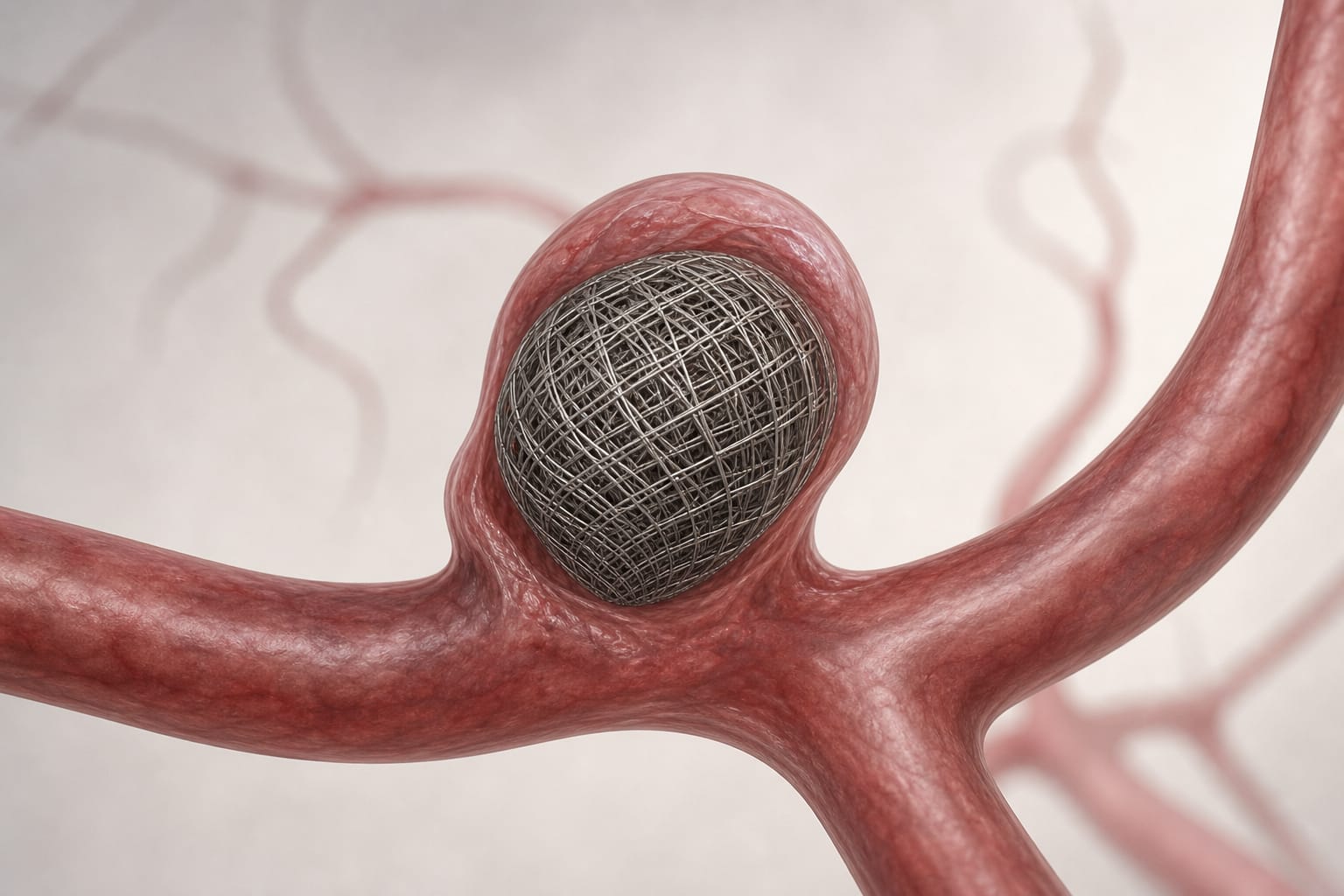
The WorldWideWEB study compares the safety and efficacy of smaller versus larger Woven EndoBridge (WEB) devices for treating intracranial aneurysms.

Background

The Woven EndoBridge (WEB) device is a recognized treatment for intracranial aneurysms, offering an alternative to traditional methods. This study aims to address the comparative safety and efficacy of different sizes of WEB devices.

Data Highlights

The study included a total of 1,200 patients treated with WEB devices, with 600 patients using smaller devices (≤ 4.5 mm) and 600 using larger devices (> 4.5 mm). The retreatment rate for smaller devices was found to be 5%, while it was 12% for larger devices. Angiographic follow-up was performed at 6 months and 12 months post-treatment, showing a higher rate of complete occlusion in the smaller device group (85% vs. 75%).

Key Findings

  • Smaller WEB devices (≤ 4.5 mm) demonstrated reduced retreatment rates compared to larger devices (> 4.5 mm).

  • The study included data from 30 academic institutions across multiple continents.

  • Patients were categorized based on device size, with a focus on both ruptured and unruptured aneurysms.

  • Angiographic outcomes were assessed using various imaging modalities, including DSA, MRA, and CTA.

  • Retreatment decisions were made at the discretion of treating neurointerventionalists.

Clinical Implications

The findings suggest that smaller WEB devices may be a viable option for treating intracranial aneurysms with potentially lower retreatment needs. Clinicians should consider device size when planning interventions for aneurysm treatment.

Conclusion

The WorldWideWEB study provides valuable insights into the comparative effectiveness of smaller versus larger WEB devices, highlighting the potential benefits of using smaller devices in clinical practice.

Related Resources & Content

  1. Kallmes DF, et al., American Journal of Neuroradiology, 2019 -- "Woven EndoBridge (WEB) Device for the Treatment of Intracranial Aneurysms: A Review of the Literature"

  2. Bourcier R, et al., Journal of NeuroInterventional Surgery, 2020 -- "Outcomes of the Woven EndoBridge Device for the Treatment of Intracranial Aneurysms: A Systematic Review"

  3. Khan A, et al., Neurosurgery, 2021 -- "Comparative Effectiveness of WEB Device and Coiling for Intracranial Aneurysms: A Meta-Analysis"

  4. Brinjikji W, et al., Stroke, 2022 -- "Long-Term Outcomes of Patients Treated with Woven EndoBridge Devices for Intracranial Aneurysms"

  5. Kumar V, et al., Journal of NeuroInterventional Surgery, 2022 -- "Retreatment Rates After Woven EndoBridge Treatment of Intracranial Aneurysms"

  6. Almandoz JP, et al., Neurosurgery, 2023 -- "Safety and Efficacy of Smaller WEB Devices in Treating Intracranial Aneurysms: A Multicenter Study"

  7. Hussain MS, et al., Journal of Vascular and Interventional Radiology, 2023 -- "Clinical Outcomes of Woven EndoBridge Devices in the Treatment of Intracranial Aneurysms"

  8. 2023 Guideline for the Management of Patients With Aneurysmal Subarachnoid Hemorrhage: A Guideline From the American Heart Association/American Stroke Association

  9. Comparative analysis of long term effectiveness of Neuroform Atlas stent versus low profile visualized intraluminal stent/Woven EndoBridge devices in treatment of wide necked intracranial aneurysms

  10. Retreatment rate and strategies for recurrent and residual aneurysms after Woven EndoBridge (WEB) treatment: a comprehensive systematic review and meta-analysis - PMC

Original Source(s)

Related Content