Pre-treatment structural brain biomarkers predict response to repetitive transcranial magnetic stimulation in subjective tinnitus - Report - MDSpire

Pre-treatment structural brain biomarkers predict response to repetitive transcranial magnetic stimulation in subjective tinnitus

  • By

  • Zhongling Ding

  • Bo Peng

  • Mengfang Gong

  • Hongxuan Qiu

  • Qian He

  • Xiaoting Zhu

  • Shiyu Kang

  • Xiaoliang Sheng

  • Jisheng Liu

  • Yakang Dai

  • Duo-Duo Tao

  • June 24, 2026

  • 0 min

Share

Structural Brain Biomarkers Prior to Treatment as Predictors of Response to rTMS

Overview

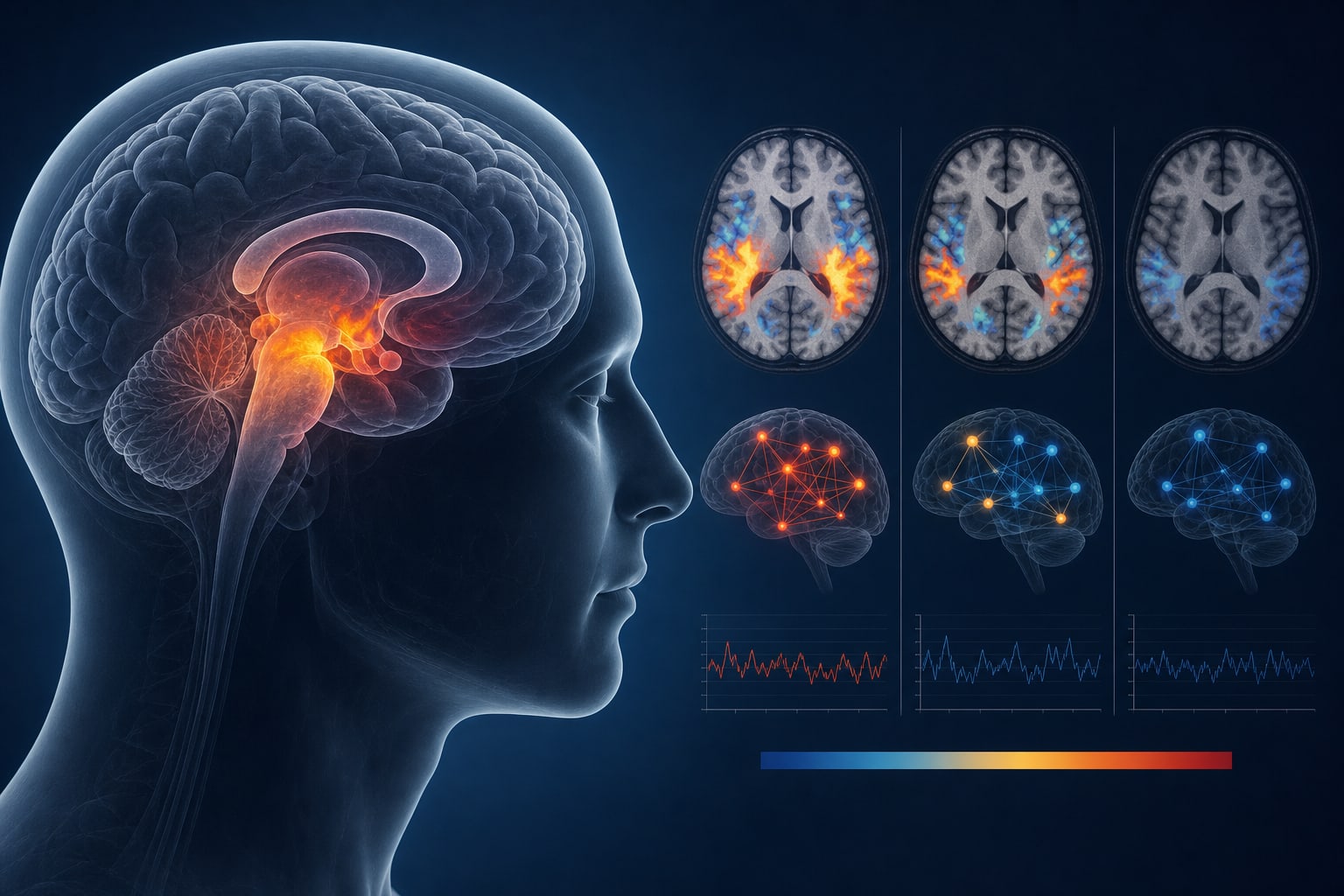
This study identifies pre-treatment brain structural biomarkers that predict the efficacy of repetitive transcranial magnetic stimulation (rTMS) in patients with subjective tinnitus. The right pars triangularis of the inferior frontal gyrus was highlighted as a significant predictor of treatment response.

Background

Subjective tinnitus affects a significant portion of the population and presents with variable treatment outcomes. The unpredictability of rTMS efficacy in tinnitus management underscores the need for reliable predictive biomarkers.

Data Highlights

FeatureResponders (n=36)Non-responders (n=28)Healthy Controls (n=18)
IFGtriang-R GMV0.90 ± 0.080.86 ± 0.070.86 ± 0.06

Key Findings

  • Thirty-six patients (56.25%) were classified as responders to rTMS.
  • Ten regional brain features distinguished responders from non-responders.
  • The predictive model achieved an AUC of 0.85, with an accuracy of 0.77.
  • The right pars triangularis of the inferior frontal gyrus was identified as the top predictor of treatment response.
  • Responders exhibited significantly larger IFGtriang-R GMV compared to both healthy controls and non-responders.
  • No structural feature showed a robust association with baseline clinical measures after Bonferroni correction.

Clinical Implications

Pre-treatment structural MRI assessment of the right pars triangularis may assist in identifying patients likely to respond to rTMS for tinnitus.

Conclusion

The study identifies specific brain structural features that serve as biomarkers for predicting rTMS efficacy in tinnitus.

Related Resources & Content

  1. VA DoD Clinical Practice Guideline (CPG) for Tinnitus, 2024 -- Tinnitus Management
  2. Neuromodulation for Subjective Tinnitus: A Systematic Review and Meta-Analysis of Randomized Trials, 2026 -- PubMed
  3. Frontiers in Psychiatry — Factors associated with treatment-emergent headache occurrence following RTMS to non-motor areas and the impact on treatment outcomes: a retrospective study
  4. Frontiers in Neurology — Impacts of Repetitive Transcranial Magnetic Stimulation Parameters on Cerebral Hemodynamics in Patients with Disorders of Consciousness
  5. Clinical Research in Cardiology — Neuroimaging Insights During the Acute Phase of Takotsubo Syndrome: Volumetric and Functional Alterations in the Right Insular Cortex
  6. Prehabilitation of Motor Networks Using Low-Frequency Repetitive Transcranial Magnetic Stimulation: A Conceptual Study
  7. Management of Tinnitus: Guidelines From the VA/DoD | AAFP
  8. VA DoD Clinical Practice Guideline (CPG) for Tinnitus
  9. Neuromodulation for Subjective Tinnitus: A Systematic Review and Meta-Analysis of Randomized Trials - PubMed
  10. Frontiers | Efficacy of repetitive transcranial magnetic stimulation for subjective chronic tinnitus: a randomized controlled trial meta-analysis
  11. Neuromodulatory effects of dual-site repetitive transcranial magnetic stimulation targeting frontal and temporal cortices in subjective tinnitus: A functional magneti resonance imaging study - ScienceDirect
  12. Structural Brain Changes Following Left Temporal Low-Frequency rTMS in Patients with Subjective Tinnitus - PMC
  13. Brain stimulation‐induced neuroplasticity underlying therapeutic response in phantom sounds - PMC
  14. Voxel-Based Morphometry and Subfield Volumetry Analysis Reveal Limbic System Involvement in Tinnitus - PubMed

Original Source(s)

Related Content