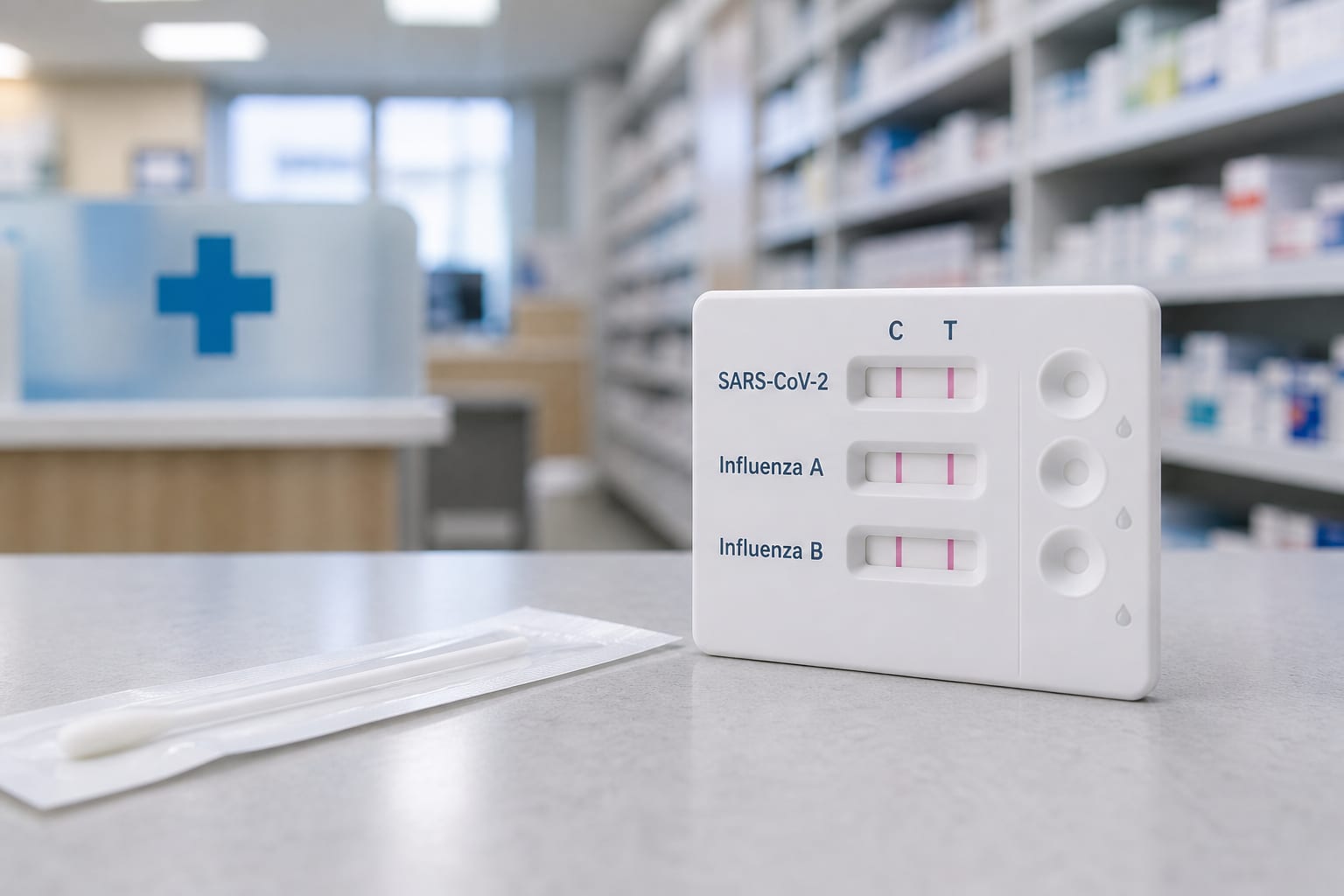
Concurrent SARS-CoV-2 and Influenza Infections Among People Tested at US Pharmacies
-
By
-
Pragna Patel
-
Jessica K. Sprinkles
-
Andrew Godoshian
-
Marcus Siddall
-
Timothy M. Uyeki
-
Henry Walke
-
Joseph Miller
-
November 18, 2026
Clinical Report: Concurrent SARS-CoV-2 and Influenza Infections in US Pharmacies
Overview
In a retrospective cohort of 817,834 people tested at US pharmacies from September 2023 through May 2025, 665 (0.081%) tested positive for both SARS-CoV-2 and influenza. Coinfection prevalence was highest among children younger than 18 years, while antiviral dispensing among people with coinfection was uncommon: 3.9% received COVID-19 treatment and 4.4% received influenza treatment, with no one receiving treatment for both.
Background
SARS-CoV-2 and influenza coinfection has been associated with a higher risk of severe outcomes, and antiviral medications may reduce the risk of severe COVID-19 and certain influenza complications. Earlier investigations generally identified patients with one infection in clinical settings and then tested for the other virus. This study used pharmacy-based multiplex testing data to assess coinfection prevalence, associated factors, and treatment in a community setting across the United States, the District of Columbia, and Puerto Rico.
Data Highlights
Measure | Finding |
|---|---|
Participants tested | 817,834 |
Positive for SARS-CoV-2 or influenza | 239,637 (29.3%) |
Positive for both viruses | 665 (0.1%); prevalence 0.081% (95% CI, 0.075%-0.087%) |
Coinfection prevalence, age <18 years | 0.145% (95% CI, 0.109%-0.186%) |
Coinfection prevalence, age 18-64 years | 0.084% (95% CI, 0.078%-0.089%) |
Coinfection prevalence, age ≥65 years | 0.051% (95% CI, 0.049%-0.053%) |
COVID-19 treatment among coinfected participants | 26/665 (3.9%) |
Influenza treatment among coinfected participants | 29/665 (4.4%); no participant received treatment for both infections |
Key Findings
The retrospective cohort included 817,834 pharmacy-tested participants from September 1, 2023, through May 31, 2025; 665 tested positive for both SARS-CoV-2 and influenza.
Coinfection prevalence was 0.081% overall and highest among children younger than 18 years (0.145%), compared with 0.084% among adults aged 18 to 64 years and 0.051% among those aged 65 years or older.
Among 144 symptomatic participants with coinfection who provided health histories, 92 (63.9%) reported no comorbidities. The most frequently reported symptoms were cough (83.3%), headache (75.0%), and congestion (71.5%).
Among all 665 coinfected participants, 26 (3.9%) received COVID-19 treatment and 29 (4.4%) received influenza treatment; none received treatment for both infections.
Among coinfected adults aged 18 to 64 years with at least one comorbidity, 19 of 42 (45.2%) received COVID-19 treatment and 19 (45.2%) received influenza treatment. Among 70 coinfected adults aged 65 years or older, 7 (10.0%) received COVID-19 treatment and 5 (7.1%) received influenza treatment.
CDC guidance states that a positive test for one virus does not exclude the other and recommends multiplex nucleic acid assays to detect influenza A/B and SARS-CoV-2; its clinician guidance also advises prompt empiric oseltamivir for suspected influenza without waiting for test results.
Clinical Implications
The study documents coinfection in a pharmacy-based community testing cohort and reports low antiviral treatment receipt among coinfected participants. CDC guidance advises considering testing for both viruses because detection of one does not rule out the other, and recommends prompt influenza antiviral treatment for suspected influenza in priority groups without waiting for test results; COVID-19 management is directed to IDSA guidance.
Conclusion
SARS-CoV-2 and influenza coinfection was uncommon in this pharmacy cohort, with the highest observed prevalence among children younger than 18 years. Antiviral treatment was recorded for a minority of coinfected participants, and no participant received treatment for both infections.
Related Resources & Content
JAMA Network Open, 2026 -- SARS-CoV-2 and Influenza Coinfection Among Persons Tested in US Pharmacies
Centers for Disease Control and Prevention, 2026 -- Clinical Guidance for Hospitalized and Non-Hospitalized Patients When SARS-CoV-2, RSV, and Influenza Viruses are Co-Circulating
Centers for Disease Control and Prevention, 2026 -- Influenza Antiviral Medications: Summary for Clinicians
Centers for Disease Control and Prevention, 2026 -- Multiplex Tests to Detect Influenza, SARS-CoV-2, and RSV
Infectious Diseases Society of America, 2026 -- IDSA Guidelines on the Treatment and Management of Patients with COVID-19
the pathologist — Shifts in Influenza Activity 2018 to 2023
MDSpire News — COVID-19 & Flu Vaccines Study: Comparable Safety
the pathologist — Flu Season in the Time of COVID-19
mdspire news — Same-Day COVID, Flu Vaccination Appears Safe
Clinical Guidance for Hospitalized and Non-Hospitalized Patients When SARS-CoV-2, RSV, and Influenza Viruses are Co-Circulating
Influenza Antiviral Medications: Summary for Clinicians
Multiplex Tests to Detect Influenza, SARS-CoV-2, and RSV
IDSA Guidelines on the Treatment and Management of Patients with COVID-19
SARS-CoV-2 and Influenza Coinfection Among Persons Tested in US Pharmacies | Infectious Diseases | JAMA Network Open | JAMA Network
Clinical impact of coinfection with SARS-CoV-2, influenza virus, and respiratory syncytial virus among adults: a multicenter retrospective cohort study [2021–2025]
Severe outcomes of individual or multiple respiratory viral infections in a large national healthcare system, 2022–2023
Based on findings from:
SARS-CoV-2 and Influenza Coinfection Among Persons Tested in US Pharmacies
Pragna Patel, Jessica K. Sprinkles, Andrew Godoshian, Marcus Siddall, Timothy M. Uyeki, Henry Walke, Joseph Miller. Jama Network Open, 2026.
https://jamanetwork.com/journals/jamanetworkopen/fullarticle/2856777
This content is an AI-generated, fully rewritten summary based on a published scholarly article. It does not reproduce the original text and is not a substitute for the original publication. Readers are encouraged to consult the source for full context, data, and methodology.