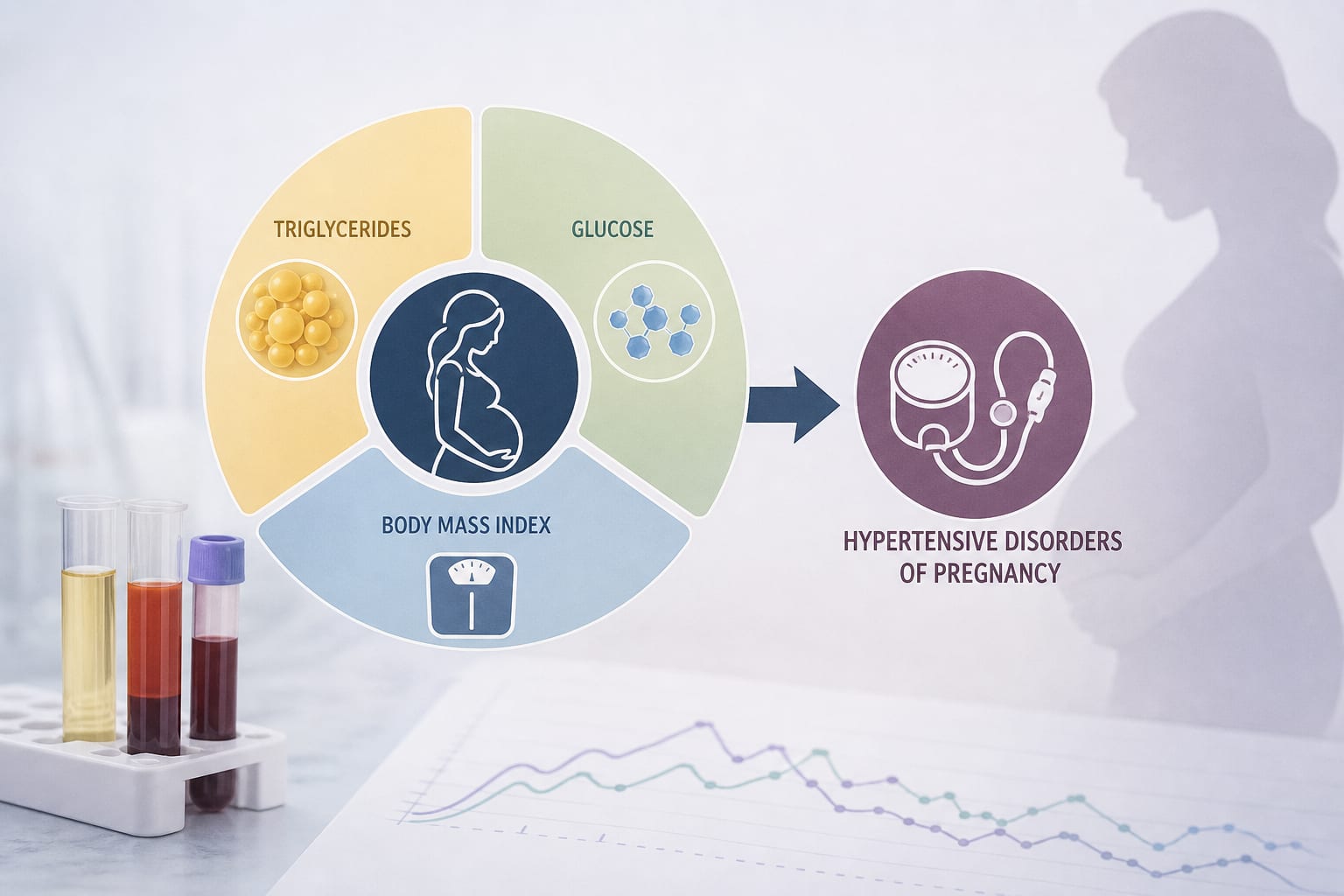
Clinical Report: Link Between Triglyceride-Glucose Body Mass Index and Hypertensive Disorders in Pregnancy
Overview
This study investigates the association between triglyceride-glucose body mass index (TyG-BMI) and hypertensive disorders of pregnancy (HDP). It finds that TyG-BMI is independently associated with increased HDP risk.
Background
Hypertensive disorders of pregnancy (HDP) are significant complications affecting maternal and fetal health, with global incidence rates ranging from 5% to 15%. They are a leading cause of maternal mortality and are associated with long-term cardiovascular risks for mothers.
Data Highlights
Measure
HDP Group
Control Group
P-value
TyG-BMI
228.4 ± 44.6
196.8 ± 36.2
< 0.001
Key Findings
TyG-BMI was significantly higher in the HDP group compared to controls (228.4 vs. 196.8).
Each 10-unit increase in TyG-BMI was associated with a 30% increase in HDP risk (adjusted OR = 1.30, 95%CI: 1.16–1.46).
RCS analysis indicated a non-linear positive association between TyG-BMI and HDP risk.
ROC analysis showed TyG-BMI had an AUC of 0.782, outperforming TyG and BMI.
The association between TyG-BMI and HDP was consistent across all subgroups analyzed.
Clinical Implications
The findings suggest that TyG-BMI may serve as a valuable indicator for identifying pregnant women at risk for HDP. Clinicians should consider incorporating TyG-BMI assessments into routine evaluations of pregnant patients.
Conclusion
TyG-BMI is a significant independent predictor of hypertensive disorders in pregnancy.
Researchers found larger biological age gaps in more recent birth cohorts and observed associations with higher risk of several cancers diagnosed before age 55.