Cytotoxic lymphocyte heterogeneity in glioblastoma: insights from single-cell and spatial multiomics toward precision immunotherapeutic reprogramming - Report - MDSpire

Cytotoxic lymphocyte heterogeneity in glioblastoma: insights from single-cell and spatial multiomics toward precision immunotherapeutic reprogramming

  • By

  • Wentao Dong

  • Yang Li

  • Zhuolin Wu

  • Quanlin Fu

  • Jinshuang Zhao

  • Bangyue Wang

  • Jia Yao

  • Chenglu Lu

  • Minfeng Tong

  • June 10, 2026

  • 0 min

Share

Clinical Report: Heterogeneity of Cytotoxic Lymphocytes in Glioblastoma

Overview

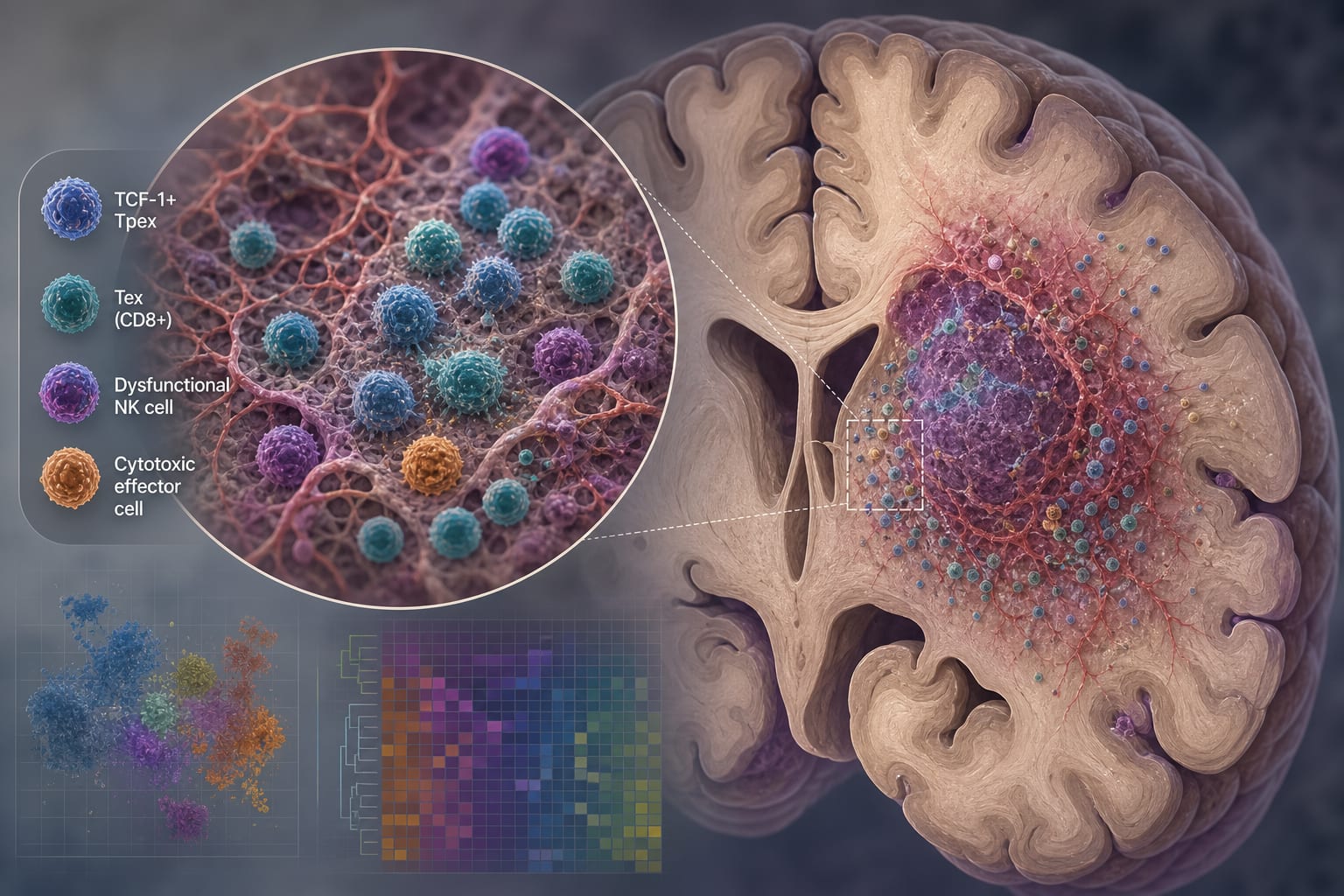
This report discusses the unique immunosuppressive tumor microenvironment of glioblastoma (GBM) and the resulting dysfunction of cytotoxic lymphocytes. Insights from single-cell and spatial multiomics reveal distinct subpopulations of CD8+ T cells and NK cells, which have implications for tailored immunotherapeutic strategies.

Background

Glioblastoma is the most aggressive primary brain tumor in adults, with a median survival of approximately 15 months despite current treatment modalities. The tumor's immunosuppressive microenvironment significantly limits the effectiveness of conventional immunotherapies. Understanding the heterogeneity of cytotoxic lymphocytes in GBM is crucial for developing effective immunotherapeutic approaches.

Data Highlights

No numerical data is provided in the source material.

Key Findings

  • GBM features a profoundly immunosuppressive tumor microenvironment that disables cytotoxic lymphocyte function.
  • Single-cell RNA sequencing has identified distinct subpopulations of CD8+ T cells, including TCF-1+ progenitor-exhausted (Tpex) and terminally exhausted (Tex) cells.
  • NK cell subsets in GBM exhibit a stress-associated, maturation-impaired 'exhaustion-like' phenotype.
  • Cytotoxic lymphocyte dysfunction is spatially organized within distinct immune niches, including perinecrotic, perivascular, and infiltrative-edge areas.
  • Mechanisms of CD8+ T cell and NK cell exhaustion differ, with implications for therapeutic strategies.
  • Potential immunotherapeutic strategies include intraoperative tumor profiling and dual blockade of NKG2A/TIGIT.

Clinical Implications

Understanding the specific mechanisms of cytotoxic lymphocyte exhaustion in GBM can inform the development of targeted immunotherapies. Strategies such as epigenetic priming of progenitor T cells and engineered NK cell delivery may enhance treatment efficacy in this challenging tumor type.

Conclusion

The insights gained from single-cell and spatial multiomics provide a framework for understanding immune dysfunction in GBM and highlight the need for precision immunotherapy tailored to the unique characteristics of the CNS tumor microenvironment.
Related Resources & Content

  1. Acta Neuropathologica, 2023 -- Immune Profiling in Glioblastoma Reveals an Inflammatory Perivascular Subtype Linked to Improved Survival Outcomes
  2. Acta Neuropathologica, 2017 -- Exploring Gliomas: Insights from Experimental Models and Clinical Realities
  3. Frontiers in Immunology, 2026 -- Integrating biocomputational techniques for vaccine development for glioblastoma multiforme: a possible way of enhancing precision
  4. Journal of Neuro-Oncology, 2024 -- Assessing the Prognostic Significance of BRMS1+ Microglia Through Single-Cell Anoikis Regulator Patterns in the Immune Landscape of Glioblastoma
  5. Journal of Clinical Oncology, 2023 -- Therapy for Diffuse Astrocytic and Oligodendroglial Tumors in Adults: ASCO-SNO Guideline Rapid Recommendation Update
  6. PMC, 2023 -- Radiotherapy combined with nivolumab or temozolomide for newly diagnosed glioblastoma with unmethylated MGMT promoter: An international randomized phase III trial
  7. Acta Neuropathologica Communications, 2024 -- Spatial transcriptomics reveals segregation of tumor cell states in glioblastoma and marked immunosuppression within the perinecrotic niche
  8. Therapy for Diffuse Astrocytic and Oligodendroglial Tumors in Adults: ASCO-SNO Guideline Rapid Recommendation Update | Journal of Clinical Oncology
  9. Radiotherapy combined with nivolumab or temozolomide for newly diagnosed glioblastoma with unmethylated MGMT promoter: An international randomized phase III trial - PMC
  10. Spatial transcriptomics reveals segregation of tumor cell states in glioblastoma and marked immunosuppression within the perinecrotic niche | Acta Neuropathologica Communications | Springer Nature Link

Original Source(s)

Related Content