L-Dopa/Carbidopa intestinal gel infusion in advanced Parkinson’s disease: real-life mobility insights from wearable sensors - Report - MDSpire

L-Dopa/Carbidopa intestinal gel infusion in advanced Parkinson’s disease: real-life mobility insights from wearable sensors

  • By

  • Alessandro Zampogna

  • Luigi Borzì

  • Domiziana Rinaldi

  • Gabriele Imbalzano

  • Martina Patera

  • Marco Falletti

  • Carlo Alberto Artusi

  • Edoardo Bianchini

  • Leonardo Lopiano

  • Gabriella Olmo

  • Antonio Suppa

  • June 15, 2026

  • 0 min

Share

Clinical Report: Real-World Mobility Assessment in Advanced Parkinson’s Disease

Overview

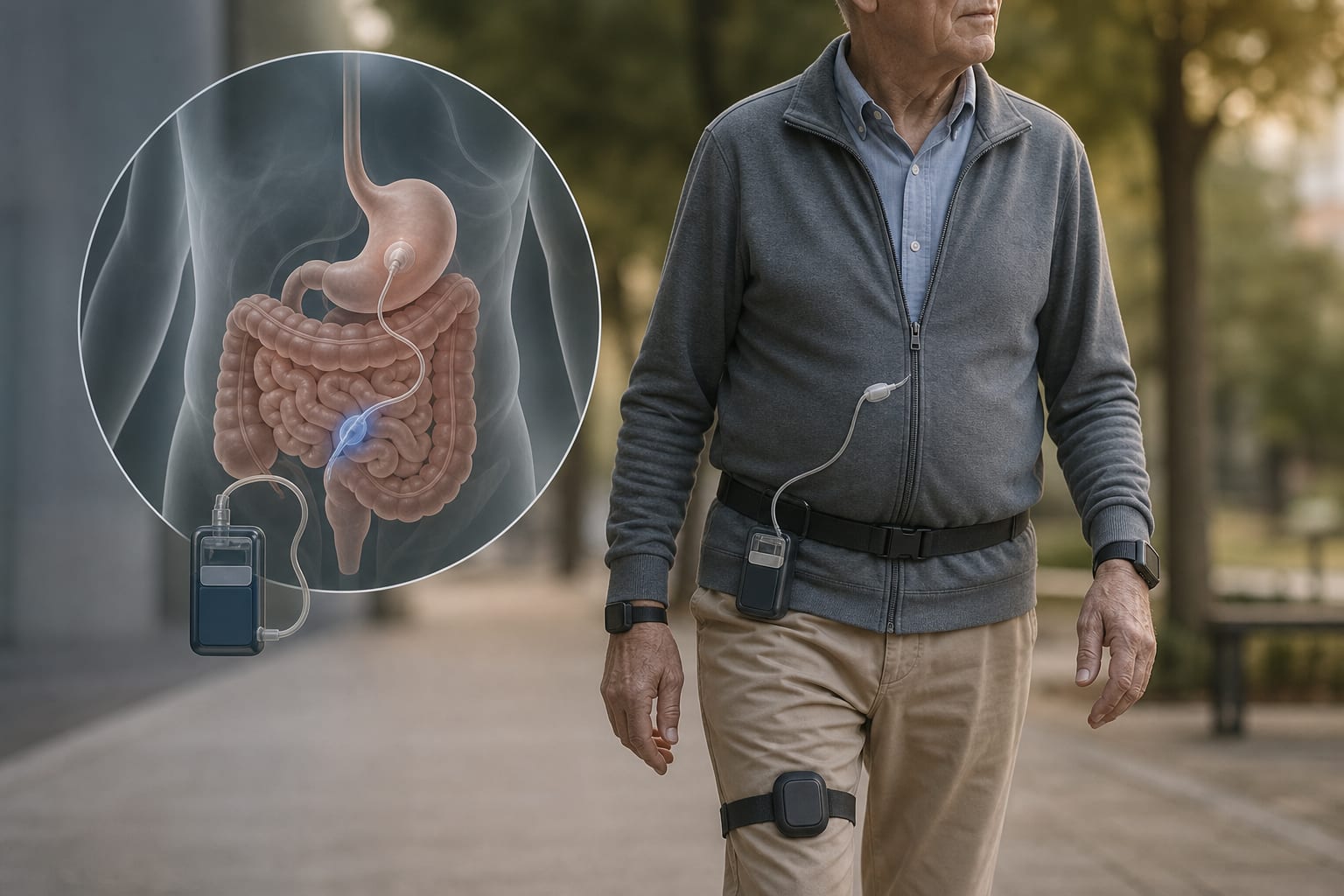
This study evaluates the impact of L-Dopa/Carbidopa intestinal gel (LCIG) on motor performance in advanced Parkinson's disease patients using wearable sensors. Results indicate that LCIG leads to less severe motor fluctuations and lower intra-day variability in gait parameters compared to oral dopaminergic therapy.

Background

Advanced Parkinson's disease (APD) is characterized by significant motor fluctuations and dyskinesias, which can severely impact patients' quality of life. Continuous dopaminergic delivery via LCIG is a therapeutic strategy aimed at mitigating these complications. Understanding the real-world effects of LCIG on motor performance is crucial for optimizing treatment and improving patient outcomes.

Data Highlights

{'format': 'Consider converting the table to a more accessible format, such as bullet points.'}

Key Findings

  • APD patients on LCIG exhibited less severe motor fluctuations compared to those on oral therapy.
  • Intra-day variability in gait parameters was lower in the LCIG group.
  • Dyskinesia duration was similar between both treatment groups.
  • Stride fluidity, step length, and stride speed were inversely associated with age and disease severity.
  • Wearable sensors effectively captured real-world motor performance variability.

Clinical Implications

The findings suggest that LCIG may provide more stable motor control in advanced Parkinson's disease patients, which could enhance patient quality of life. Clinicians may consider utilizing wearable sensor technology for ongoing assessment and management of motor symptoms in these patients.

Conclusion

LCIG appears to offer improved motor performance stability in advanced Parkinson's disease patients compared to oral therapies, highlighting the potential of wearable technology in clinical practice.

Related Resources & Content

  1. European Academy of Neurology/Movement Disorder Society ‐ European Section guideline on the treatment of Parkinson's disease: I. Invasive therapies - Deuschl - 2022 - European Journal of Neurology
  2. Continuous intrajejunal infusion of levodopa-carbidopa intestinal gel for patients with advanced Parkinson's disease: a randomised, controlled, double-blind, double-dummy study
  3. npj Digital Medicine — Home-Based Detection of Isolated REM Sleep Behavior Disorder Using a Lumbar Wearable Sensor
  4. Frontiers in Neurology — Early neural shift detection using functional magnetic resonance imaging: a pilot study with Parkinson’s disease patients undergoing istradefylline and hybrid assistive limb interventions
  5. npj Digital Medicine — Utilizing Deep Learning for Precise Evaluation of Gait Deficits in Parkinson's Disease via Smartphone Video Analysis
  6. npj Digital Medicine — A Comprehensive Review of Real-World Digital Mobility Outcomes Related to Gait in Parkinson’s Disease
  7. Home-Based Detection of Isolated REM Sleep Behavior Disorder Using a Lumbar Wearable Sensor
  8. Utilizing Deep Learning for Precise Evaluation of Gait Deficits in Parkinson's Disease via Smartphone Video Analysis
  9. European Academy of Neurology/Movement Disorder Society ‐ European Section guideline on the treatment of Parkinson's disease: I. Invasive therapies - Deuschl - 2022 - European Journal of Neurology - Wiley Online Library
  10. Continuous intrajejunal infusion of levodopa-carbidopa intestinal gel for patients with advanced Parkinson's disease: a randomised, controlled, double-blind, double-dummy study - PubMed

Original Source(s)

Related Content