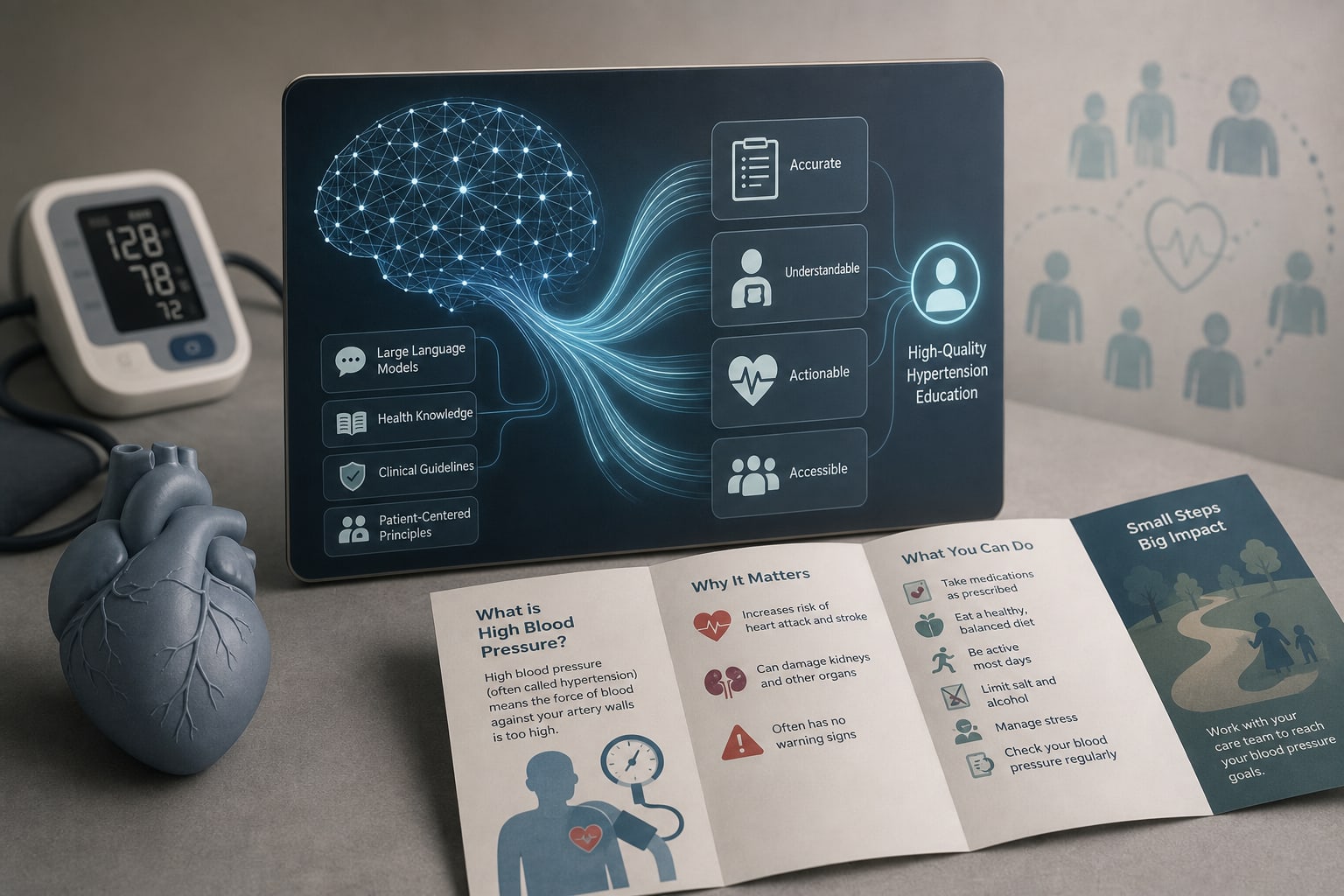
Evaluating the Effectiveness of Generative AI in Hypertension Patient Education: A Cross-Platform Analysis of Quality, Readability, and Practicality of LLM-Generated Resources
-
By
-
Mengqiu Hu
-
Zhiqiang Wang
-
Zhiwen Zhang
-
Muwei Li
-
July 3, 2026
Clinical Report: Evaluating the Effectiveness of Generative AI in Hypertension Patient Education
Overview
This study evaluates the effectiveness of six large language models (LLMs) in generating patient education materials for hypertension, assessing the quality, readability, and actionability of the generated content.
Background
Hypertension is a significant global health issue, affecting approximately 1.3 billion adults and contributing to cardiovascular disease and related complications. Effective patient education is crucial for improving health literacy and self-management in hypertension. However, existing educational materials often exceed patients' comprehension levels.
Data Highlights
No numerical data or trial data was provided in the source material.
Key Findings
- Six LLM platforms were evaluated for their ability to generate hypertension-related patient education materials.
- Evaluations included assessments of quality, readability, and actionability using standardized tools.
- AI-generated materials showed variability in quality and readability across different platforms.
- Lower textual complexity did not always correlate with higher patient actionability.
- Standardized assessment frameworks are necessary for validating AI outputs in patient education.
Clinical Implications
The findings indicate variability in the quality and actionability of LLM-generated patient education materials for hypertension.
Conclusion
The study provides insights into the capabilities of generative AI in hypertension education, emphasizing the need for quality assessment in the development of patient-facing materials.
Related Resources & Content
- Frontiers in Cardiovascular Medicine, 2026 -- Cross-platform evaluation of LLM-generated educational texts on cardiac myxoma: quality, readability, and actionability using network analysis and latent profile analysis
- DIGITAL HEALTH, 2026 -- Quality evaluation of AI-generated diabetes-related health education texts from different generative models
- Frontiers in Digital Health, 2026 -- Performance of large language models in delivering accurate and comprehensible patient information on heart failure and cardiomyopathy
- npj Digital Medicine — Collaboration Between Humans and Large Language Models in Clinical Practice: A Systematic Review and Meta-Analysis
- Uncontrolled high blood pressure puts over a billion people at risk
- New High Blood Pressure Guideline Emphasizes Prevention, Early Treatment to Reduce CVD Risk
- Predicting Risk of cardiovascular disease EVENTs (PREVENT) Calculator - Professional Heart Daily | American Heart Association
- New ESC Hypertension Guidelines recommend intensified BP targets and introduce a novel elevated blood pressure category to better identify people at risk for heart attack and stroke
- Hub - 2025 High Blood Pressure Guideline published in Hypertension - Professional Heart Daily | American Heart Association
- A Randomized Trial of Intensive versus Standard Blood-Pressure Control | New England Journal of Medicine
- Trial of Intensive Blood-Pressure Control in Older Patients with Hypertension | New England Journal of Medicine
- Updated meta-analysis for antihypertensive treatment guided by home blood pressure compared to treatment based on office blood pressure: systematic review - PubMed
- Smartphone application-based intervention to lower blood pressure: a systematic review and meta-analysis | Hypertension Research
- Sodium Reduction Program Incorporating Genetic Profile and an AI-Based App
- Sodium Reduction and Salt Substitutes Shown to Decrease BP, Recurrent Stroke - American College of Cardiology
Based on findings from:
Challenges of patient-facing generative artificial intelligence in hypertension care: A cross-platform evaluation of the quality, readability, and actionability of LLM-Generated patient education materials
Mengqiu Hu, Zhiqiang Wang, Zhiwen Zhang, Muwei Li. Digital Health, 2026.
https://journals.sagepub.com/doi/abs/10.1177/20552076261464724
This content is an AI-generated, fully rewritten summary based on a published scholarly article. It does not reproduce the original text and is not a substitute for the original publication. Readers are encouraged to consult the source for full context, data, and methodology.