Associations of mental health symptoms and triglyceride-glucose index with incident cardiovascular disease: a cohort study from the UK Biobank - Report - MDSpire
Advertisement
Associations of mental health symptoms and triglyceride-glucose index with incident cardiovascular disease: a cohort study from the UK Biobank
Links Between Mental Health Symptoms, Triglyceride-Glucose Index, and CVD
Overview
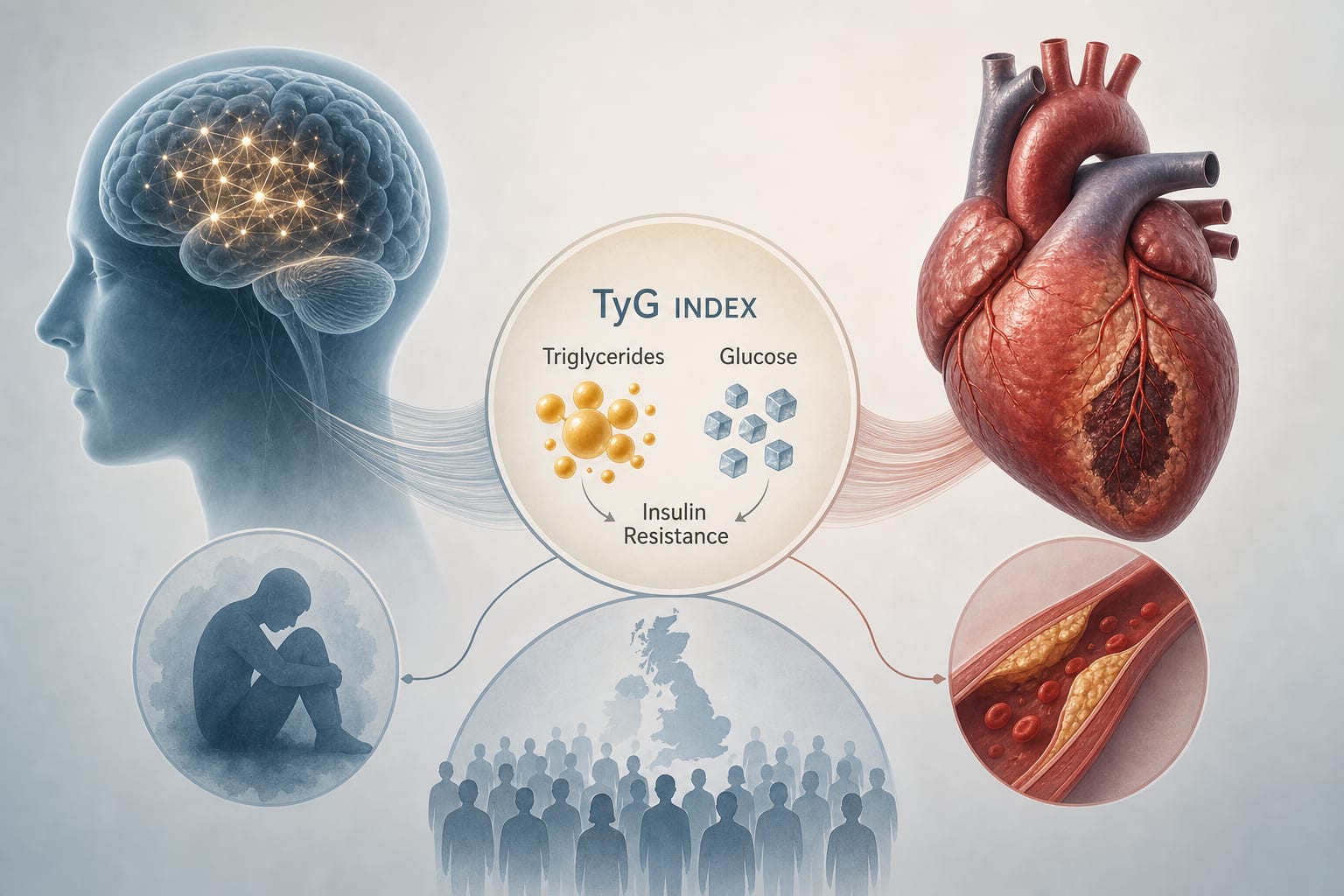
This study investigates the relationship between mental health symptoms, insulin resistance as measured by the triglyceride-glucose (TyG) index, and the risk of cardiovascular disease (CVD). Findings indicate that individuals with clear mental health symptoms have a higher risk of incident CVD and myocardial infarction.
Background
Cardiovascular disease (CVD) is a leading cause of morbidity and mortality globally, and its association with mental health symptoms such as depression and anxiety is documented. Insulin resistance (IR) is recognized as a significant risk factor for CVD, and understanding the interplay between mental health and metabolic disturbances is crucial. The triglyceride-glucose (TyG) index serves as a practical measure of IR in large populations.
Data Highlights
Measure
Result
Incident CVD (PHQ-4 ≥ 2)
HR 1.35 (95% CI 1.31–1.39)
Incident MI (PHQ-4 ≥ 2)
HR 1.30 (95% CI 1.23–1.37)
Mediation effect (CVD)
5.3% (95% CI 4.5%–6.3%)
Mediation effect (MI)
9.3% (95% CI 7.4%–12.5%)
Interaction (CVD)
HR for interaction 1.11 (95% CI 1.02–1.19)
Interaction (MI)
RERI 0.33 (95% CI 0.14–0.52)
Key Findings
Participants with PHQ-4 ≥ 2 had a 35% increased risk of incident CVD compared to those with no symptoms.
The risk of myocardial infarction (MI) was 30% higher in individuals with clear mental health symptoms (PHQ-4 ≥ 2).
The TyG index mediated 5.3% of the association between mental health symptoms and incident CVD.
Significant interactions were observed between TyG tertile 3 and PHQ-4 ≥ 2 on incident CVD.
Those with both PHQ-4 ≥ 2 and TyG tertile 3 exhibited the highest risks of incident CVD and MI.
Clinical Implications
Healthcare providers should consider the assessment of mental health symptoms in conjunction with metabolic factors like the TyG index when evaluating cardiovascular risk.
Conclusion
This study highlights the importance of recognizing the interplay between mental health symptoms and insulin resistance in the context of cardiovascular disease risk.