Durable response to ALK inhibition in low-allele-frequency SPTBN1–ALK–rearranged gastric cancer followed by lineage plasticity–mediated resistance: a case report - Report - MDSpire
Advertisement
Sustained Response to ALK Inhibition in Gastric Cancer with Low-Frequency SPTBN1–ALK Rearrangement and Subsequent Resistance via Lineage Plasticity: A Case Study
Clinical Report: Sustained Response to ALK Inhibition in Gastric Cancer
Overview
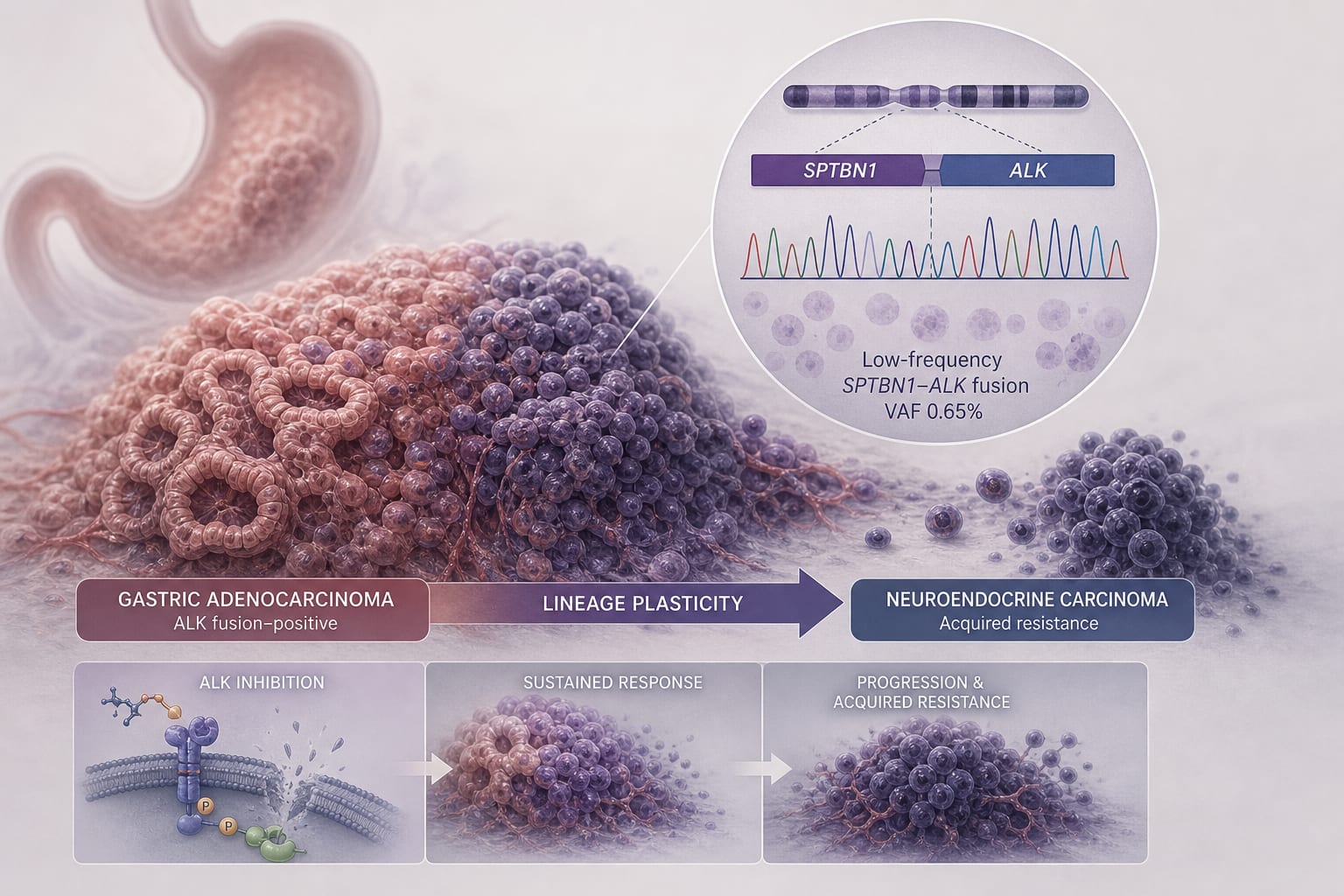
This case study presents a 52-year-old woman with metastatic gastric adenocarcinoma exhibiting a rare SPTBN1–ALK fusion. Treatment with the ALK inhibitor iruplinalkib resulted in a durable partial response lasting approximately 14 months.
Background
ALK rearrangements are infrequent in gastric cancer, and their therapeutic implications remain largely undefined. While ALK inhibitors have shown efficacy in other malignancies, data regarding their use in gastric tumors are limited.
Data Highlights
No numerical data available.
Key Findings
The patient had a rare SPTBN1–ALK fusion detected at a low variant allele frequency (0.65%).
After chemotherapy failure, treatment with iruplinalkib led to a partial response lasting approximately 14 months.
At progression, there was an increase in the variant allele frequency of the fusion to 5.94% and expansion of TP53-mutant alleles.
Histologic transformation to small-cell neuroendocrine carcinoma was observed, indicating lineage plasticity.
No canonical ALK kinase domain resistance mutations were detected, suggesting a non–on-target resistance mechanism.
Clinical Implications
Comprehensive genomic profiling may assist in identifying actionable alterations in gastric cancer.
Conclusion
This case highlights the presence of low-frequency ALK fusions in gastric cancer.
Dana-Farber Cancer Institute's Dr. Sara Tolaney from the ASCENT-03 stud in breast cancer. The data further strengthens the case for approval of sacituzumab govitecan as first-line treatment for patients with advanced triple-negative breast cancer.
How AI enables scalable biomarker analysis that preserves tissue samples, addressing some of the most persistent bottlenecks in clinical care and research