Overt hyperthyroidism is associated with increased dispersion of ventricular repolarization: a case-control study - Report - MDSpire

Overt hyperthyroidism is associated with increased dispersion of ventricular repolarization: a case-control study

  • By

  • Maksymilian Kłosowicz

  • Magdalena Urbańczuk

  • Aleksandra Burbelka

  • Agnieszka Gala-Błądzińska

  • Krzysztof Balawender

  • July 7, 2026

  • 0 min

Share

Clinical Report: Increased Ventricular Repolarization Dispersion Linked to Overt Hyperthyroidism

Overview

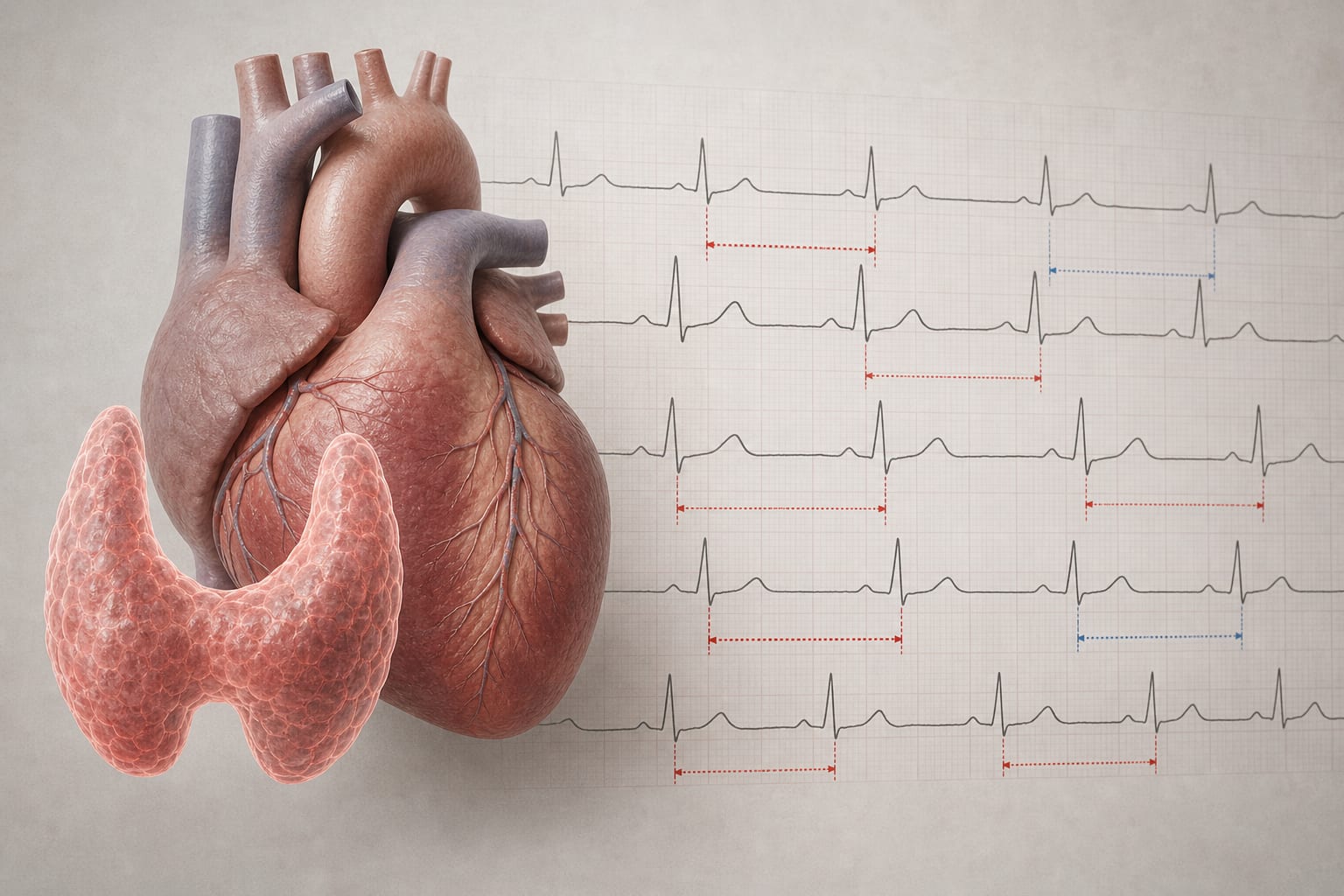
This study investigates the relationship between overt hyperthyroidism and ventricular repolarization dispersion parameters.

Background

Overt hyperthyroidism is linked to increased cardiovascular morbidity, including arrhythmias and heart failure. Understanding the electrocardiographic markers of ventricular repolarization can provide insights into the cardiovascular risks associated with this condition.

Data Highlights

ParameterOvert Hyperthyroidism (n=55)Controls (n=42)p-value
QT dispersion (QTd)HigherLower< 0.001
Bazett-corrected QT dispersion (QTcBd)HigherLower< 0.001
Fridericia-corrected QT dispersion (QTcFd)HigherLower< 0.001
JT dispersion (JTd)HigherLower< 0.001
Fridericia-corrected JT dispersion (JTcFd)HigherLower< 0.001
Tpeak–Tend dispersion (Tp-ed)HigherLower< 0.001

Key Findings

  • All six assessed dispersion parameters were significantly higher in patients with overt hyperthyroidism compared to controls (p < 0.001).
  • The best discriminatory performance was observed for JTcFd (AUC 0.813) and QTcBd (AUC 0.804).
  • Tp-ed was independently associated with overt hyperthyroidism in multivariable analysis.
  • Correlations between thyroid hormone levels and dispersion indices were weak and non-significant.
  • Electrophysiological changes in overt hyperthyroidism may contribute to increased arrhythmic risk, although clinical outcomes were not assessed.

Clinical Implications

The study highlights the potential for advanced electrocardiographic markers to identify ventricular repolarization abnormalities in patients with overt hyperthyroidism. Clinicians should consider these markers when evaluating cardiovascular risk in this patient population.

Conclusion

Increased ventricular repolarization dispersion is associated with overt hyperthyroidism, suggesting the need for further investigation into its clinical implications regarding arrhythmia risk.

Related Resources & Content

  1. American Thyroid Association, Guidelines for Managing Hyperthyroidism and Other Causes of Thyrotoxicosis, 2016 -- New Guidelines for Managing Hyperthyroidism and Other Causes of Thyrotoxicosis
  2. The Journal of Clinical Endocrinology & Metabolism, 2024 -- Heart ventricular function in hospitalized patients with severe hypothyroidism and myxedema coma
  3. The Journal of Clinical Endocrinology & Metabolism, 2024 -- Subclinical Hypothyroidism as a Distinct Predictor of Cardiovascular Outcomes in Patients with Left Ventricular Thrombus
  4. The Journal of Clinical Endocrinology & Metabolism, 2024 -- Management Strategies for Patients Experiencing Thyroid Storm
  5. Pediatric Cardiology — Ventricular Dysfunction Resulting from Aberrant Conduction in Double Ventricular Response
  6. New Guidelines for Managing Hyperthyroidism and Other Causes of Thyrotoxicosis | American Thyroid Association
  7. Relationship between Tpeak-Tend (TPE), TPE/QT ratio and TPE dispersion in patients with subclinical hyperthyroidism - Anatolian Current Medical Journal
  8. Frontiers | Mechanisms of torsades de pointes: an update
  9. Tpeak‐Tend ECG Marker in Obesity and Cardiovascular Diseases: A Comprehensive Review - Dykiert - 2024 - Scientifica - Wiley Online Library
  10. Full article: A systematic review of the clinical characteristics and course of atrioventricular blocks in hyperthyroidism
  11. 2023 ACC/AHA/ACCP/HRS Guideline for the Diagnosis and Management of Atrial Fibrillation: A Report of the American College of Cardiology/American Heart Association Joint Committee on Clinical Practice Guidelines - PMC

Original Source(s)

Related Content