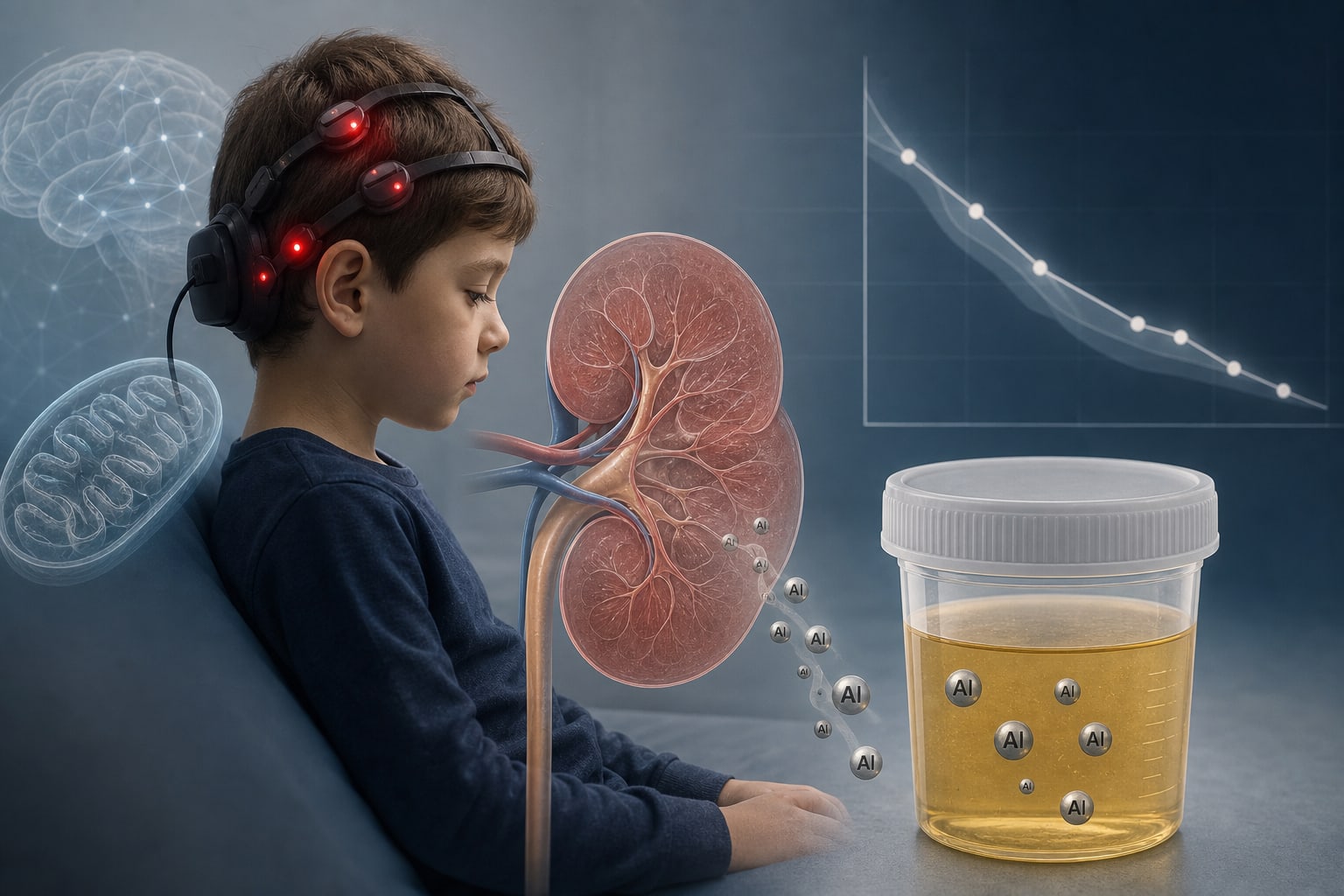
Changes in Urinary Metal Levels After 660 nm Photobiomodulation in a Child Diagnosed with Autism Spectrum Disorder: A Case Study
-
By
-
Alex Zaharakis
-
Christian Bogner
-
June 23, 2026
Changes in Urinary Metal Levels After 660 nm Photobiomodulation in a Child Diagnosed with Autism Spectrum Disorder: A Case Study
Overview
This case study reports an increase in urinary aluminum levels following pulsed 660 nm photobiomodulation (PBM) in a child with autism spectrum disorder (ASD).
Background
Aluminum exposure has been linked to neurodevelopmental disorders, including ASD. Current treatment options for heavy metal mobilization, such as chelation therapy, carry risks, particularly in pediatric populations. Nonchelation strategies may influence metal excretion.
Data Highlights
| Time Point | Urinary Aluminum (µg/g creatinine) |
|---|---|
| Baseline 1 | 10.0 |
| Baseline 2 | 9.8 |
| Day 3 | 58 |
| Day 7 | 98 |
| Follow-up | 49 |
Key Findings
- Initial urinary aluminum levels were stable at 10.0 and 9.8 µg/g creatinine.
- After PBM, urinary aluminum levels increased to 58 µg/g on Day 3 and peaked at 98 µg/g on Day 7.
- At follow-up, urinary aluminum remained elevated at 49 µg/g creatinine.
- Mercury levels exceeded reference values in all specimens, including baseline, with a follow-up level of 8.4 µg/g creatinine.
Clinical Implications
The observed increase in urinary aluminum following PBM should be documented in patients undergoing such interventions.
Conclusion
This case study provides evidence of increased urinary aluminum excretion following PBM in a child with ASD.
Related Resources & Content
- Mold et al., BMC Psychiatry, 2018 -- Evidence of aluminum accumulation in ASD
- Adams et al., The Pathologist, 2013 -- Differences in urinary metal excretion profiles
- American Academy of Pediatrics, Pediatrics, 2020 -- Identification, Evaluation, and Management of Children With Autism Spectrum Disorder
- Environmental Health, 2024 -- Exposure to heavy metals in utero and autism spectrum disorder
- Frontiers in Psychiatry — Atypical modulation of electrodermal reactivity during exposure to graded unisensory and multisensory stimuli in autistic children and adolescents
- the analytical scientist — Uncovering Autism’s Earliest Metallic Traces with LIBS
- Investigation of Plasma and Urinary Neurotransmitter Levels in Chinese Pediatric Patients with Autism Spectrum Disorder
- Urinary Markers Show Promise in ASD
- Atypical modulation of electrodermal reactivity during exposure to graded unisensory and multisensory stimuli in autistic children and adolescents
- Identification, Evaluation, and Management of Children With Autism Spectrum Disorder | Pediatrics | American Academy of Pediatrics
- Exposure to heavy metals in utero and autism spectrum disorder at age 3: a meta-analysis of two longitudinal cohorts of siblings of children with autism | Environmental Health | Springer Nature Link
- Photobiomodulation CME part I: Overview and mechanism of action - PubMed
Based on findings from:
Alterations in urinary metals following pulsed 660 nm photobiomodulation in a pediatric patient with autism spectrum disorder: a case report
Alex Zaharakis, Christian Bogner. Frontiers In Pediatrics, 2026.
https://www.frontiersin.org/journals/pediatrics/articles/10.3389/fped.2026.1819736/full
This content is an AI-generated, fully rewritten summary based on a published scholarly article. It does not reproduce the original text and is not a substitute for the original publication. Readers are encouraged to consult the source for full context, data, and methodology.