Fine-Tuning, Retrieval-Augmented Generation, and Hybrid Large Language Models for Postoperative Decision Support: Comparative Analysis - Report - MDSpire
Advertisement
Fine-Tuning, Retrieval-Augmented Generation, and Hybrid Large Language Models for Postoperative Decision Support: Comparative Analysis
Clinical Report: Optimizing Hybrid Large Language Models for Decision-Making
Overview
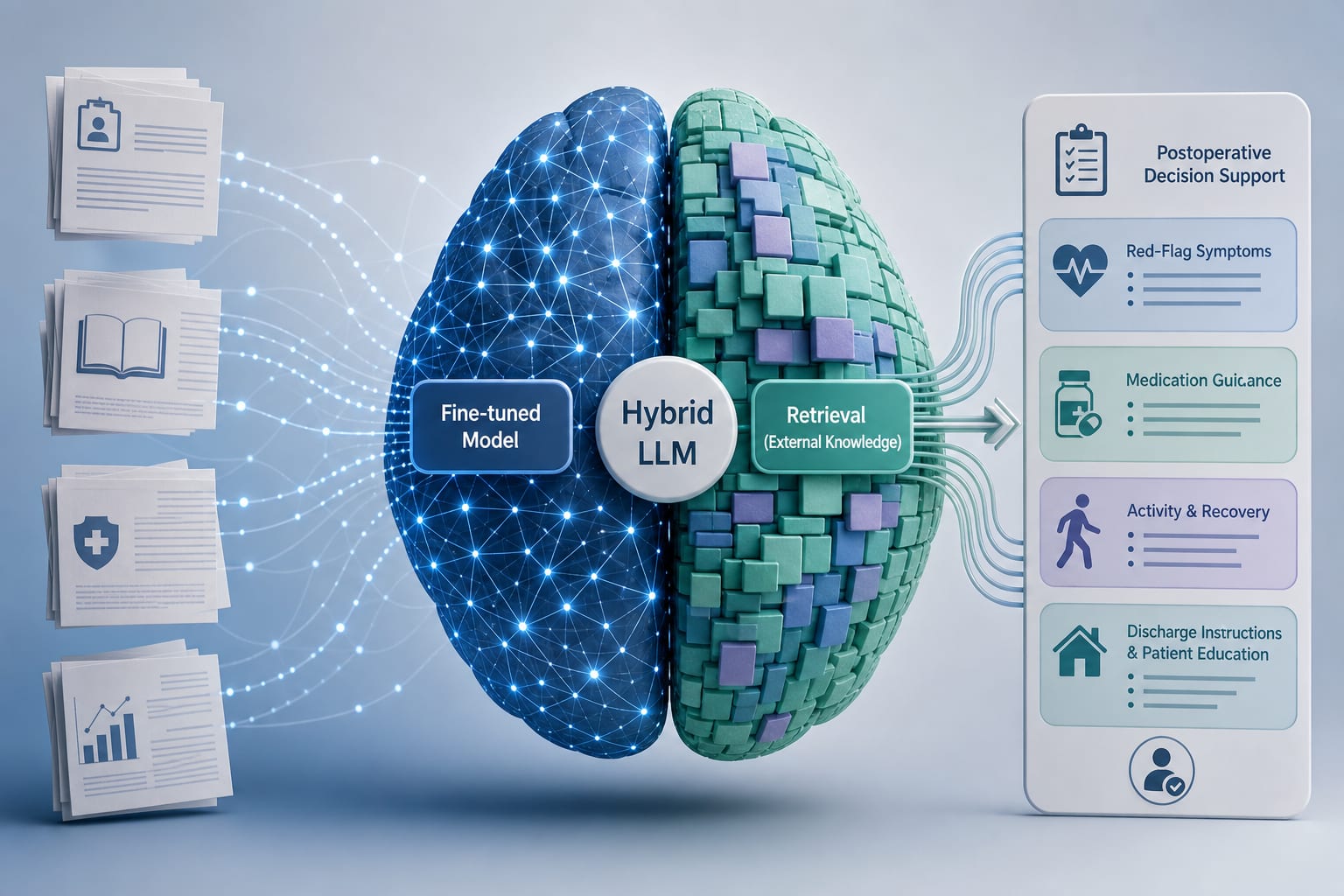
This study evaluates four configurations of large language models (LLMs) for postoperative decision support, highlighting the strengths and limitations of each approach.
Background
The integration of large language models in clinical settings presents challenges in maintaining accuracy and relevance, particularly in postoperative care. Understanding the comparative performance of different LLM configurations can inform the development of more reliable patient education resources.
Data Highlights
No numerical data available in the source material.
Key Findings
Four LLM configurations were assessed: baseline, fine-tuned, RAG-based, and hybrid.
Fine-tuning improves model performance on specific tasks but risks overwriting general knowledge.
RAG enhances LLMs by integrating external knowledge without altering model weights.
Hybrid models leverage the strengths of both fine-tuning and RAG.
All models were evaluated under identical infrastructure and settings for consistency.
Clinical Implications
Clinicians may consider these models for generating patient education materials.
Conclusion
The comparative study of LLM configurations reveals insights into optimizing postoperative decision support systems.
by Srinivasagam Prabha, Bernardo Gabriele Collaco, Cesar Abraham Gomez-Cabello, Syed Ali Haider, Ariana Genovese, Zhihui Fang, Nadia Wood, Sanjay Bagaria, Cui Tao, Antonio Jorge Forte