Clear Liquid Diets and Enhanced Safety in Procedures: Insights from the OCULUS Trial—A Response
-
By
-
Akram I. Ahmad
-
Tilak Shah
-
September 1, 2026
Clinical Report: Clear Liquid Diets and Enhanced Safety in Procedures
Overview
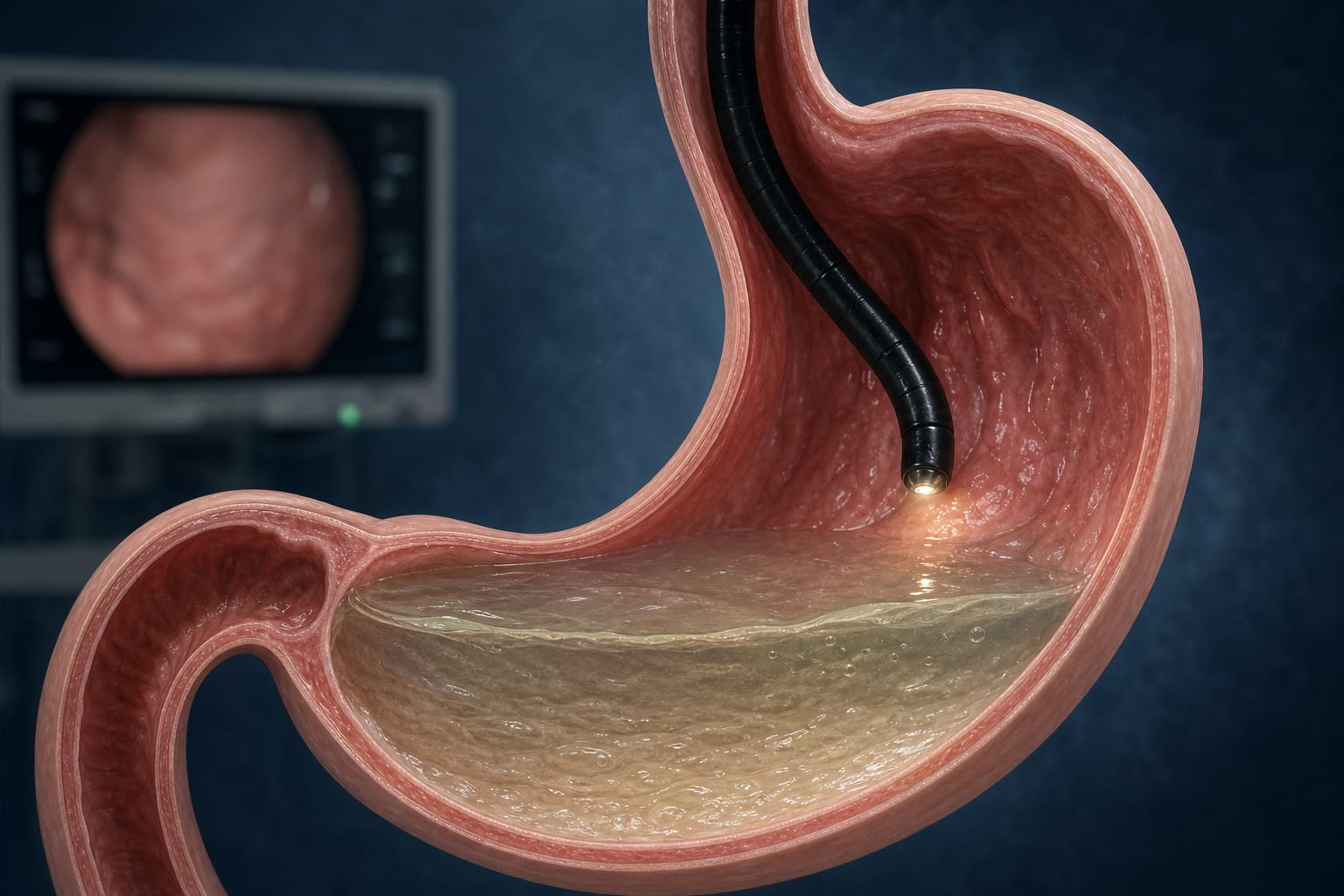
The OCULUS trial highlights the importance of clear liquid diets in reducing clinically significant residual gastric volume (CS-RGV) during upper endoscopy. No cases of CS-RGV were observed among participants who adhered to a 24-hour clear liquid diet, regardless of medication management (source: JAMA Internal Medicine, 2026).
Background
The management of glucagon-like peptide-1 (GLP-1) and glucose-dependent insulinotropic polypeptide (GIP) receptor agonists (GLP-1/GIP RAs) during periprocedural periods is critical for patient safety. Understanding the implications of dietary modifications, such as clear liquid diets, can help mitigate risks associated with aspiration during procedures like endoscopy (source: 2025 ADS/ANZCA/GESA/NACOS clinical practice recommendations).
Data Highlights
No cases of clinically significant residual gastric volume (CS-RGV) were detected among OCULUS participants following a 24-hour clear liquid diet.
Key Findings
- CS-RGV occurred in none of the participants who followed a 24-hour clear liquid diet before endoscopy.
- In the OCULUS trial, CS-RGV was significantly lower when medication was withheld compared to when it was continued.
- Subgroup findings suggest that clear liquids may reduce CS-RGV risk, but require cautious interpretation.
- Point-of-care ultrasonography may help exclude CS-RGV before sedation, though further validation is needed.
- Guidelines recommend risk stratification for patients receiving GLP-1/GIP RAs, emphasizing the need for dietary modifications.
Clinical Implications
Healthcare providers should consider the implications of a 24-hour clear liquid diet for patients undergoing upper endoscopy while on GLP-1/GIP RAs to minimize aspiration risks.
Conclusion
The findings from the OCULUS trial support the use of clear liquid diets to enhance safety during endoscopic procedures.
Related Resources & Content
- JAMA Internal Medicine, 2026 -- Holding vs Continuing GLP-1/GIP Agonists Before Upper Endoscopy: The OCULUS Randomized Clinical Trial
- JAMA Internal Medicine, 2026 -- Transparent Fluids and Enhanced Safety in Procedures: Insights from the OCULUS Study
- JAMA Internal Medicine, 2026 -- Error in the Visual Abstract
- 2025 ADS/ANZCA/GESA/NACOS clinical practice recommendations on the peri-procedural use of GLP-1/GIP receptor agonists - PMC
- Retinal Physician — Initial DIAMOND Results Support OCS-01 Efficacy
- Holding vs Continuing GLP-1/GIP Agonists Before Upper Endoscopy: The OCULUS Randomized Clinical Trial | Trials | JAMA Internal Medicine | JAMA Network
- 2025 ADS/ANZCA/GESA/NACOS clinical practice recommendations on the peri-procedural use of GLP-1/GIP receptor agonists - PMC
- Glucagon-like peptide-1 receptor agonists increase the risk of residual gastric content and pulmonary aspiration on upper endoscopy: A meta-analysis - ScienceDirect
Based on findings from:
Clear Liquids, Safer Procedures—Lessons from the OCULUS Trial—Reply
Akram I. Ahmad, Tilak Shah. Jama Internal Medicine, 2026.
https://jamanetwork.com/journals/jamainternalmedicine/fullarticle/2851434
This content is an AI-generated, fully rewritten summary based on a published scholarly article. It does not reproduce the original text and is not a substitute for the original publication. Readers are encouraged to consult the source for full context, data, and methodology.