Clinical Report: Hormonal Profile During Minipuberty in PMDS
Background
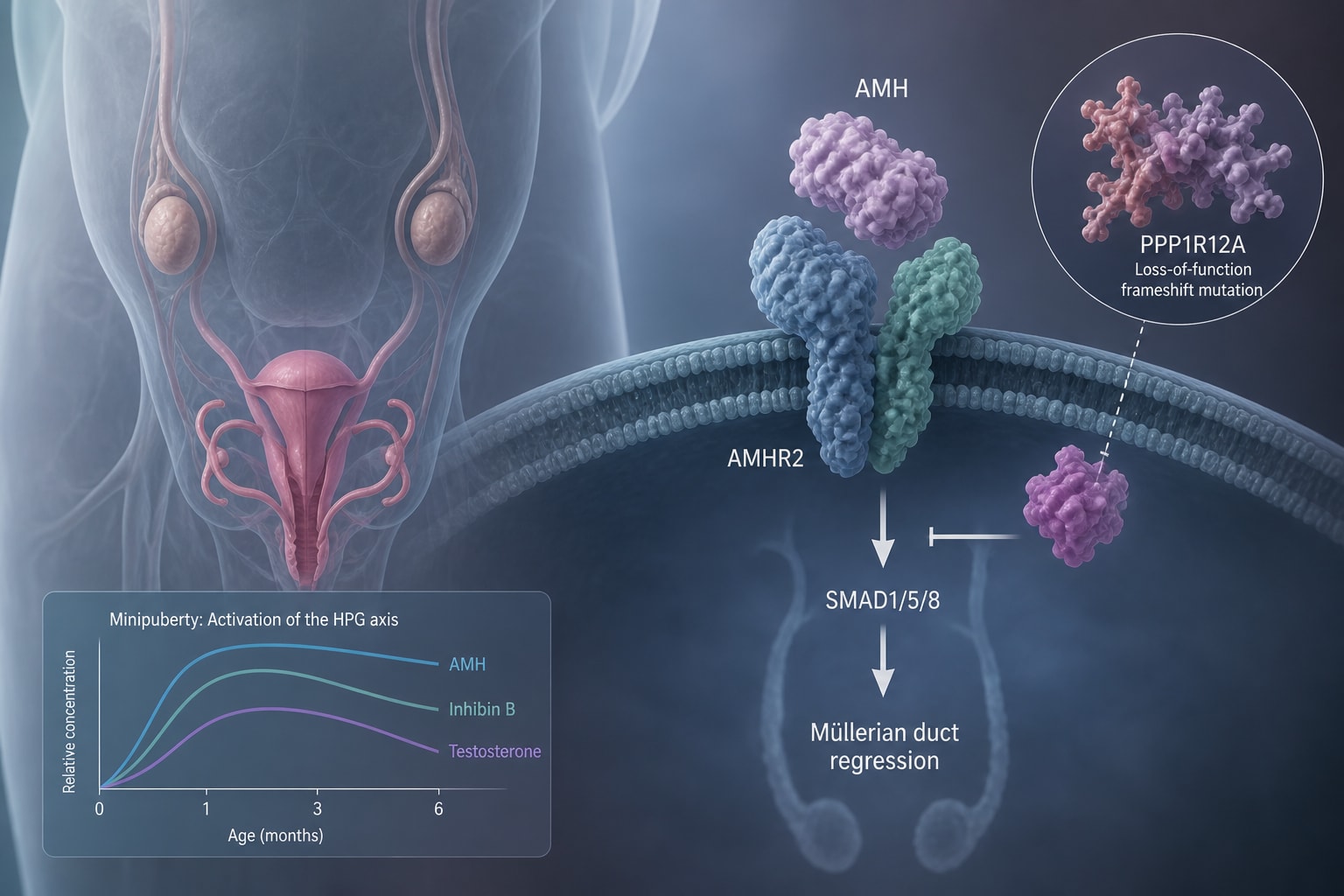
Persistent Müllerian duct syndrome (PMDS) is a rare disorder of sexual development characterized by the presence of Müllerian derivatives in 46,XY individuals. Traditionally linked to mutations in anti-Müllerian hormone (AMH) or its receptor, recent studies have identified PPP1R12A mutations as an additional genetic cause.
Data Highlights
Measurement
At Birth
During Minipuberty
At 10 Months
Inhibin B (pg/mL)
108
259
76
AMH (pmol/L)
174.4
342
149.8
Testosterone (nmol/L)
1.4
9.2
N/A
LH (IU/L)
N/A
19.1
N/A
FSH (IU/L)
N/A
10.4
N/A
Key Findings
A novel de novo heterozygous loss-of-function mutation in PPP1R12A was identified in a 46,XY neonate.
The patient exhibited preserved gonadal function during minipuberty with elevated levels of inhibin B, AMH, and testosterone.
At 10 months, AMH and inhibin B levels fell below age-specific reference intervals, suggesting potential Sertoli cell dysfunction.
The endocrine profile supports the hypothesis that PPP1R12A may influence Müllerian duct development rather than primary gonadal failure.
Minipuberty is critical for assessing hypothalamic-pituitary-gonadal axis activation in infants.
Clinical Implications
Monitoring hormonal levels during minipuberty can provide insights into gonadal function in patients with PMDS. Clinicians should be aware of the potential for evolving Sertoli cell dysfunction as these patients age, necessitating ongoing endocrine evaluation.
Conclusion
The findings from this case study enhance the understanding of hormonal profiles in PMDS and highlight the role of PPP1R12A in duct development. Continued research is needed to elucidate the long-term implications of these hormonal changes.
Investigators examined Life’s Essential 8 scores and carotid ultrasonography measures across cardiovascular-kidney-metabolic stages in 1,283 young adults.