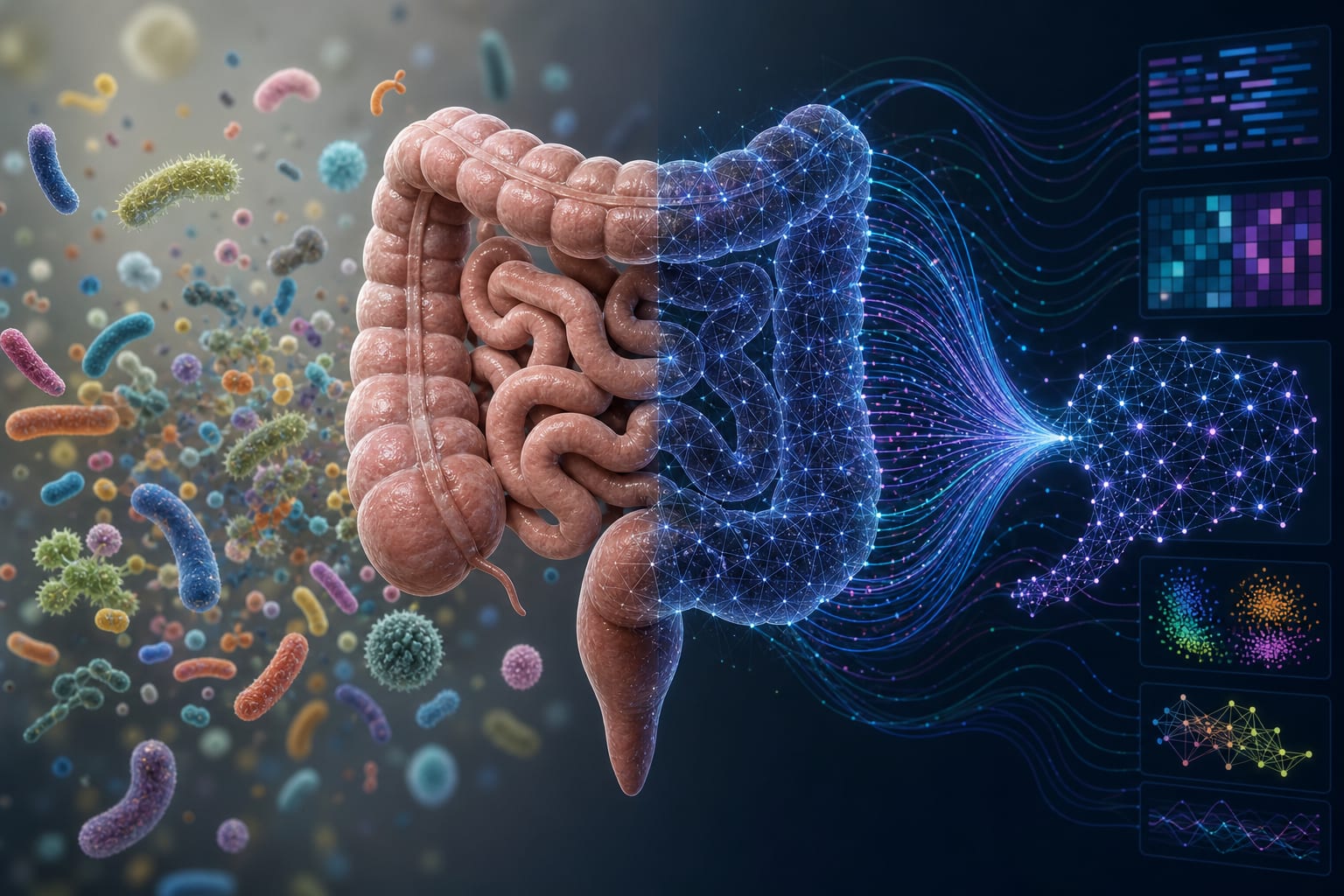
Harnessing Artificial Intelligence for Advanced Human Microbiome Studies
-
By
-
Tian Zhou
-
Fangqing Zhao
-
July 1, 2026
Clinical Report: Harnessing Artificial Intelligence for Advanced Human Microbiome Studies
Overview
{'add': 'Specify challenges of interpretability and data governance.'}
Background
{'add': "Detail traditional methods' limitations and AI's specific solutions."}
Data Highlights
{'remove': 'Placeholder text; replace with relevant data.'}
Key Findings
{'rephrase': 'Ensure findings are supported by the source.'}
Clinical Implications
{'expand': 'Include specific AI tools for integration.'}
Conclusion
{'reiterate': 'Emphasize the need to address AI challenges.'}
Related Resources & Content
- the pathologist, The Pathologist, 2026 -- Improving How We Read the Microbiome
- the pathologist, The Pathologist, 2026 -- Is Your AI Tool Clinically Ready?
- DIGITAL HEALTH, DIGITAL HEALTH, 2026 -- Role of artificial intelligence in bacterial diagnostics and surveillance of anti-microbial resistance
- npj Digital Medicine, npj Digital Medicine, 2025 -- Unlocking the potential: multimodal AI in biotechnology and digital medicine—economic impact and ethical challenges
- Safety and effectiveness of fecal microbiota, live-jslm (REBYOTA®) administered by colonoscopy for prevention of recurrent Clostridioides difficile infection: 8-week results from CDI-SCOPE, a single-arm, phase IIIb trial - PMC, PMC, 2026
- nature medicine, Nature Medicine, 2025 -- Consensus Statements in 2025
- Safety and effectiveness of fecal microbiota, live-jslm (REBYOTA®) administered by colonoscopy for prevention of recurrent Clostridioides difficile infection: 8-week results from CDI-SCOPE, a single-arm, phase IIIb trial - PMC
- nature medicine
-
Consensus Statements in 2025
| Nature Microbiology