Naringin and denosumab ameliorate osteoporosis and suppress the aldosterone-MR/SGK1 signaling axis by modulating the bone-kidney interorgan communication in Orchiectomized rats - Report - MDSpire

Naringin and denosumab ameliorate osteoporosis and suppress the aldosterone-MR/SGK1 signaling axis by modulating the bone-kidney interorgan communication in Orchiectomized rats

  • By

  • Shishuo Xiong

  • Guoying Wu

  • Yelin Zhong

  • Rong Xiang

  • Yukai Zhang

  • Haiwei Guo

  • Zehua Guo

  • Wenhao Lu

  • Qing Lan

  • Yongzhen Chen

  • Ying Li

  • June 30, 2026

  • 0 min

Share

Clinical Report: Naringin and Denosumab Improve Osteoporosis in Rats

Overview

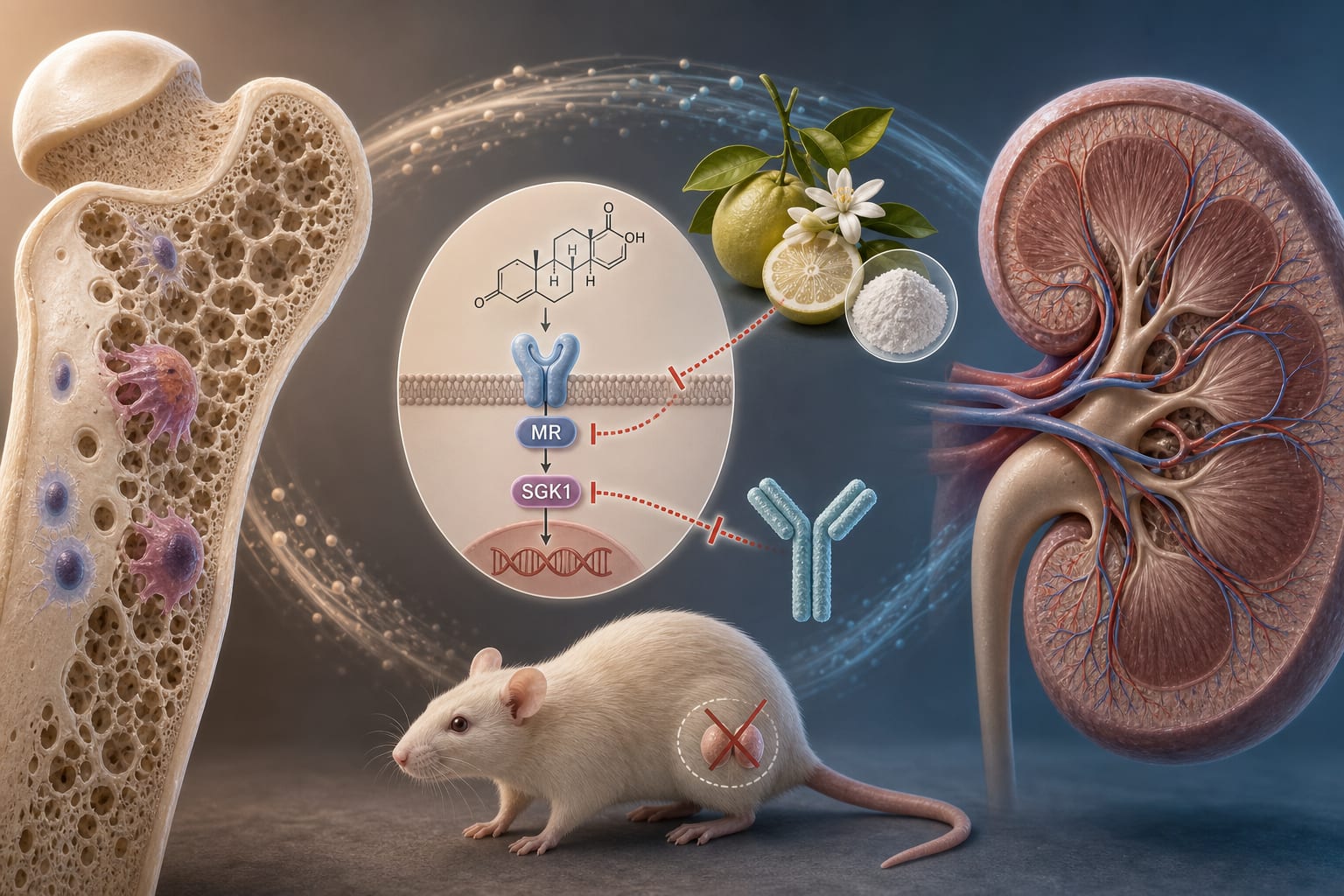
This study demonstrates that both naringin and denosumab significantly improve bone mass and inhibit the aldosterone-MR/SGK1 pathway in orchiectomized rats.

Background

Osteoporosis is a prevalent skeletal disease that increases fracture risk and affects quality of life. Recent research has highlighted the role of the renin-angiotensin-aldosterone system in bone metabolism, particularly the impact of aldosterone on bone health.

Data Highlights

TreatmentBone Mineral Density (BMD)Bone Volume Fraction (BV/TV)Trabecular Number (Tb.N)Trabecular Separation (Tb.Sp)
NaringinIncreasedIncreasedIncreasedDecreased
DenosumabExploratory trendIncreasedIncreasedDecreased

Key Findings

  • Naringin significantly increased bone mineral density and improved trabecular microarchitecture.
  • Denosumab showed a similar exploratory trend in improving bone metrics.
  • Both treatments suppressed the elevation of serum aldosterone in orchiectomized rats.
  • Naringin and denosumab inhibited the MR/SGK1 signaling pathway in the kidney.
  • Both treatments corrected the imbalance in RANKL/Runx2 expression in femur tissue.

Clinical Implications

Further research is warranted to explore the mechanisms behind the interactions observed in this study.

Conclusion

This study provides evidence for a functional interaction between bone health and systemic aldosterone metabolism.

Related Resources & Content

  1. Author(s)/Org, Source, Year -- Title
  2. the asco post — Nonmetastatic Breast Cancer: Treatment Strategies After Denosumab Discontinuation in Patients Treated With Aromatase Inhibitors
  3. Blood Cancer Journal — Evaluating results from the multiple myeloma patient subset treated with denosumab or zoledronic acid in a randomized phase 3 trial
  4. The Journal of Clinical Endocrinology & Metabolism — Efficacy Assessment of Romosozumab Versus Denosumab and Risedronate in Patients Starting Glucocorticoid Treatment
  5. The ASCO Post — Nonmetastatic Breast Cancer: Treatment Strategies After Denosumab Discontinuation in Patients Treated With Aromatase Inhibitors
  6. Nonmetastatic Breast Cancer: Treatment Strategies After Denosumab Discontinuation in Patients Treated With Aromatase Inhibitors
  7. Evaluating results from the multiple myeloma patient subset treated with denosumab or zoledronic acid in a randomized phase 3 trial
  8. Efficacy Assessment of Romosozumab Versus Denosumab and Risedronate in Patients Starting Glucocorticoid Treatment
  9. Clinical Practice Guidelines and Recommendations | ACP
  10. Primary Aldosteronism: An Endocrine Society Clinical Practice Guideline

Original Source(s)

Related Content