Case Report: Similar STR profiles in non-twin siblings complicating chimerism analysis after allogeneic hematopoietic stem cell transplantation - Report - MDSpire

Case Report: Similar STR profiles in non-twin siblings complicating chimerism analysis after allogeneic hematopoietic stem cell transplantation

  • By

  • Amro A. Filfilan

  • Mohieldin Elsayid

  • Meaad Almowaled

  • Naif S. Sannan

  • Waseem Alzamzami

  • Doaa Alamoudi

  • Modhi Khamis

  • Dania A. Monagel

  • June 16, 2026

  • 0 min

Share

Clinical Report: Challenges in Chimerism Assessment Due to Identical STR Profiles

Overview

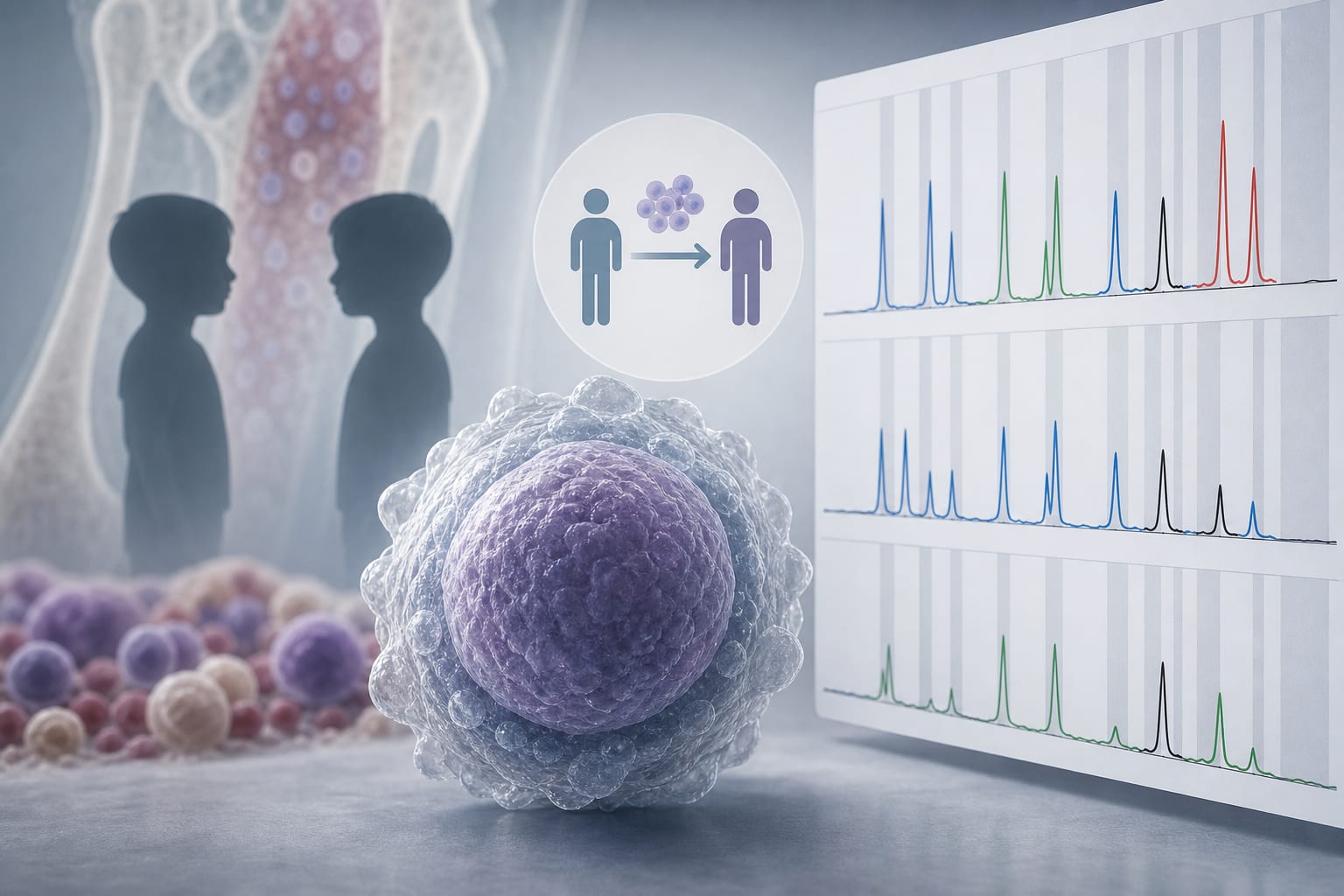
This case study highlights the challenges of chimerism assessment in a pediatric patient with Fanconi anemia following allogeneic hematopoietic stem cell transplantation. The presence of nearly identical short tandem repeat (STR) profiles between the patient and a non-twin sibling donor limited the ability to monitor chimerism effectively.

Background

Chimerism monitoring is critical after allogeneic hematopoietic stem cell transplantation (allo-HSCT) to assess donor engraftment and detect potential complications. In cases involving non-twin siblings, the likelihood of shared alleles can complicate this monitoring, particularly in populations with high consanguinity. Understanding these challenges is essential for improving post-transplant outcomes.

Data Highlights

No numerical data available in the article.

Key Findings

  • The patient achieved neutrophil engraftment on day +13 and sustained trilineage recovery through day +1376.
  • Pre-transplant STR analysis revealed near-complete donor-recipient genetic concordance with only one informative autosomal locus available for tracking.
  • Serial post-transplant monitoring showed absence of the recipient-specific allele at the single informative locus, indicating full donor-derived hematopoiesis.
  • This case underscores the limitations of standard STR-based chimerism monitoring in non-twin siblings from consanguineous populations.
  • Pre-transplant verification of donor-recipient STR informativity is crucial for effective chimerism monitoring.

Clinical Implications

Clinicians should be aware of the limitations of STR profiling in cases of high genetic concordance, particularly among non-twin siblings. Pre-transplant assessments should include the evaluation of informative loci to guide monitoring strategies and consider alternative methods like digital PCR or next-generation sequencing when necessary.

Conclusion

This case illustrates the complexities of chimerism assessment in pediatric patients with Fanconi anemia and emphasizes the need for careful pre-transplant planning and monitoring strategies to ensure optimal outcomes.

Related Resources & Content

  1. Bone Marrow Transplantation, 2022 -- Impact of Lineage-Specific Early Complete Donor Chimerism on Relapse Risk Following Allogeneic Hematopoietic Stem Cell Transplantation in Acute Myeloid Leukemia
  2. Blood Cancer Journal, 2017 -- Comparative Analysis of Donor Chimerism Levels in Peripheral Blood Versus Bone Marrow Following Hematopoietic Stem Cell Transplantation
  3. Bone Marrow Transplantation, 2023 -- A New Flow Cytometry Technique for Evaluating Post-HSCT Donor Chimerism Using RNA Hybridization
  4. Blood Cancer Journal, 2021 -- Mixed T cell lineage chimerism in acute leukemia/MDS using pre-emptive donor lymphocyte infusion strategy—Is it prognostic?—a single-center retrospective study
  5. Frontiers, 2026 -- Case Report: Similar STR Profiles in Non-Twin Siblings Complicating Chimerism Analysis after Allogeneic Hematopoietic Stem Cell Transplantation
  6. Chimerism and a framework for clinical practice: A report from the Cellular Therapies Section Coordinating Committee (CTSCC) of Association for Advancement of Blood and Biotherapies (AABB)
  7. Chimerism kinetics in pediatric hematopoietic stem cell transplantation: from biological basis to advanced monitoring technologies
  8. Highly Sensitive Detection of Donor Chimerism by Next-Generation Sequencing
  9. Frontiers | (Case Report: Similar STR Profiles in Non-Twin Siblings Complicating Chimerism Analysis after Allogeneic Hematopoietic Stem Cell Transplantation)
  10. Enhanced chimerism detection with multiple single Nucleotide Polymorphism Sequencing: Improving risk stratification post-allogeneic hematopoietic stem cell transplantation - ScienceDirect
  11. Third‐Generation Nanopore Sequencing for Post‐Transplant Chimerism Monitoring - Pedini - 2026 - HLA - Wiley Online Library
  12. Outcomes in allogeneic hematopoietic stem cell transplantation for Fanconi anemia | Bone Marrow Transplantation
  13. Updated EBMT/ESID inborn errors working party guidelines for haematopoietic stem cell transplantation for inborn errors of immunity and metabolism | Bone Marrow Transplantation
  14. Summary of Changes

Original Source(s)

Related Content