Reduced DPP9 levels sensitize experimental breast tumors to combinatory treatment with irradiation and Olaparib - Report - MDSpire

Reduced DPP9 levels sensitize experimental breast tumors to combinatory treatment with irradiation and Olaparib

  • By

  • Lisa Heß

  • Jule Koch

  • Finja Göttsche

  • Thomas Reinheckel

  • June 10, 2026

  • 0 min

Share

Clinical Report: Decreased Levels of DPP9 Enhance Sensitivity of Experimental Breast Tumors to Combined Irradiation and Olaparib Therapy

Overview

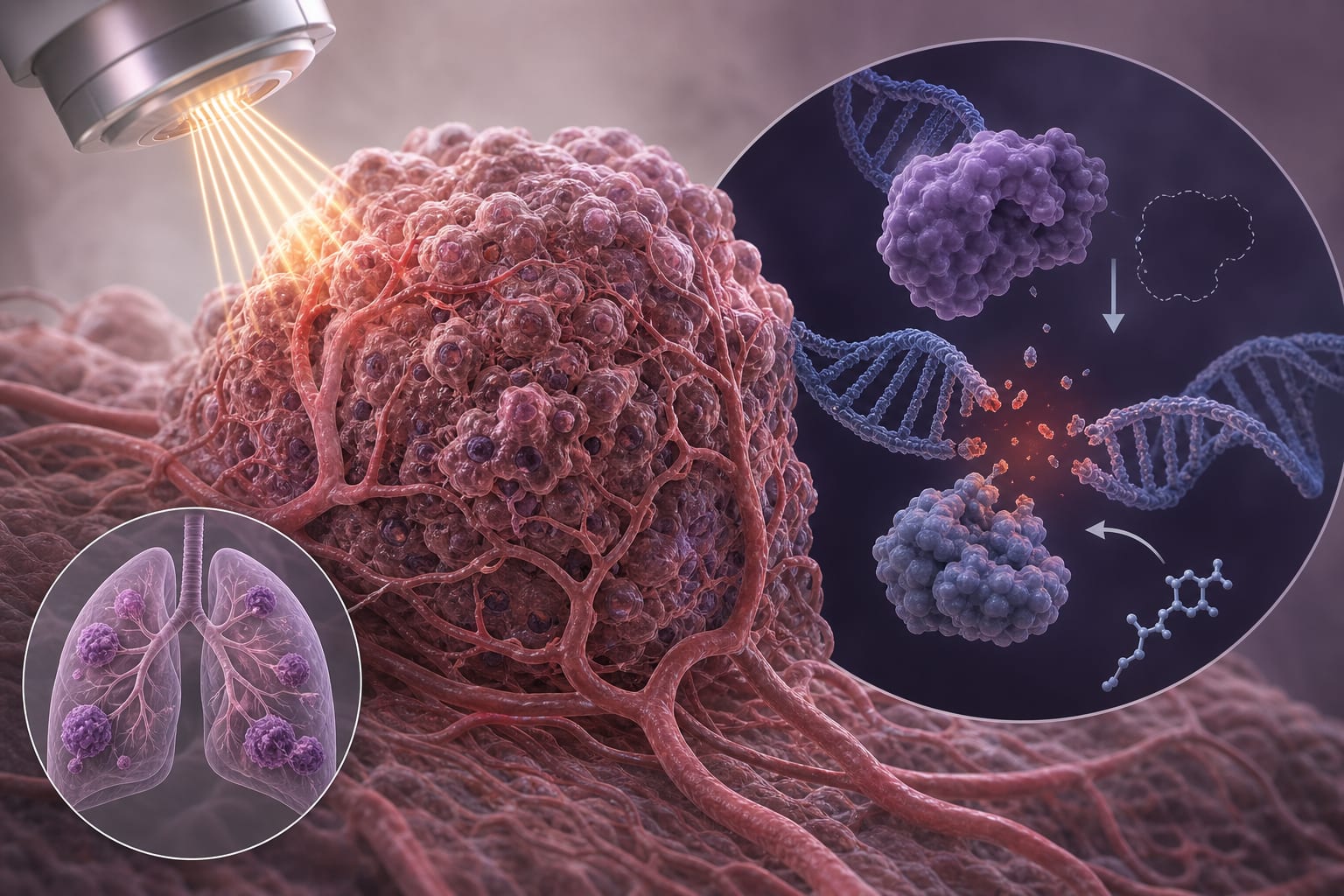
Reduced expression of dipeptidyl peptidase 9 (DPP9) in triple-negative breast cancer (TNBC) enhances sensitivity to combined irradiation and Olaparib therapy. This study utilized a mouse model to demonstrate the effects of DPP9 deficiency on treatment response.

Background

Triple-negative breast cancer (TNBC) is known for its aggressive nature and poor prognosis due to limited targeted therapies. DPP9 has been associated with tumor growth and metastasis in breast cancer, with lower levels correlating with worse patient outcomes.

Data Highlights

No numerical data or trial data provided in the source material.

Key Findings

  • DPP9 deficiency in TNBC models resulted in increased tumor weight and lung metastasis.
  • Upon irradiation, DPP9-deficient tumors exhibited faster regrowth compared to controls.
  • Combined treatment with irradiation and Olaparib further reduced tumor growth in DPP9-deficient tumors.
  • Metastasis formation showed mixed outcomes in DPP9-deficient tumors after treatment.
  • DPP9 is implicated in the proteolytic cleavage of BRCA2, affecting DNA repair mechanisms.

Clinical Implications

Clinicians should consider DPP9 expression when designing therapeutic strategies involving irradiation and PARP inhibitors like Olaparib.

Conclusion

This study demonstrates that reduced DPP9 levels enhance sensitivity to combined therapies in TNBC.

Related Resources & Content

  1. Author(s)/Org, Source, Year -- Title
  2. Author(s)/Org, Source, Year -- Title
  3. Author(s)/Org, Source, Year -- Title
  4. Author(s)/Org, Source, Year -- Title
  5. Author(s)/Org, Source, Year -- Title
  6. Author(s)/Org, Source, Year -- Title
  7. Author(s)/Org, Source, Year -- Title
  8. Author(s)/Org, Source, Year -- Title
  9. The ASCO Post — Olaparib for Patients With Metastatic Breast Cancer and Mutations in Homologous Recombination–Related Genes
  10. Toxicity Concerns for PARP Inhibition Given Concurrently With Adjuvant Radiotherapy for Breast Cancer
  11. AACR 2025: Molecularly Selected, Tumor-Agnostic Phase II Trial Focuses on Combination Therapy
  12. Olaparib for Patients With Metastatic Breast Cancer and Mutations in Homologous Recombination–Related Genes
  13. NCCN Guidelines® Insights: Breast Cancer, Version 5.2025 - PubMed
  14. Germline Testing in Patients With Breast Cancer: ASCO–Society of Surgical Oncology Guideline | Journal of Clinical Oncology
  15. 1 Recommendations | Olaparib for treating BRCA mutation-positive HER2-negative advanced breast cancer after chemotherapy | Guidance | NICE
  16. Olaparib OlympiA Olaparib OlympiA Olaparib OlympiA
  17. Adjuvant Olaparib for Patients with BRCA1- or BRCA2-Mutated Breast Cancer | New England Journal of Medicine
  18. OlympiAD final overall survival and tolerability results: Olaparib versus chemotherapy treatment of physician's choice in patients with a germline BRCA mutation and HER2-negative metastatic breast cancer - PubMed
  19. Concurrent Olaparib and Radiotherapy in Patients With Triple-Negative Breast Cancer
  20. Phase I/II study of stereotactic radiosurgery with concurrent olaparib followed by adjuvant durvalumab and physician’s choice systemic therapy in patients with breast cancer brain metastases. | Journal of Clinical Oncology
  21. PARP inhibitors as radiosensitizers: a comprehensive review of preclinical evidence and clinical applications
  22. Dipeptidyl-peptidase 9 regulates the dynamics of tumorigenesis and metastasis in breast cancer - ScienceDirect

Original Source(s)

Related Content