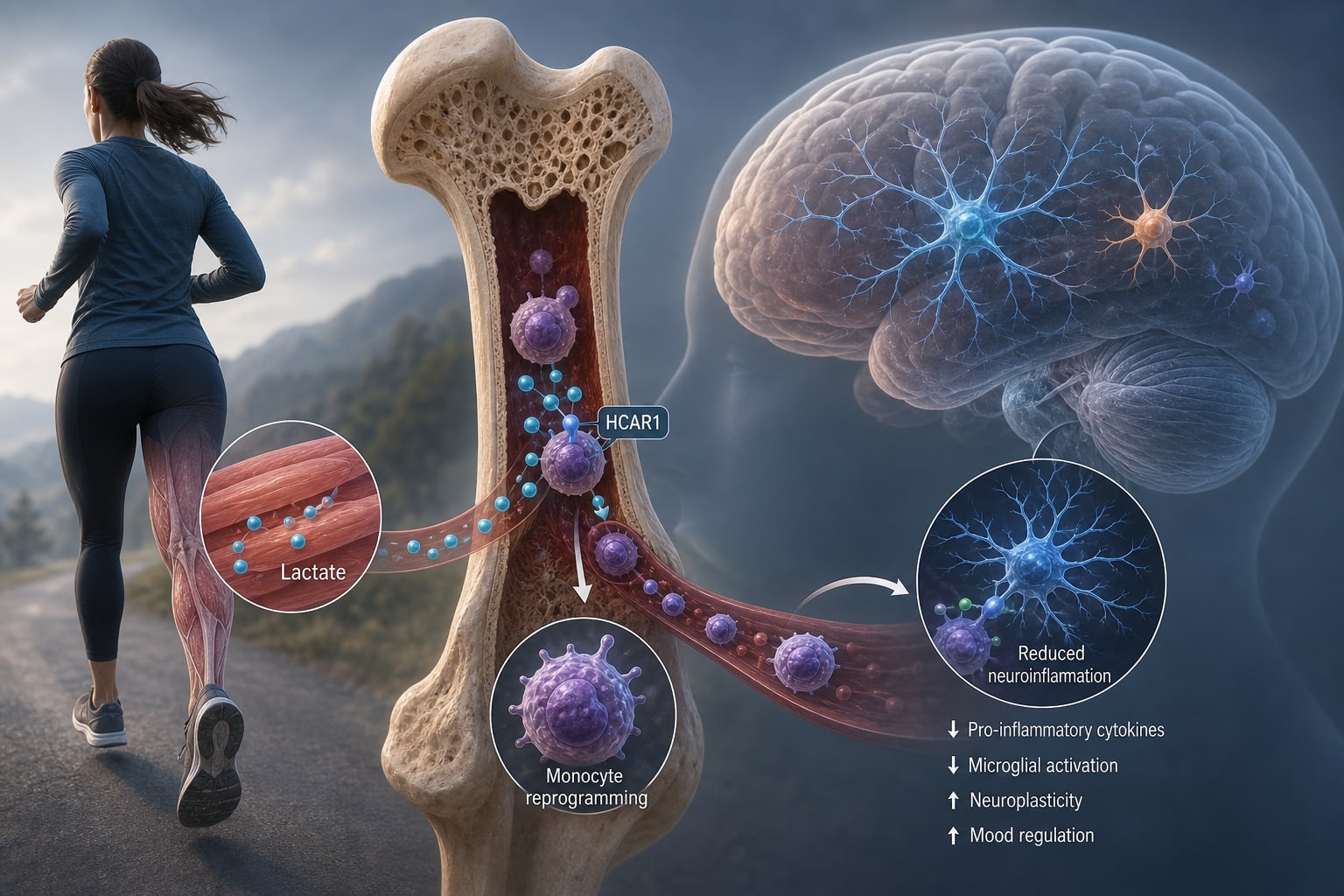
The Role of the Lactate-HCAR1 Pathway in Exercise Psychiatry: A Potential Mechanism Connecting Bone Marrow-Brain Immunity to Inflammation-Induced Depression
-
By
-
Chuankai Luan
-
Chuanping Lei
-
Min Liu
-
July 17, 2026
Clinical Report: The Role of the Lactate-HCAR1 Pathway in Exercise Psychiatry
Overview
This review explores the lactate-HCAR1 pathway as a potential mechanism linking exercise to inflammation-related depression.
Background
Exercise is recognized as an effective intervention for depression, yet the biological mechanisms behind its antidepressant effects are not fully understood. Traditional models focus on brain-centered pathways, which may not account for the complexities of inflammation-related depression.
Data Highlights
No numerical or trial data provided in the source material.
Key Findings
- Exercise-induced lactate acts as an immunometabolic signal rather than merely a metabolic byproduct.
- The lactate-HCAR1 axis connects exercise metabolism to immune regulation and inflammation-related depressive symptoms.
- Conventional exercise psychiatry often overlooks the heterogeneity of major depression and its inflammatory components.
- Future research should focus on lactate kinetics, inflammatory biomarkers, and immune cell phenotypes in relation to exercise.
- This framework is proposed as a testable hypothesis.
Clinical Implications
Further research is needed to validate this hypothesis and explore its clinical applications.
Conclusion
The lactate-HCAR1 pathway presents a novel perspective on the relationship between exercise and inflammation-related depression.
Related Resources & Content
- Frontiers | The lactate–HCAR1 axis in exercise psychiatry: a candidate mechanism linking bone marrow–brain immunity to inflammation-related depression
- Brain — Inflammatory Signals Outside the Axial Skeleton and Their Connection to Central and Peripheral Immune Responses in Depression
- Critical Care (Springer) — Unlocking the metabolic and anti-inflammatory therapeutic potential of lactate in critically ill patients
- Critical Care (Springer) — Lactate regulation in high-altitude hypoxic adaptation attenuates LPS-Induced acute lung injury: links to glucose metabolism and anti-inflammatory therapeutic potential
- Frontiers in Endocrinology — The liver-brain axis, from its function to preventive therapeutic strategies in diseases
- Overview | Depression in adults: treatment and management | Guidance | NICE
- American College of Physicians Recommends Cognitive Behavioral Therapy or Second-Generation Antidepressants for Adults With Major Depressive Disorder
- Exercise to treat depression yields similar results to therapy and antidepressants | Cochrane
- Lifestyle Interventions for Major Depressive Disorder (MDD): An Expert Consensus Statement From the American College of Lifestyle Medicine - PubMed
- Effect and acceptability of different exercise modes on adult patients with clinically diagnosed depression: a network meta-analysis - PubMed
- Resistance training for depression: a systematic review and meta-analysis of randomized controlled trials - PubMed
- An umbrella review of inflammatory biomarkers and their relationship to treatment response in MDD - PubMed
- Does multimodal exercise reduce C-reactive protein levels in major depressive disorder? Preliminary results from a randomized controlled trial - ScienceDirect
- Effect of Different Exercise Modalities on Inflammatory Markers in Individuals with Depressive Disorder: A Systematic Review and Meta-Analysis - PubMed
- Running exercise reverses depression-induced bone marrow myeloid skewing and neuroinflammation via the lactate-GPR81 axis - ScienceDirect
- Frontiers | The lactate–HCAR1 axis in exercise psychiatry: a candidate mechanism linking bone marrow–brain immunity to inflammation-related depression
This content is an AI-generated, fully rewritten summary based on a published scholarly article. It does not reproduce the original text and is not a substitute for the original publication. Readers are encouraged to consult the source for full context, data, and methodology.