Association of intratumoral CD68+CD163+ M2-like macrophages with survival in metastatic colorectal cancer treated with chemotherapy plus bevacizumab - Report - MDSpire

Correlation of Intratumoral M2-like Macrophages (CD68+CD163+) with Survival Outcomes in Metastatic Colorectal Cancer Patients Undergoing Chemotherapy and Bevacizumab Treatment

  • By

  • Xiaobin Xin

  • Huixian Qiu

  • Yan Zang

  • Lei Zhou

  • Tao Qin

  • Qingnuan Kong

  • July 17, 2026

Share

Clinical Report: Correlation of Intratumoral M2-like Macrophages with Survival Outcomes

Overview

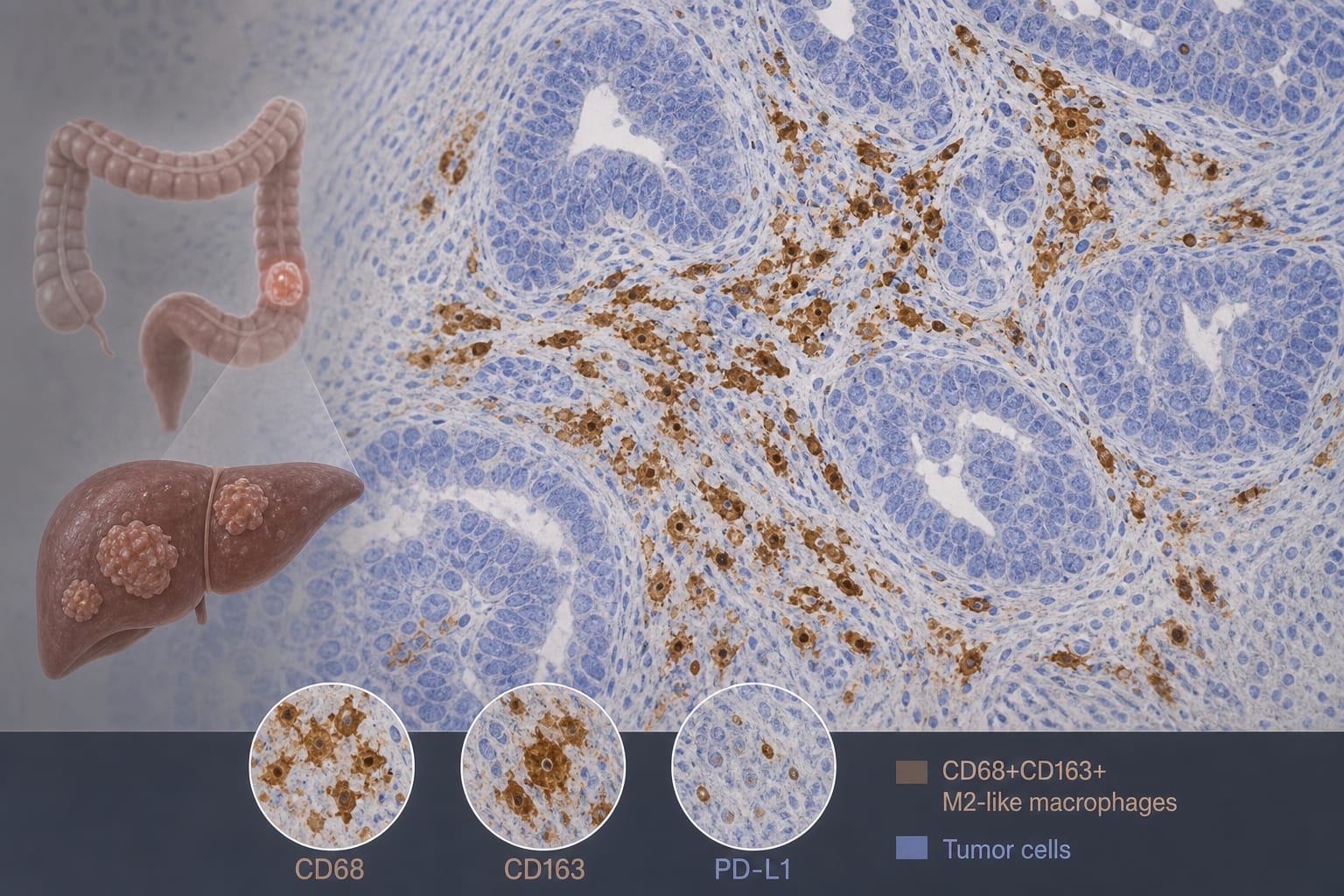
This study investigates the relationship between intratumoral M2-like macrophages and survival outcomes in metastatic colorectal cancer (mCRC) patients undergoing chemotherapy and bevacizumab treatment. Increased densities of CD68+CD163+ M2-like TAMs are significantly associated with post-treatment resistance.

Background

Metastatic colorectal cancer (mCRC) is a prevalent and lethal malignancy, often treated with chemotherapy and bevacizumab. Despite this treatment, many patients develop resistance, which limits long-term survival. Understanding the role of tumor-associated macrophages (TAMs) in treatment resistance is crucial for identifying potential biomarkers and therapeutic targets.

Data Highlights

GroupCD68+CD163+ M2-like TAMs DensitySurvival Outcomes
ResistantIncreasedShorter OS (p < 0.05), Trend toward shorter PFS (p = 0.06)
Non-resistantDecreasedLonger OS

Key Findings

  • Resistant mCRC patients exhibited significantly higher densities of CD68+CD163+ M2-like TAMs compared to non-resistant patients (p < 0.05).
  • High density of intratumoral CD68+CD163+ M2-like TAMs correlates with shorter overall survival (OS) (p < 0.05).
  • Multivariate Cox regression analysis indicates that dense infiltration of CD68+CD163+ M2-like TAMs is an independent poor prognostic marker for both OS and progression-free survival (PFS).
  • The infiltration levels of CD68+CD163+PD-L1+ M2-like TAMs were also significantly associated with post-treatment resistance.
  • Conventional clinicopathological features did not correlate with the infiltration levels of these macrophage subsets.

Clinical Implications

The findings indicate that assessing the density of intratumoral CD68+CD163+ M2-like TAMs may serve as a prognostic marker in mCRC patients undergoing chemotherapy and bevacizumab treatment.

Conclusion

The study highlights the significant association between intratumoral M2-like TAMs and treatment resistance in mCRC.

Related Resources & Content

  1. Author(s)/Org, Source, Year -- Title
  2. the asco post — Impact of HER2-Receptor Status in mCRC Treated With Chemotherapy Plus Bevacizumab or Anti-EGFR Agents
  3. The ASCO Post — GI Symposium Presentations Include Important Updates in Treatment and Prognosis of Pancreatic and Colorectal Cancers
  4. The ASCO Post — Studies Evaluate Bevacizumab-Containing Regimens in Metastatic Colorectal Cancer
  5. Moderate Bevacizumab Dosage Combined with TAS-102 Extends Progression-Free Survival in Refractory Metastatic Colorectal Cancer
  6. Impact of HER2-Receptor Status in mCRC Treated With Chemotherapy Plus Bevacizumab or Anti-EGFR Agents
  7. GI Symposium Presentations Include Important Updates in Treatment and Prognosis of Pancreatic and Colorectal Cancers
  8. Studies Evaluate Bevacizumab-Containing Regimens in Metastatic Colorectal Cancer
  9. Metastatic colorectal cancer: ESMO Clinical Practice Guideline for diagnosis, treatment and follow-up
  10. Frontiers | Association of intratumoral CD68+CD163+ M2-like macrophages with survival in metastatic colorectal cancer treated with chemotherapy plus bevacizumab

Original Source(s)

Related Content