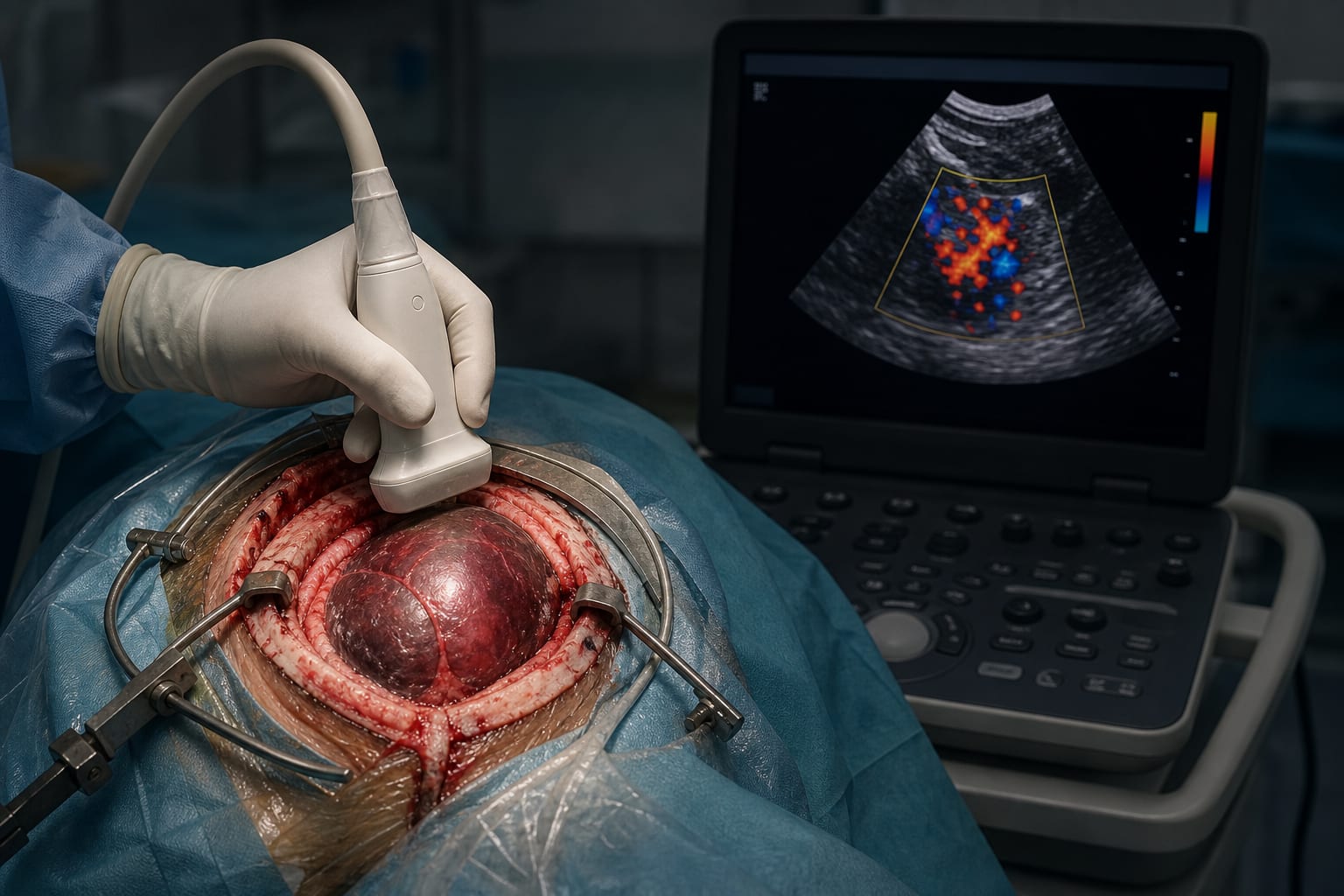
Fast Bilinear Spline Motion Stabilization for Infrared Thermography in Awake Craniotomy
Overview
This study introduces a novel motion correction technique for infrared thermography (IRT) during awake craniotomy, using bilinear spline registration to estimate and correct brain motion. The method balances image similarity with biomechanical constraints, achieving near-real-time performance without requiring multimodal imaging.
Background
Infrared thermography is a noncontact method to measure brain surface temperature, which reflects physiological and pathological processes such as tumor presence and cerebral bypass patency. However, IRT is highly sensitive to motion artifacts caused by cardiac and respiratory pulsations, brain shifting, and patient movement, especially in awake craniotomy. Existing motion correction methods either require multimodal imaging or are computationally intensive, limiting their clinical utility. A fast, robust, single-modality motion correction method is needed to enable practical intraoperative use of IRT.
Data Highlights
The proposed bilinear spline registration method models motion as a vector field defined over a grid of control points, interpolating pixel displacements bilinearly. The optimization minimizes a least squares error between target and moved images, regularized to ensure biomechanically plausible smooth motion fields. Validation was performed on five minutes of thermal video data from ten human patients, demonstrating improved speed and robustness compared to prior methods.
Key Findings
The bilinear spline registration technique effectively estimates brain motion by interpolating control point displacements, enabling accurate frame-to-frame alignment.
Regularization incorporating biomechanical constraints preserves physical plausibility and smoothness of brain motion fields.
The method operates on single-modality thermal images, eliminating the need for concurrent white-light imaging hardware.
Compared to existing techniques, this approach achieves faster processing suitable for near-real-time intraoperative application.
Validation on human patient data confirms robustness and potential clinical utility in awake craniotomy procedures.
Clinical Implications
This motion correction method facilitates reliable intraoperative infrared thermography by mitigating motion artifacts without additional imaging hardware, enhancing the feasibility of real-time brain temperature monitoring. Its speed and robustness support integration into neurosurgical workflows, potentially improving functional brain mapping and vascular monitoring during awake craniotomy.
Conclusion
The bilinear spline registration method offers a practical, fast, and biomechanically informed solution for motion stabilization in infrared thermography during awake craniotomy. This advancement may accelerate clinical adoption of IRT-based neurosurgical monitoring tools.
References
Senger et al. 2017 -- Motion Correction of Infrared Thermography Data
Moshaei-Nezhad et al. 2019 -- Optical Flow and Phase Correlation for IRT Motion Correction
Chen et al. 2020 -- Multimodal Image Registration for IRT
Moshaei-Nezhad et al. 2021 -- Demons Registration for Faster IRT Motion Correction