Research progress on the neural mechanism of light therapy improving cognitive function in depression: from retinal projections to neuroplasticity - Report - MDSpire

Research progress on the neural mechanism of light therapy improving cognitive function in depression: from retinal projections to neuroplasticity

  • By

  • Mengying Lin

  • Haihua Tian

  • Weiwei Xie

  • Tingting Wu

  • Ling Huang

  • Xiangping Wu

  • Yuanzhi Zhao

  • July 7, 2026

  • 0 min

Share

Clinical Report: Advancements in Understanding Neural Mechanisms of Light Therapy

Overview

Light Therapy (LT) engages neural pathways from retinal inputs to neuroplastic changes. This review synthesizes evidence on LT's efficacy and its underlying mechanisms.

Background

Cognitive impairment is a significant symptom of depression, impacting patient recovery and increasing the risk of neurodegenerative diseases. Light Therapy offers a non-invasive intervention that has expanded from treating seasonal affective disorder to non-seasonal depression.

Data Highlights

No numerical data or trial data provided in the source material.

Key Findings

  • Light Therapy (LT) improves cognitive function in patients with depression.
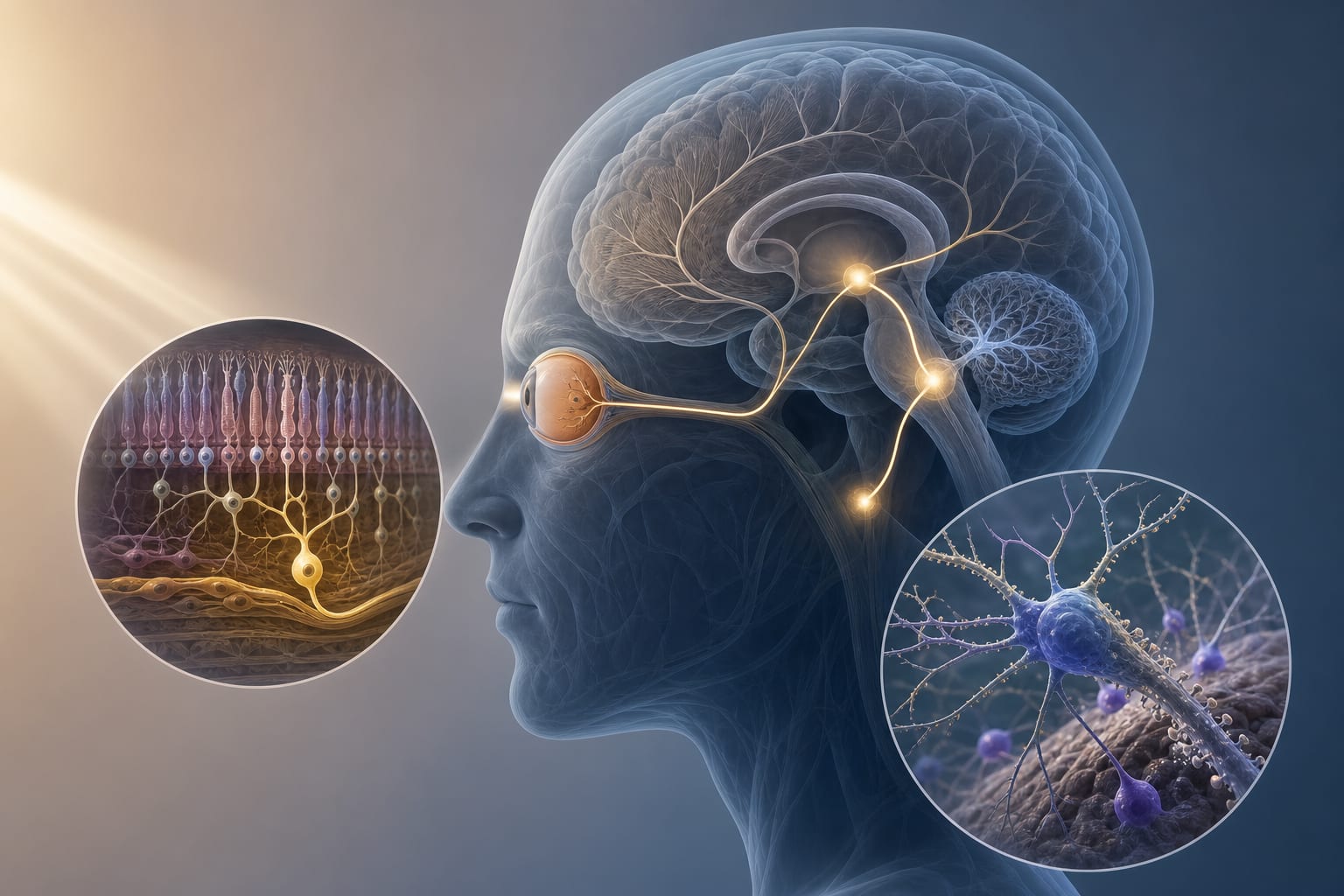
  • LT engages retinofugal projections via intrinsically photosensitive retinal ganglion cells (ipRGCs) to key brain regions.
  • Neuroplastic changes induced by LT include hippocampal neurogenesis and prefrontal synaptic remodeling.
  • Transcranial photobiomodulation (tPBM) is an emerging method showing potential in treating depressive symptoms.

Clinical Implications

The findings suggest that Light Therapy could be an effective non-invasive treatment for cognitive impairment in depression. Clinicians should consider LT as part of a comprehensive treatment plan for patients with mild to moderate depressive symptoms.

Conclusion

Further research is needed to refine treatment parameters and optimize clinical applications.

Related Resources & Content

  1. U.S. Department of Veterans Affairs and U.S. Department of Defense, Annals of Internal Medicine, 2022 -- The Management of Major Depressive Disorder: Synopsis of the 2022 U.S. Department of Veterans Affairs and U.S. Department of Defense Clinical Practice Guideline
  2. Canadian Network for Mood and Anxiety Treatments (CANMAT), PMC, 2023 -- CANMAT 2023 Update on Clinical Guidelines for Management of Major Depressive Disorder in Adults
  3. Lam et al., JAMA Psychiatry, 2016 -- Efficacy of Bright Light Treatment, Fluoxetine, and the Combination in Patients With Nonseasonal Major Depressive Disorder: A Randomized Clinical Trial
  4. JAMA Psychiatry, 2024 -- Bright Light Therapy for Nonseasonal Depressive Disorders
  5. Retinal Physician — Can Photobiomodulation Regulate Dry AMD?
  6. Retinal Physician — Can Photobiomodulation Regulate Dry AMD?
  7. Retinal Physician — Can Photobiomodulation Regulate Dry AMD?
  8. Frontiers in Immunology — Immunological landscape of nanotechnology-based depression research: a bibliometric analysis of neuroinflammation and immune modulation
  9. Retinal Physician — Can Photobiomodulation Regulate Dry AMD?
  10. The Management of Major Depressive Disorder: Synopsis of the 2022 U.S. Department of Veterans Affairs and U.S. Department of Defense Clinical Practice Guideline | Annals of Internal Medicine
  11. Canadian Network for Mood and Anxiety Treatments (CANMAT) 2023 Update on Clinical Guidelines for Management of Major Depressive Disorder in Adults: Réseau canadien pour les traitements de l'humeur et de l'anxiété (CANMAT) 2023 : Mise à jour des lignes directrices cliniques pour la prise en charge du trouble dépressif majeur chez les adultes - PMC
  12. Efficacy of Bright Light Treatment, Fluoxetine, and the Combination in Patients With Nonseasonal Major Depressive Disorder: A Randomized Clinical Trial - PubMed
  13. Bright Light Therapy for Nonseasonal Depressive Disorders
  14. Bright light therapy-induced improvements of mood, cognitive functions and cerebellar functional connectivity in subthreshold depression: A randomized controlled trial - PMC

Original Source(s)

Related Content