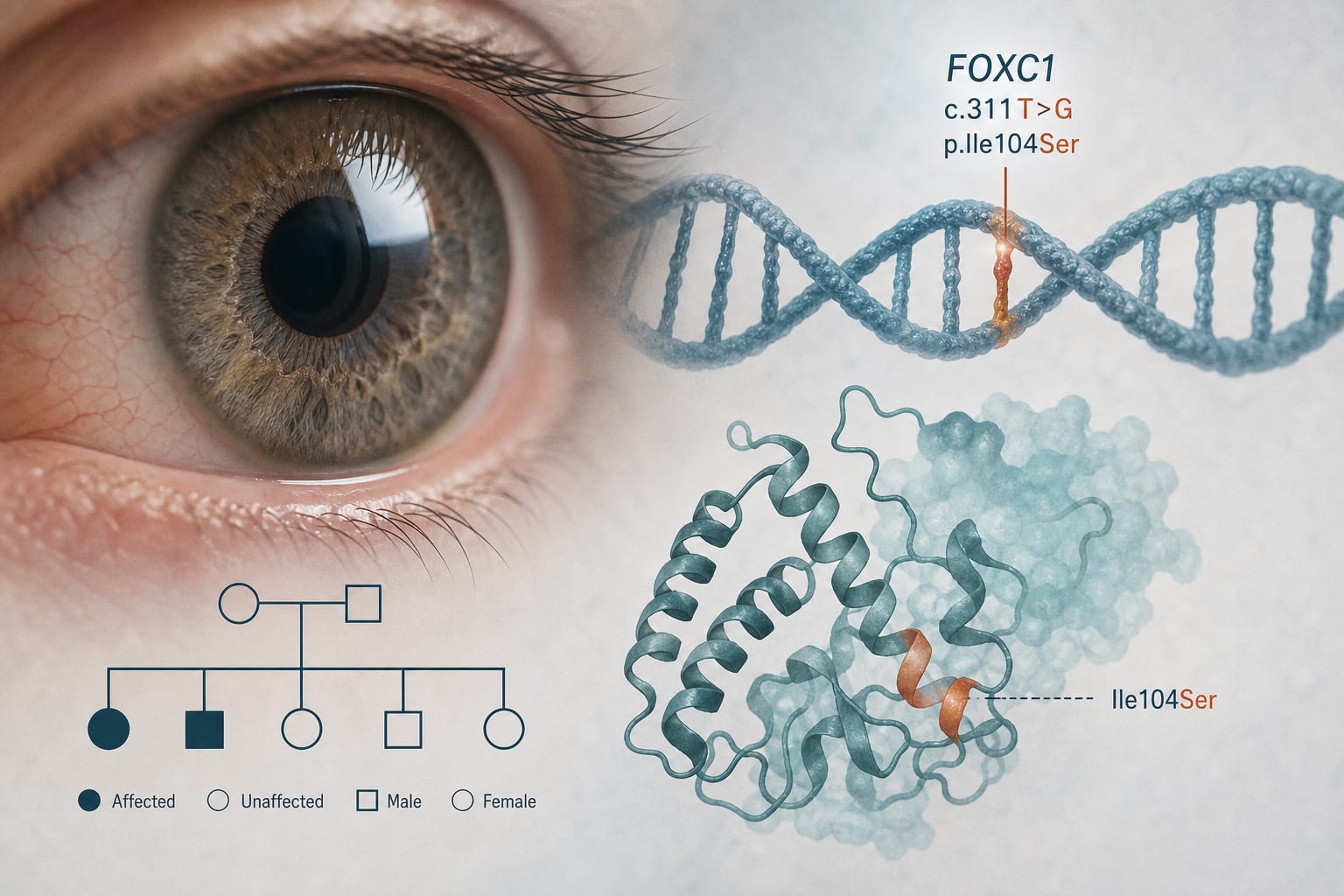
Case Study: Identification of a New FOXC1 Variant c.311T>G (p.Ile104Ser) in a Chinese Family Affected by Axenfeld-Rieger Syndrome
-
By
-
Bin Lin
-
Li Li
-
Dong-kan Li
-
June 8, 2026
Clinical Report: Identification of a New FOXC1 Variant in Axenfeld-Rieger Syndrome
Overview
This report identifies a novel FOXC1 variant (c.311T>G, p.Ile104Ser) in a Chinese family affected by Axenfeld-Rieger syndrome (ARS), initially misdiagnosed with juvenile-onset open-angle glaucoma (JOAG). This misdiagnosis highlights the critical need for accurate genetic testing and systemic evaluation in patients with early-onset glaucoma to ensure appropriate management.
Background
Axenfeld-Rieger syndrome (ARS) is an autosomal dominant disorder often linked to FOXC1 variants, leading to severe early-onset glaucoma. Accurate diagnosis is critical, as ARS can mimic juvenile-onset open-angle glaucoma (JOAG), complicating clinical management. Key clinical features of ARS include anterior segment dysgenesis, facial anomalies, and systemic associations. Understanding the genetic basis of ARS can improve patient outcomes and inform genetic counseling.
Data Highlights
The novel FOXC1 variant c.311T>G (p.Ile104Ser) was identified in a Chinese family, showing incomplete penetrance in an unaffected carrier father, indicating the complexity of genetic expression.Key Findings
Proband and sister initially diagnosed with JOAG presented with anterior segment dysgenesis, which is a hallmark of ARS. Identified a novel heterozygous missense variant c.311T>G (p.Ile104Ser) in FOXC1, absent from the East Asian population in gnomAD and predicted to be highly deleterious. The variant co-segregated with the disease phenotype in the family, while incomplete penetrance was observed in the unaffected father carrying the same variant, emphasizing the need for careful clinical evaluation.Clinical Implications
Clinicians should consider genetic testing for FOXC1 variants in patients with early-onset glaucoma, especially when systemic features of ARS are present. Early identification of ARS can prevent misdiagnosis and ensure appropriate management of glaucoma, potentially altering treatment approaches.
Conclusion
The identification of the FOXC1 variant expands the genotypic spectrum of FOXC1-related disorders and highlights the necessity of thorough clinical evaluations and genetic counseling in cases of early-onset glaucoma.
Related Resources & Content
- Frontiers in Medicine, 2026 -- Identification and pathogenicity analysis of a novel intronic COL4A5 variant in a Chinese family
- conexiant, 2026 -- FOXC1 Duplications Linked to Early-Onset Glaucoma
- Clinical practice guideline for anterior segment dysgenesis | Japanese Journal of Ophthalmology, 2026
- Axenfeld-Rieger syndrome: more than meets the eye - PMC, 2023
- Acta Neuropathologica — C9orf72 GGGGCC Repeat Expansion Homozygosity in Frontotemporal Dementia
- Basic Research in Cardiology — Variants in the Coding and Non-coding Regions of the SHOX2 Gene Associated with Early-Onset Atrial Fibrillation
- Axenfeld-Rieger syndrome: more than meets the eye - PMC
- Clinical practice guideline for anterior segment dysgenesis | Japanese Journal of Ophthalmology | Springer Nature Link
- Surgical Outcomes in Axenfeld-Rieger Syndrome: A Multicenter Retrospective Analysis - University of Miami
Based on findings from:
Case Report: Novel FOXC1 variant c.311T>G (p.Ile104Ser) in a Chinese family with Axenfeld-Rieger syndrome
Bin Lin, Li Li, Dong-kan Li. Frontiers In Medicine, 2026.
https://www.frontiersin.org/journals/medicine/articles/10.3389/fmed.2026.1868263/full
This content is an AI-generated, fully rewritten summary based on a published scholarly article. It does not reproduce the original text and is not a substitute for the original publication. Readers are encouraged to consult the source for full context, data, and methodology.