Interpreting Tracheal High-Flow Dynamics During Spontaneous Breathing Trials: Insights Beyond Inspiratory Effort
-
By
-
Li-Xia Xu
-
September 7, 2026
Clinical Report: Interpreting Tracheal High-Flow Dynamics During SBTs
Background
Spontaneous breathing trials (SBTs) are critical for assessing readiness for extubation in mechanically ventilated patients. The use of high-flow oxygen (HFO) during SBTs has gained attention, but its physiological implications and effectiveness compared to traditional methods require thorough evaluation.
Data Highlights
No numerical data or trial data provided in the source material.
Key Findings
- Inspiratory effort with tracheal HFO was similar to that observed during T-piece breathing.
- Post-extubation oxygen therapy varied among patients, complicating comparisons to SBT conditions.
- Esophageal pressure measurements were limited to 3 minutes post-extubation, affecting data interpretation.
- Exclusion of patients requiring immediate reintubation may bias the analysis of SBT outcomes.
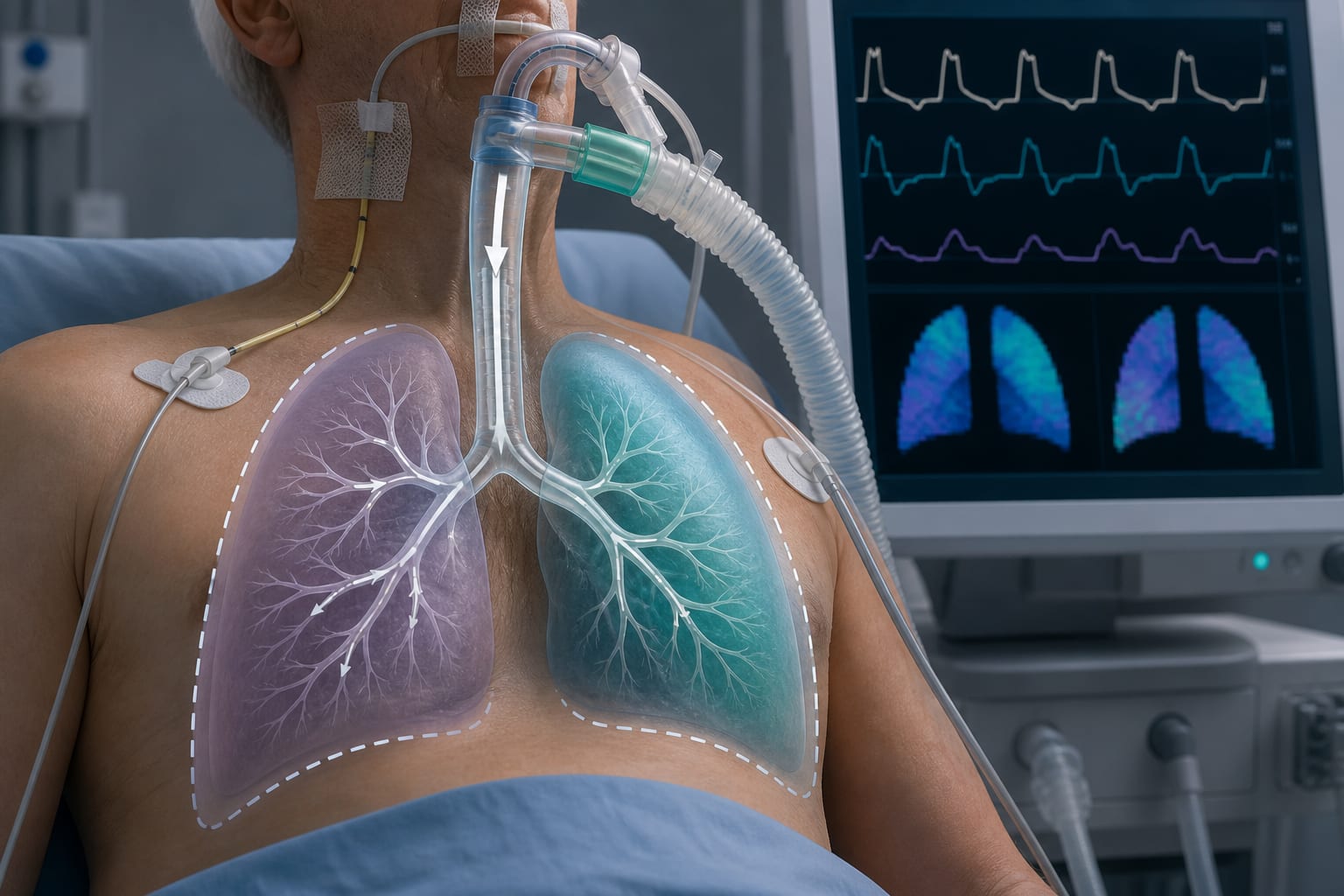
- Tracheal HFO maintained end-expiratory lung volume and improved oxygenation and ventilation homogeneity.
Clinical Implications
Clinicians should consider the physiological support provided by tracheal HFO when interpreting inspiratory effort during SBTs. The findings suggest that while inspiratory effort may appear comparable, the full physiological challenge of an unsupported SBT may not be replicated.
Conclusion
The study highlights the complexities of interpreting inspiratory effort during SBTs with tracheal HFO. Further research is needed to clarify the implications of these findings for clinical practice.
Related Resources & Content
- Xu et al., Critical Care, 2022 -- Effect of high-flow oxygen versus T-piece ventilation strategies during spontaneous breathing trials on weaning failure among patients receiving mechanical ventilation: a randomized controlled trial
- AARC, 2024 -- Guidelines for Spontaneous Breathing Trials
- Critical Care — The effect of asymmetrical vs. symmetrical high flow nasal cannula on inspiratory effort
- European Radiology — Three-Dimensional MR Spirometry Reveals Functional Characteristics of Normal Human Respiratory Dynamics
- Critical Care (Springer) — Assessment of inspiratory effort using airway occlusion pressure (ΔPocc) during non-invasive ventilation: a post-Hoc exploratory analysis
- Intensive Care Medicine — Highlights from Intensive Care Medicine 2012: Focus on Noninvasive Ventilation, Patient Monitoring, Ventilator Interactions, Acute Respiratory Distress Syndrome, Sedation Practices, Pediatric Considerations, and Additional Topics
- Assessment of inspiratory effort using airway occlusion pressure during non-invasive ventilation
- Three-Dimensional MR Spirometry Reveals Functional Characteristics of Normal Human Respiratory Dynamics
- DE-RESC240019 1..11
- Effect of high-flow oxygen versus T-piece ventilation strategies during spontaneous breathing trials on weaning failure among patients receiving mechanical ventilation: a randomized controlled trial - PMC
- ERS clinical practice guidelines: high-flow nasal cannula in acute respiratory failure | European Respiratory Society
Based on findings from:
Beyond similar inspiratory effort: interpreting tracheal high-flow during spontaneous breathing trials
Li-Xia Xu. Critical Care, 2026.
https://link.springer.com/article/10.1186/s13054-026-06312-2
This content is an AI-generated, fully rewritten summary based on a published scholarly article. It does not reproduce the original text and is not a substitute for the original publication. Readers are encouraged to consult the source for full context, data, and methodology.