Neutrophil-to-lymphocyte ratio is associated with early cervical shortening after cerclage: a single-center cohort study integrating C-reactive protein - Report - MDSpire
Advertisement
Neutrophil-to-lymphocyte ratio is associated with early cervical shortening after cerclage: a single-center cohort study integrating C-reactive protein
Association of Neutrophil-to-Lymphocyte Ratio with Early Cervical Shortening Following Cerclage
Overview
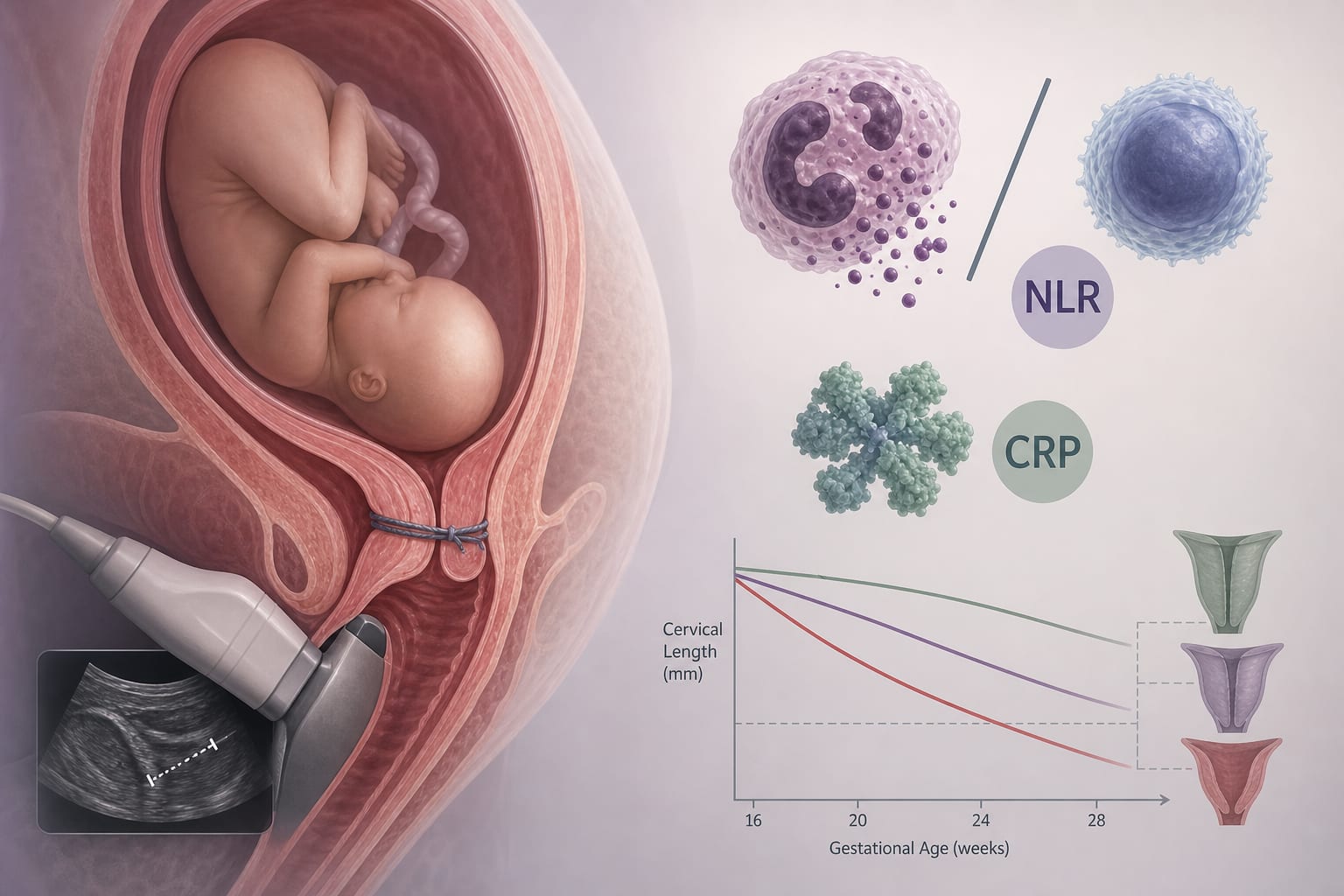
This study investigates the correlation between pre-operative neutrophil-to-lymphocyte ratio (NLR) and C-reactive protein (CRP) levels with early cervical shortening post-cerclage. Findings suggest that higher NLR is associated with increased cervical shortening and spontaneous preterm birth rates.
Background
Cervical cerclage is a common intervention for cervical insufficiency, yet a significant percentage of treated pregnancies still result in preterm birth. Understanding the role of systemic inflammation, as indicated by NLR and CRP, may help identify patients at higher risk for adverse outcomes following cerclage.
Data Highlights
Measure
Result
NLR correlation with CL shortening
r = 0.61, p < 0.001
CL shortening per 1-unit increase in NLR
0.09 mm/week
PTB before 32 weeks in high-NLR without atosiban
60.0%
PTB before 32 weeks in high-NLR with atosiban
14.3%
PTB before 32 weeks in low-NLR
0%
AUC for combined NLR and CRP predicting large shortening
0.81
Key Findings
Pre-operative NLR is significantly correlated with cervical length shortening post-cerclage.
Each 1-unit increase in NLR corresponds to an additional 0.09 mm/week of cervical shortening.
High-NLR women (≥3.5) without atosiban had a 60% rate of preterm birth before 32 weeks.
Atosiban use was associated with lower preterm birth rates in high-NLR women.
Combined NLR and CRP levels effectively predicted significant cervical shortening.
Findings are exploratory and require validation in larger, prospective studies.
Clinical Implications
Clinicians should consider the pre-operative NLR as a potential marker for assessing the risk of cervical shortening and preterm birth in patients undergoing cerclage. However, due to confounding factors, the clinical utility of atosiban in this context remains uncertain and warrants further investigation.
Conclusion
The study highlights the association between systemic inflammatory markers and cervical shortening post-cerclage, emphasizing the need for further research to validate these findings in larger cohorts.