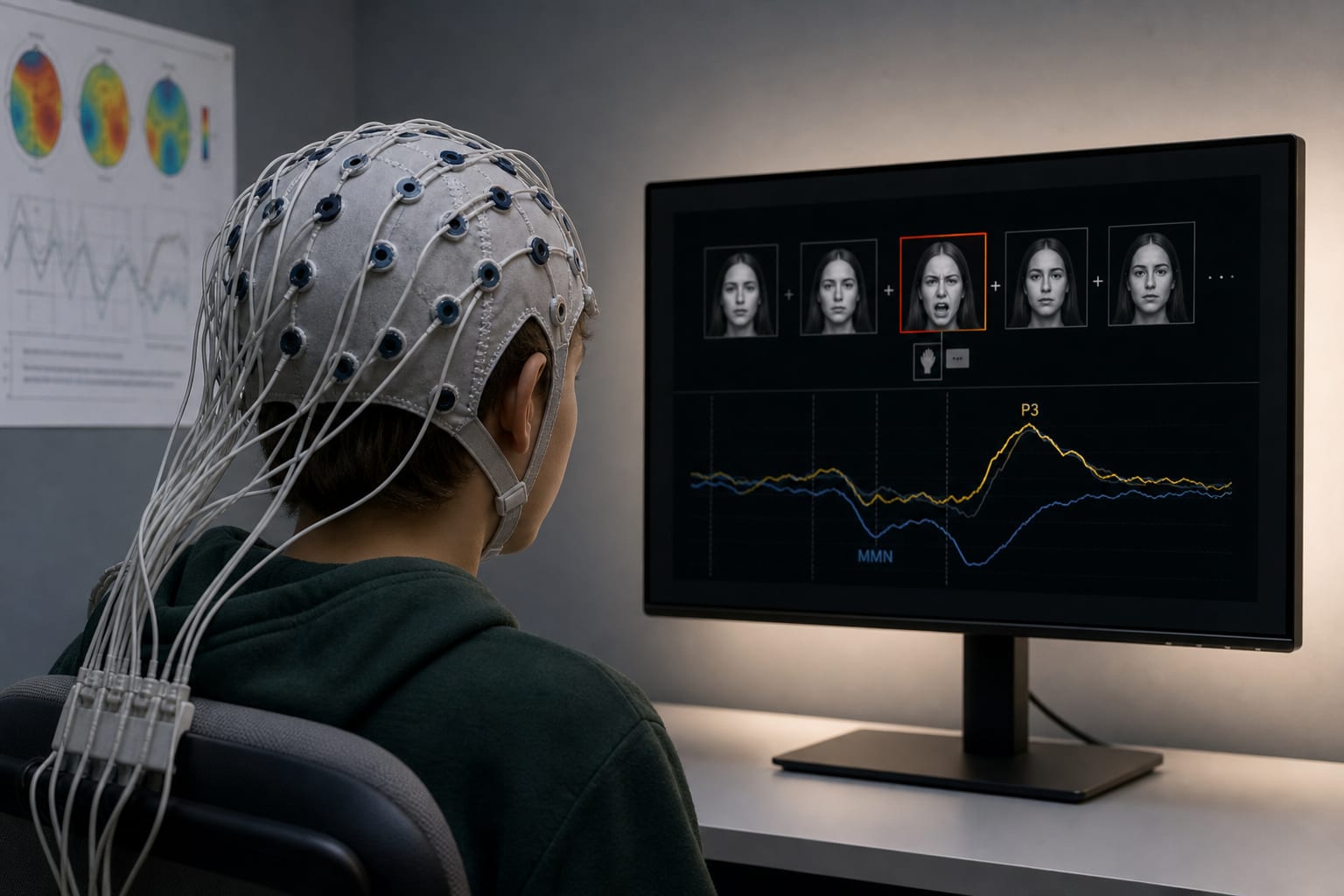
Clinical Report: Changes Over Time in MMN and P3 During Emotional Processing
Overview
This study investigates the effects of a 12-week clinical intervention on neurocognitive processing, specifically focusing on automatic negative bias and controlled evaluative processing in adolescents with nonsuicidal self-injury (NSSI).
Background
Nonsuicidal self-injury (NSSI) is a prevalent behavior among adolescents, often linked to emotional distress and significant psychosocial consequences. Understanding the neurocognitive mechanisms underlying NSSI is crucial for developing effective interventions. This study explores how clinical interventions can modify emotional processing in adolescents with NSSI, providing insights into potential biomarkers for treatment response.
Data Highlights
Measure
Baseline
Week 12
p-value
Self-injury ideation days
Data needed
Data needed
0.036
NSSI episode frequency
Data needed
Data needed
0.007
MMN amplitude to negative stimuli
Data needed
Data needed
0.047
P3 amplitude to negative stimuli
Data needed
Data needed
0.027
Key Findings
The clinical intervention reduced self-injury ideation days and NSSI episode frequency significantly.
P3 amplitude to negative stimuli increased, suggesting improved controlled evaluation of emotional information.
No significant changes were observed in responses to positive and neutral conditions.
Post-intervention correlations emerged between NSSI ideation days and positive P3 amplitude.
MMN and P3 may serve as biomarkers for tracking intervention responses in adolescents with NSSI.
Clinical Implications
The findings suggest that targeted clinical interventions can effectively modify neurocognitive processing in adolescents with NSSI. Clinicians may consider monitoring MMN and P3 as potential biomarkers to assess treatment efficacy and emotional processing improvements, integrating these measures into routine assessments.
Conclusion
This study highlights the potential of clinical interventions to alter neurocognitive processing in adolescents with NSSI, emphasizing the importance of understanding these mechanisms for effective treatment strategies, particularly in light of existing literature on emotion regulation.