Clinical Report: Adaptive Deep Brain Stimulation Enhances Gait in Parkinson's Disease
Overview
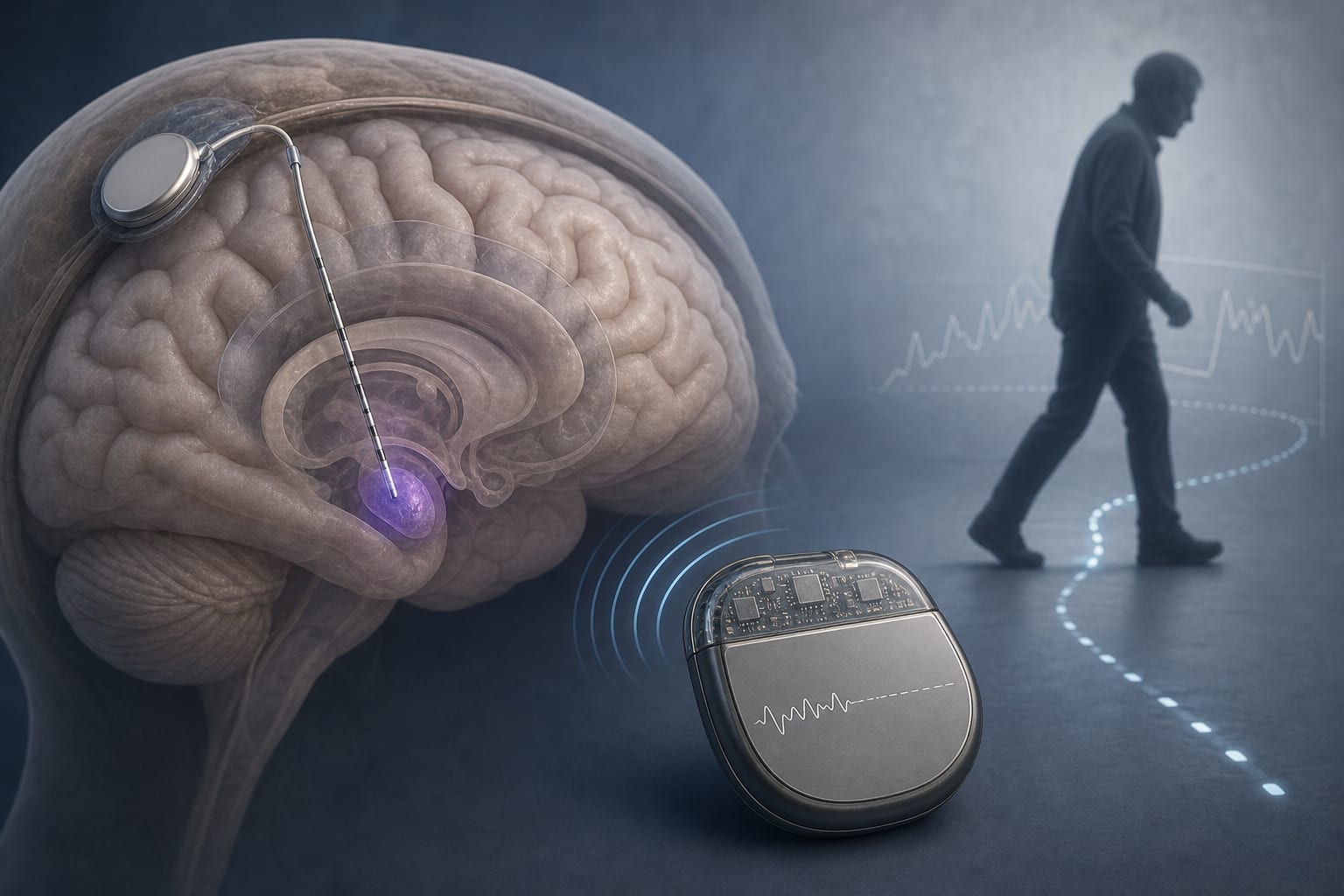
This study demonstrates that adaptive deep brain stimulation (aDBS) tailored to individual locomotor activities significantly improves gait function in patients with Parkinson's disease (PD). By utilizing real-time physiological data from the subthalamic nucleus (STN), the therapy addresses therapy-resistant locomotor deficits effectively.
Background
Parkinson's disease is associated with severe locomotor deficits that often remain unresponsive to standard treatments, including deep brain stimulation (DBS). Up to 90% of patients experience therapy-resistant impairments that increase fall risk and diminish quality of life. Optimizing DBS parameters to address these specific deficits is crucial for improving patient outcomes.
Data Highlights
{'format': 'Ensure proper JSON representation of the table.'}
Key Findings
Adaptive DBS (aDBS) can be personalized to enhance gait function in PD patients.
Real-time STN dynamics can be decoded to inform activity-dependent stimulation strategies.
35 individuals with advanced PD were enrolled, confirming the prevalence of locomotor impairments.
Conventional DBS parameters often fail to alleviate gait deficits and may worsen symptoms.
Machine learning techniques were employed to optimize stimulation based on individual mobility activities.
Clinical Implications
Clinicians should consider the implementation of adaptive DBS strategies to address locomotor deficits in patients with Parkinson's disease. Personalized stimulation based on real-time physiological data may enhance patient outcomes and reduce the risk of falls.
Conclusion
The findings support the potential of adaptive DBS as a viable therapeutic option for improving gait function in Parkinson's disease, emphasizing the need for personalized treatment approaches.
Dizziness is one of the most common yet complex complaints encountered across primary care, neurology, otolaryngology, and cardiology. It can present as vertigo, imbalance, or nonspecific lightheadedness. It can leave both patients and physicians searching for clear answers.