Clinical Report: Inducible Nitric Oxide Synthase as a Crucial Factor in the Efficacy of Anti-PD-1 Treatment for Melanoma
Overview
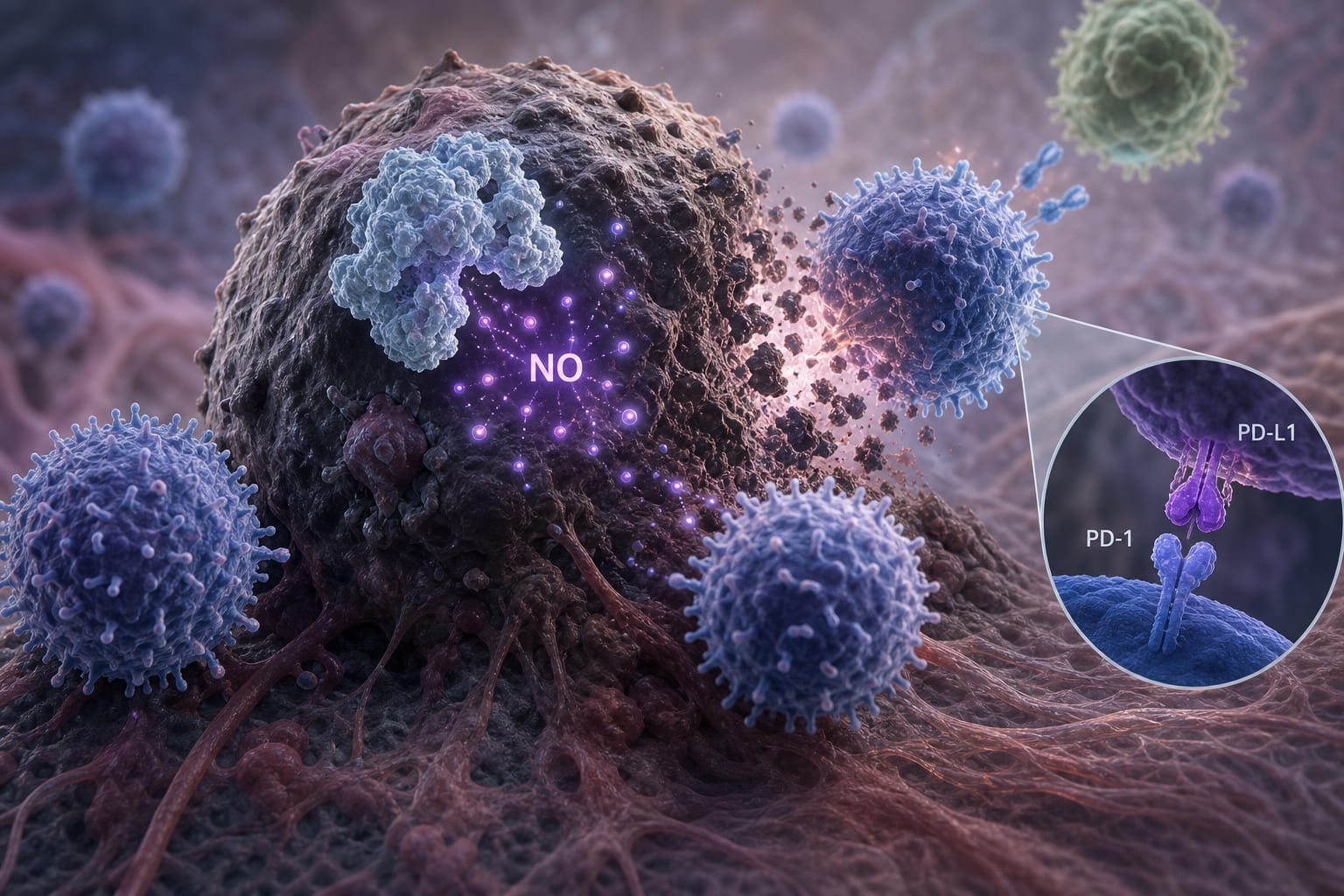
This study demonstrates that inducible nitric oxide synthase (iNOS) and its product, nitric oxide (NO), are essential for the efficacy of anti-PD-1 therapy in melanoma.
Background
Understanding the role of iNOS and NO in melanoma treatment is vital, as these factors have historically been associated with poor outcomes. This study aims to clarify the mechanisms by which iNOS influences the effectiveness of anti-PD-1 therapy.
Data Highlights
Parameter
iNOS KO Mice
Wild-Type Mice
Tumor Growth Rate
Significantly Faster
Slower
Response to Anti-PD-1
No Effect
Effective
Hazard Ratio for PFS (NO-producing dendritic cells)
0.453 (95% CI = 0.270-0.992; p=0.048)
Key Findings
iNOS KO mice exhibited significantly faster tumor growth compared to wild-type mice.
Anti-PD-1 therapy was ineffective in iNOS KO mice.
NO donors inhibited melanoma cell proliferation and induced apoptosis in vitro.
Transcriptomic analysis revealed that anti-PD-1 upregulated interferon pathway genes in wild-type but not iNOS KO mice.
A NO-producing dendritic-cell subset was associated with improved progression-free survival in melanoma patients receiving anti-PD-1 therapy.
Clinical Implications
The findings suggest that further investigation into the role of iNOS-derived NO in predicting response to anti-PD-1 therapy in melanoma patients is warranted.
Conclusion
iNOS-derived NO is crucial for the effectiveness of anti-PD-1 immunotherapy in melanoma, promoting interferon signaling and immune activation.
by Quang Tam Nguyen, Youngchul Kim, Thi Hong Nga Le, Saurabh Garg, Vishanna Balkaran, Trisha Bhathivi, Alejandra Chamizo, Christopher W. Dukes, Kimberly Ward, Andrew S. Brohl, Lilit Karapetyan, Nikhil I. Khushalani, Zeynep Eroglu, Ahmad A. Tarhini, James J. Mulé, Joseph Markowitz