Plasma HERV-K envelopE RNA: a minimally invasive biomarker for lung adenocarcinoma detection and prognostic assessment in the context of conventional serum tumor markers - Report - MDSpire

Plasma HERV-K envelopE RNA: a minimally invasive biomarker for lung adenocarcinoma detection and prognostic assessment in the context of conventional serum tumor markers

  • By

  • Fan Bu

  • Zi-Yan Jin

  • Zhi-Qiang Ling

  • July 1, 2026

  • 0 min

Share

Clinical Report: HERV-K EnvelopE RNA as a Biomarker for Lung Adenocarcinoma

Overview

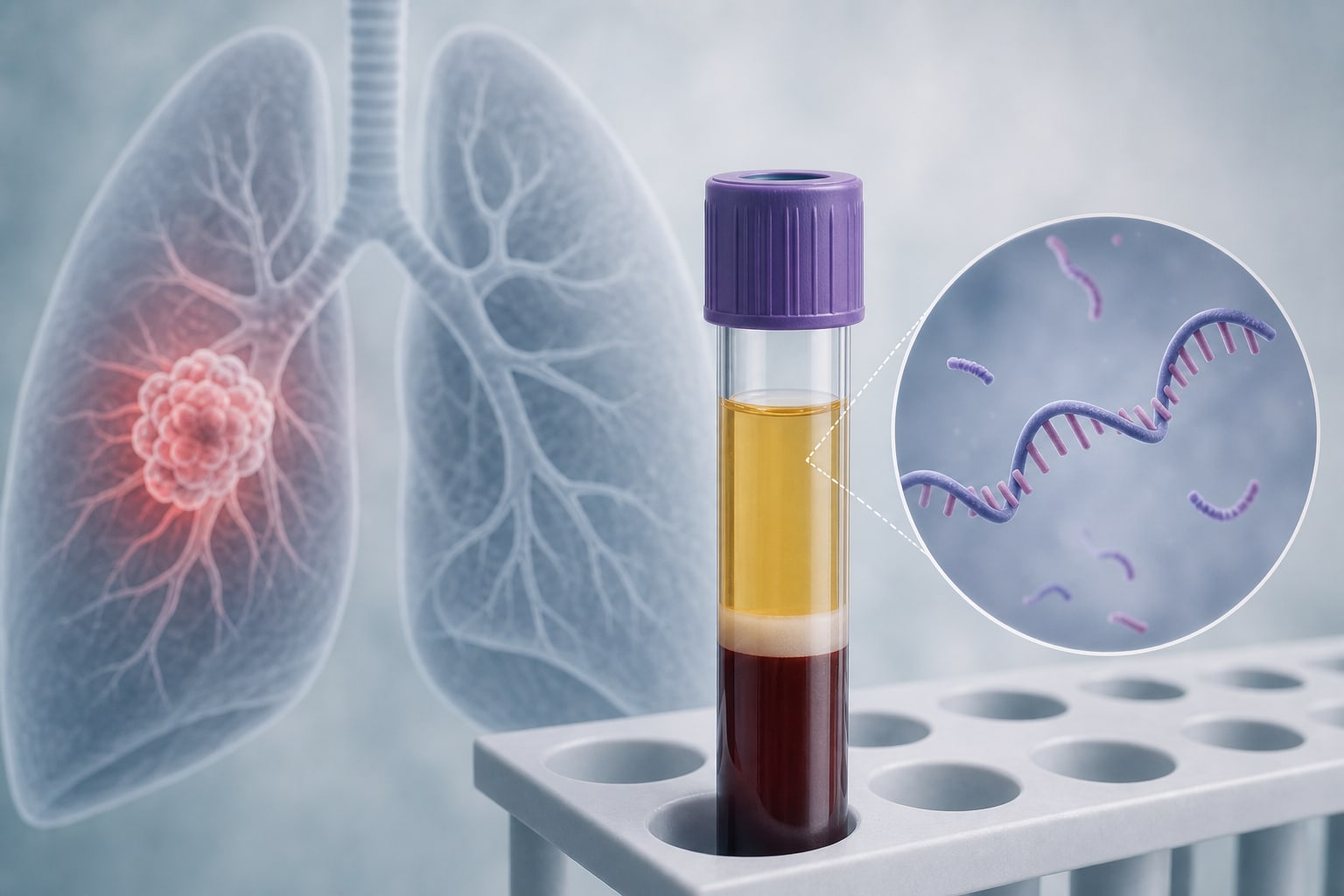
This study investigates the potential of plasma HERV-K env mRNA as a non-invasive biomarker for diagnosing lung adenocarcinoma (LUAD). The findings indicate that HERV-K env mRNA levels are significantly elevated in lung cancer patients compared to benign conditions.

Background

Lung adenocarcinoma (LUAD) is the most common subtype of lung cancer, and its early detection is crucial for improving patient outcomes. Current diagnostic methods, including low-dose computed tomography and serum tumor markers, have limitations in specificity and sensitivity.

Data Highlights

ParameterResult
HERV-K env mRNA in NSCLC tissues vs. adjacent tissuesP < 0.0001
HERV-K env mRNA in LUAD vs. LUSCP < 0.0001
Correlation of plasma HERV-K env mRNA with LUSC tissuer = 0.9025
Correlation of plasma HERV-K env mRNA with LUAD tissuer = 0.7305
ROC AUC for stage I/II LUAD vs. healthy controls0.914
Overall survival association with high plasma HERV-K env mRNA in LUADP = 0.035

Key Findings

  • HERV-K env mRNA is significantly upregulated in NSCLC tissues compared to adjacent tissues.
  • Plasma HERV-K env mRNA levels are elevated in lung cancer patients compared to benign nodules and healthy controls.
  • Strong correlation exists between plasma HERV-K env mRNA and tissue expression in both LUAD and LUSC.
  • High plasma HERV-K env mRNA is associated with poorer overall survival in LUAD patients.
  • ROC analysis indicates excellent diagnostic performance for stage I/II LUAD.

Clinical Implications

Further validation in larger, multicenter studies is necessary to establish the clinical utility of plasma HERV-K env mRNA.

Conclusion

Plasma HERV-K env mRNA may serve as a biomarker for lung adenocarcinoma. Future studies are needed to confirm these findings.

Related Resources & Content

  1. The ASCO Post, 2012 -- Targeting Human Endogenous Retrovirus K Envelope Protein Inhibits Breast Cancer Growth
  2. Frontiers in Oncology, 2026 -- An expression signature of 19 human endogenous retroviruses identifies immunogenic luminal breast cancers likely to respond to immunotherapy
  3. Frontiers in Oncology, 2026 -- Peripheral Immune Cell Profiles and Tumor Marker Expression in High-Risk HPV-Infected Cervical Lesions: A Comparative Study
  4. Final Recommendation Statement: Lung Cancer: Screening | United States Preventive Services Taskforce
  5. NCCN Guidelines® Insights: Non-Small Cell Lung Cancer, Version 7.2025 - PubMed
  6. the new gastroenterologist — Cell-free DNA testing shows promise for early liver cancer detection
  7. Final Recommendation Statement: Lung Cancer: Screening | United States Preventive Services Taskforce
  8. NCCN Guidelines® Insights: Non-Small Cell Lung Cancer, Version 7.2025 - PubMed
  9. Circulating cell-free DNA methylation as biomarker for lung cancer detection: a systematic review and meta-analysis of diagnostic studies | Systematic Reviews | Springer Nature Link

Original Source(s)

Related Content