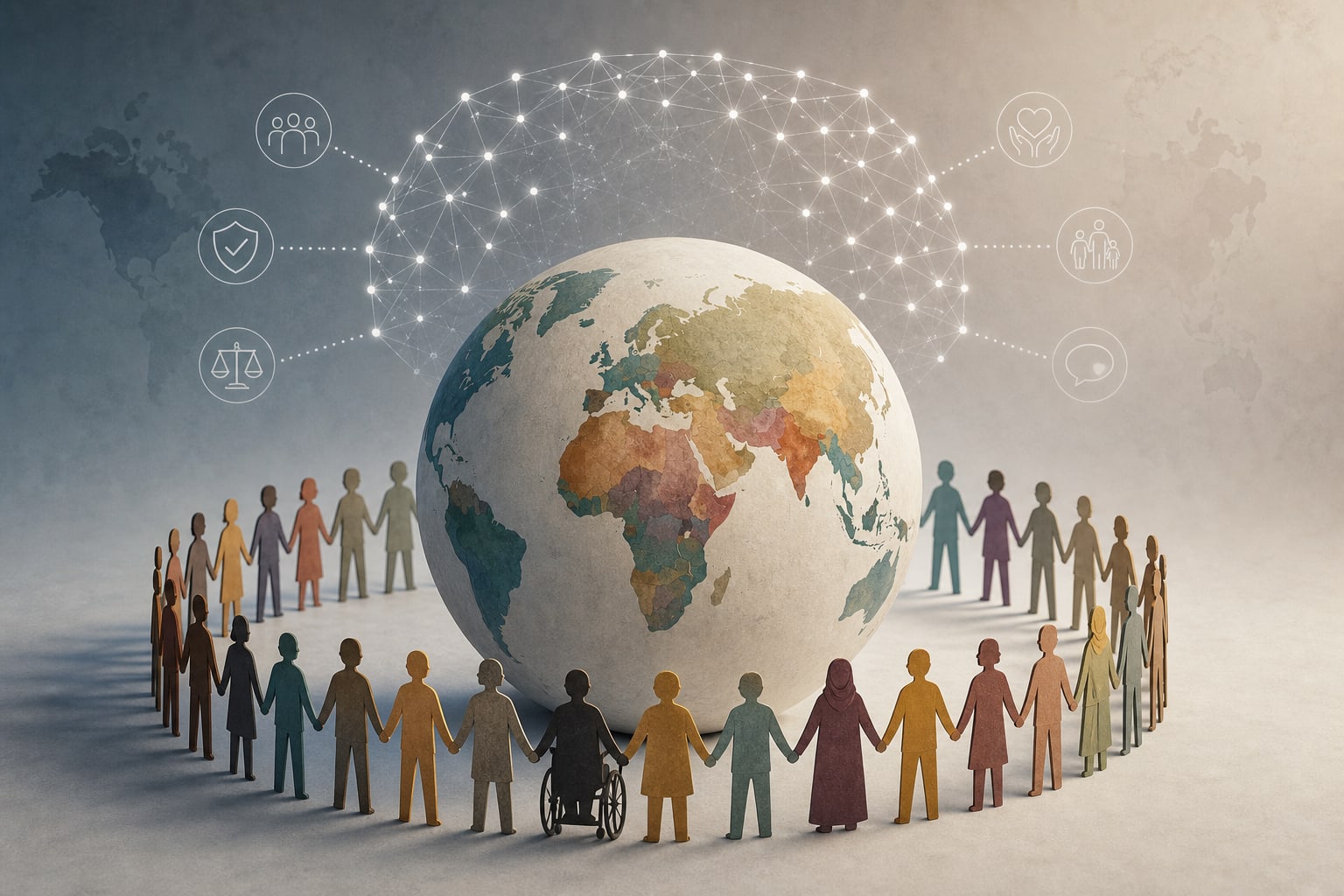
Editorial: Psychological health in the digital age across global communities
-
By
-
Xieyining Huang
-
Tali Gazit
-
June 22, 2026
-
0 min
Clinical Report: Mental Well-Being in the Digital Era Among Global Populations
Overview
This editorial discusses the urgent need for a global majority perspective on mental well-being in the digital age, highlighting the disparities in digital product development and its implications for psychological health. It emphasizes the role of psychologists and psychiatrists in addressing these challenges and advancing research focused on the Global Majority.
Background
The rapid advancement of digital technologies, particularly AI, has predominantly been driven by high-income regions, while the majority of users reside in emerging and developing economies. This disparity can lead to the embedding of Western cultural assumptions in widely adopted digital products, potentially causing systematic harms. Understanding these dynamics is crucial for ensuring equitable mental health outcomes across diverse populations.
Data Highlights
No specific numerical data or trial data was provided in the source material.
Key Findings
- Digital adoption is rising fastest in developing markets, creating a power asymmetry in digital product development.
- Social media can provide emotional support but also poses risks through design features like infinite scroll and beauty filters.
- Stronger self-regulation among adolescents can mitigate excessive digital media use.
- Loneliness is both a contributor to and a result of problematic digital use among youth.
- Content moderators in the Global Majority face unique psychological challenges that require targeted interventions.
Clinical Implications
Psychologists and psychiatrists are encouraged to engage in shaping user safety and well-being in digital contexts. There is a need for research that uplifts Global Majority perspectives to inform interventions and policy decisions.
Conclusion
The editorial calls for a deeper understanding of mental well-being in the digital era, particularly from the perspective of the Global Majority, to address the unique challenges faced by these populations.
Related Resources & Content
- Frontiers in Psychiatry, Editorial: The influence of internet and technology on mental health and psychological adjustment of young adults, 2026
- Frontiers in Psychiatry, Linking mental health and digital addiction in general population: an overview of thematic evolution and trends from a science mapping perspective, 2026
- DIGITAL HEALTH, The digital technology–well-being paradox: No link between digital use and life satisfaction in older adults, 2026
- npj Digital Medicine, Assessing Youth Mental Health Needs Through an Adaptive Digital Tool: Findings from a Cross-Sectional Analysis, 2026
- Mental Health Gap Action Programme (mhGAP) guideline for mental, neurological and substance use disorders: executive summary, WHO, 2025
- Systematic review and meta analysis of chatbots in the management of depressive and anxiety symptoms, npj Digital Medicine, 2026
- A guided chatbot-based psychological intervention for psychologically distressed older adolescents and young adults: a randomised clinical trial in Jordan, npj Digital Medicine, 2026
- Mental Health Gap Action Programme (mhGAP) guideline for mental, neurological and substance use disorders: executive summary
- Systematic review and meta analysis of chatbots in the management of depressive and anxiety symptoms | npj Digital Medicine
- A guided chatbot-based psychological intervention for psychologically distressed older adolescents and young adults: a randomised clinical trial in Jordan | npj Digital Medicine
This content is an AI-generated, fully rewritten summary based on a published scholarly article. It does not reproduce the original text and is not a substitute for the original publication. Readers are encouraged to consult the source for full context, data, and methodology.