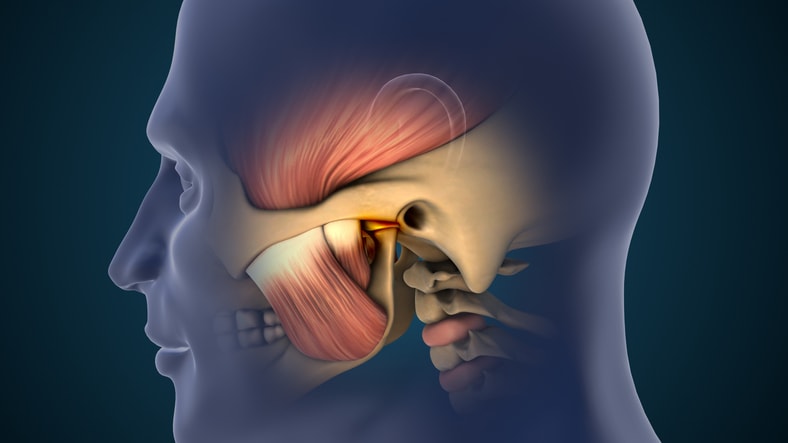
Clinical Report: PsA may be linked to jaw limitations
Overview
In a prospective, controlled cross-sectional study of 105 patients with psoriasis and 73 matched controls, jaw functional limitation was greater among patients with psoriatic arthritis (PsA) than among those without PsA. Psoriasis severity was independently associated with poorer sleep quality, while biologic treatment status was associated with better sleep quality; the study design does not establish treatment effects.
Background
Psoriasis can coexist with PsA, which involves musculoskeletal disease as well as skin manifestations. The study assessed temporomandibular function and sleep because both may be affected in people with psoriasis. Current PsA guidance uses a domain-based, treat-to-target approach that considers joint and skin involvement when selecting therapy. The study authors identified PsA-associated temporomandibular functional limitation as their principal novel finding.
Data Highlights
| Measure or comparison | Findings |
|---|---|
| Study population | 178 participants: 105 patients with psoriasis and 73 age- and sex-matched controls |
| JFLS-20 by PsA status | Mean score 0.80 with PsA vs. 0.45 without PsA |
| JFLS-20 by group | Healthy controls, 0.52; no systemic therapy, 0.54; nonbiologic systemic therapy, 0.59; biologics, 0.51 |
| Poor sleep quality (PSQI >5) | No systemic therapy, 60%; nonbiologic systemic therapy, 60%; biologics, 7%; healthy controls, 10% |
| Mean PSQI score | No systemic therapy, 6.05; nonbiologic systemic therapy, 5.70; biologics, 4.23; healthy controls, 4.05 |
| Mean PASI score | Biologics, 1.57; no systemic therapy, 7.19; nonbiologic systemic therapy, 6.89 |
| PsA subgroup by biologic status | Mean JFLS-20: 0.67 with biologics vs. 0.92 without; mean PSQI: 4.25 vs. 7.00 |
Key Findings
- PsA status was independently associated with greater jaw functional limitation after adjustment for the reported covariates; skin disease severity and biologic treatment status were not independently associated with jaw function.
- Jaw limitation was not significantly greater in the overall psoriasis group than in healthy controls, and group mean JFLS-20 scores were similar.
- Higher PASI scores remained independently associated with poorer sleep quality, while biologic treatment status was associated with better sleep quality; PsA status was not independently associated with sleep quality.
- Among patients with PsA, those receiving biologics had lower mean jaw limitation and PSQI scores than those not receiving biologics, but exploratory comparisons could not determine whether treatment accounted for these differences.
- No statistically significant differences in psoriasis severity, jaw function, or sleep quality were observed between the IL-17/IL-17A/F and IL-23 inhibitor groups.
- Limitations included the single-center cross-sectional design, small sample, patient-reported measures without objective dental or sleep assessments, unadjusted multiple exploratory comparisons, and exclusion of patients receiving tumor necrosis factor inhibitors.
Clinical Implications
The study findings support attention to jaw functional symptoms in patients with psoriasis and PsA, while they do not establish that biologic therapy improves jaw function or sleep. The authors noted that treatment-related associations are difficult to separate from differences in disease activity and treatment response.
Conclusion
In this study, PsA was independently associated with greater jaw functional limitation, whereas poorer sleep was associated with greater skin disease severity. The cross-sectional findings and study limitations preclude causal conclusions about treatment effects.
Related Resources & Content
- Karakoyun Ö, et al., Skin Health and Disease, 2026 -- Sleep quality and temporomandibular joint function in psoriasis: a prospective controlled study
- Gossec L, et al., Annals of the Rheumatic Diseases, 2024 -- EULAR recommendations for the management of psoriatic arthritis with pharmacological therapies: 2023 update
- Ritchlin CT, et al., Nature Reviews Rheumatology, 2025 -- Consensus definitions of complex-to-manage and treatment-refractory psoriatic arthritis: a GRAPPA initiative
- inside dentistry — Potential Link Between Periodontal Disease and Prostatitis
- Arthritis & Rheumatology — Impact of Structural Damage on Functionality in Psoriatic Arthritis: Findings from a Longitudinal Cohort Study
- Arthritis Care & Research — Associations of Lifestyle-Related Factors and Psoriatic Arthritis Disease Activity: The Dutch South West Psoriatic Arthritis Study
- ASCO Publications — Assessment of immune status of patients with locally advanced cancer of the upper jaw.
- Sleep quality and temporomandibular joint function in psoriasis: a prospective controlled study
- Temporomandibular joint involvement in psoriatic arthritis: a prospective clinical and ultrasonographic study
- EULAR recommendations for the management of psoriatic arthritis with pharmacological therapies: 2023 update
- EULAR recommendations for the management of psoriatic arthritis with pharmacological therapies: 2023 update
- Diagnosis and therapeutic management of psoriatic arthritis: summary of 2024 update of the Spanish clinical practice guideline (ESPOGUIA)
- Consensus definitions of complex-to-manage and treatment-refractory psoriatic arthritis: a GRAPPA initiative | Nature Reviews Rheumatology
- Guideline for the diagnosis and treatment of psoriasis arthropathica (psoriatic arthritis) (2026 edition) - PMC
- Temporomandibular joint involvement in psoriatic arthritis: a prospective clinical and ultrasonographic study - PubMed
- Temporomandibular disorders in women with psoriatic arthritis by history of psoriasis: a cross-sectional study
- Temporomandibular Joint Involvement in Psoriatic Arthritis: An Underrecognized Manifestation.
- Sleep in psoriasis: A meta-analysis - PubMed
- Association between bruxism and inflammatory rheumatic diseases: is there a possible bidirectional relationship?
Based on findings from:
PsA may be linked to jaw limitations
Andrea Surnit. MDSpire News, 2026.
https://news.mdspire.com/dermatology/articles/psa-may-be-linked-to-jaw-limitations/
This content is an AI-generated, fully rewritten summary based on a published scholarly article. It does not reproduce the original text and is not a substitute for the original publication. Readers are encouraged to consult the source for full context, data, and methodology.