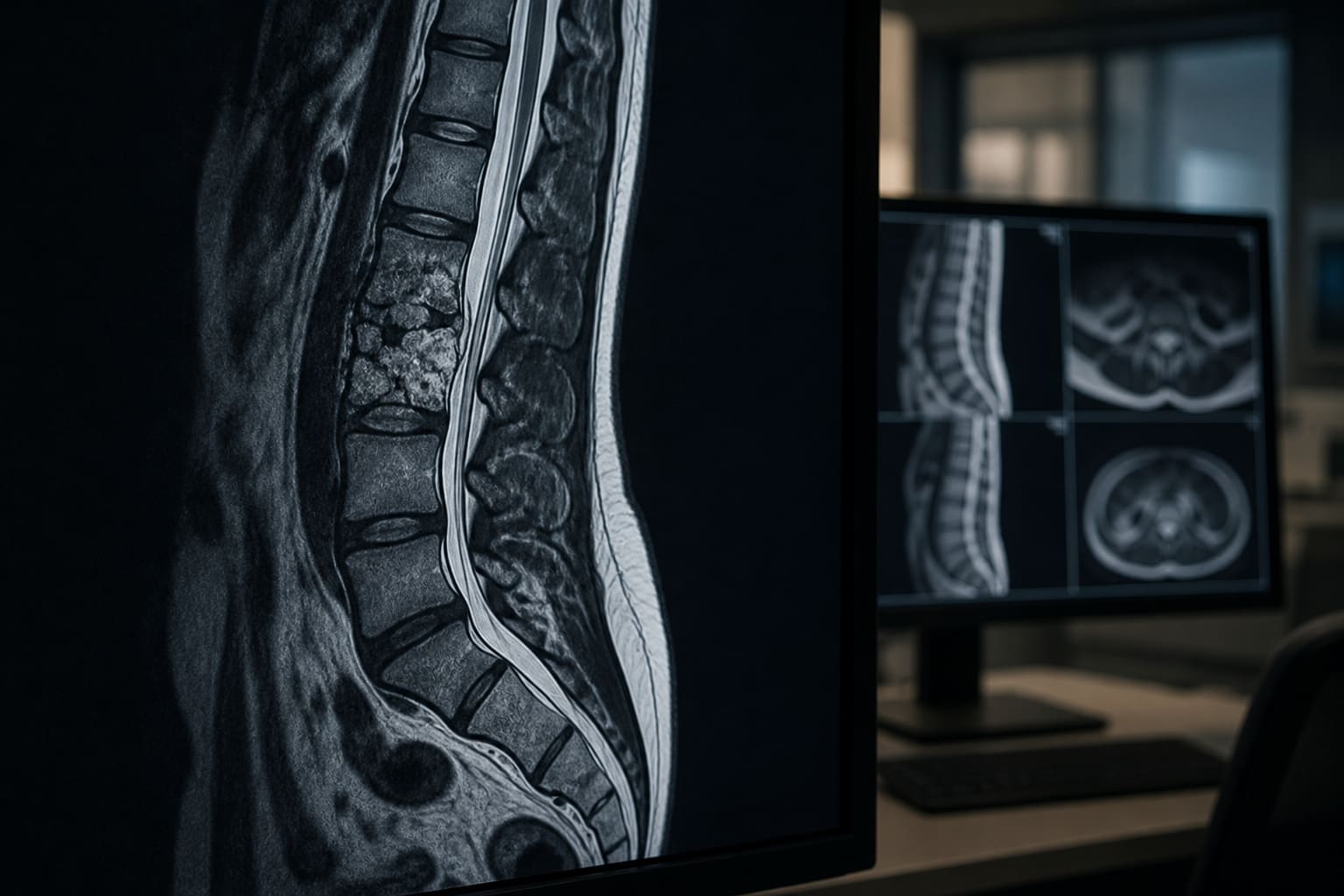
Clinical Report: Clinical and Imaging Outcomes in Spinal Tuberculosis
Overview
This retrospective study evaluated clinical and MRI findings, treatment duration, and outcomes in 62 patients with spinal tuberculosis (TB) at a London NHS Trust. Median treatment duration was 12 months. Clinical and radiological improvement was greater at 12 months than at 6 months, but the study lacked a control group to establish whether longer treatment was superior.
Background
Spinal TB is an extrapulmonary form of TB that may present insidiously with nonspecific symptoms and can lead to chronic pain, neurological abnormalities, or deformity. MRI is the preferred imaging modality, and whole-spine assessment is important because noncontiguous vertebral involvement may occur. Biopsy can support diagnosis where feasible. Treatment is primarily antituberculosis therapy, with surgery considered for spinal cord compression, neurological deficit, or instability. As summarized in the article, UK guidance recommends 6 months without additional central nervous system involvement, American Thoracic Society guidance favors 9 months with possible extension to 12 months according to severity, and World Health Organization guidance proposes 9 months.
Objective
To characterize clinical and radiological disease activity at diagnosis, mid-treatment, and treatment completion, alongside treatment duration and outcomes.
Approach
Consecutive patients diagnosed from 2011 through 2022 were identified through the National Tuberculosis Surveillance System. Eligible patients were aged 16 years or older and had confirmed or convincing MRI evidence of spinal TB, repeat MRI examinations, and clinical follow-up through 12 months.
A neuroradiologist blinded to clinical outcomes reviewed serial MRI scans using a five-domain severity score. A weighted clinical score assessed pain and neurological symptoms. Within-patient changes were analyzed using Wilcoxon signed-rank tests, and associations between clinical and MRI score changes were assessed using Spearman correlation.
Data Highlights
Measure | Source information |
|---|
Study design and setting | Retrospective cohort of consecutive patients attending a large London NHS Trust spinal TB clinic |
Study period | January 1, 2011, to December 31, 2022 |
Eligibility | Confirmed or convincing MRI evidence of spinal TB and at least two spinal MRI examinations |
Assessment schedule | At diagnosis, during mid-treatment (4–8 months), and near treatment completion (approximately 12 months after initiation) |
Imaging score domains | Active osteomyelitis/discitis; bone destruction; paravertebral or psoas collections; dural/intradural abnormalities; epidural abnormalities |
Long-term complication definition | Spinal TB-attributable condition persisting beyond 6 months after treatment completion |
Key Findings
Of 94 identified cases, 62 were evaluated after 32 were excluded for incomplete clinical data. Median age was 33 years; 73% were male, and 84% were migrants.
Median treatment duration was 12 months: 41 patients received 12 months, 7 received 6–11 months, and 14 received longer treatment.
Median MRI scores decreased from 7 at baseline to 3.5 at 6 months and 1 at 12 months. Twelve-month MRI assessments were available for 51 patients.
Improvement was greater at 12 months than at 6 months for both MRI scores (P < .001) and clinical scores (P = .003). Changes in clinical and MRI scores correlated at both time points.
Neck or back pain affected 55/62 patients (89%) at presentation and 29/57 (51%) at 12 months.
Three patients (5%) underwent surgery. Twelve (19%) experienced long-term complications, including chronic back pain, motor weakness, or residual urinary symptoms. No relapses or TB-related deaths occurred.
Interpretation
Continued clinical and radiological improvement between 6 and 12 months supports considering both assessments when individualizing treatment duration. However, the absence of a dedicated 6-month treatment comparison arm prevents conclusions about the superiority of longer therapy.
Clinical Implications
The authors recommend considering spinal TB in patients with acute or chronic back pain who have lived in countries with high TB incidence, even without neurological deficits. Serial MRI may help assess treatment response when interpreted alongside clinical findings. Persistent abnormalities, including bone destruction, do not necessarily indicate treatment failure; radiological resolution may lag behind clinical improvement and microbiological cure.
Limitations
Retrospective design and absence of a control group.
Exclusion of 32 cases because of incomplete clinical data.
Twelve-month clinical and MRI assessments available for 57 and 51 patients, respectively.
MRI scoring by one reader, preventing assessment of inter-reader reliability.
No dedicated comparison of 6-month and longer treatment courses.
Conclusion
Clinical and MRI findings improved during treatment, with greater improvement at 12 months than at 6 months. An individualized approach guided by clinical and radiological response may be warranted, but prospective randomized studies are needed to establish optimal treatment duration.
Related Resources & Content
Clinical and radiological outcomes of spinal tuberculosis: a retrospective study — Akhilesh Sharma, Rebekah Merriman, Sinead Foley, et al. — International Journal of Infectious Diseases. 2026;173:109153. doi:10.1016/j.ijid.2026.109153.
Tuberculosis NICE guideline — National Institute for Health and Care Excellence — NICE. 2016.
Official American Thoracic Society/Centers for Disease Control and Prevention/Infectious Diseases Society of America clinical practice guidelines: treatment of drug-susceptible tuberculosis — Nahid P, Dorman SE, Alipanah N, et al. — Clinical Infectious Diseases. 2016;63(7):e147–e195.
Spinal tuberculosis treatment: an enduring bone of contention — Garg D, Goyal V — Annals of Indian Academy of Neurology. 2020;23(4):441–448.