Disruption of a GalR2–mitochondrial axis in the ventral hippocampus contributes to depression-like phenotypes after prenatal stress - Report - MDSpire

Disruption of a GalR2–mitochondrial axis in the ventral hippocampus contributes to depression-like phenotypes after prenatal stress

  • By

  • Jingjing Yue

  • Jing Zhang

  • Xiaoyi Yu

  • Zhiheng Li

  • Yanhua Wang

  • Siyi Zhao

  • Yunfei Bai

  • Xiaoxiao Li

  • Hui Li

  • Yutao Yang

  • Zhi-Qing David Xu

  • June 8, 2026

  • 0 min

Share

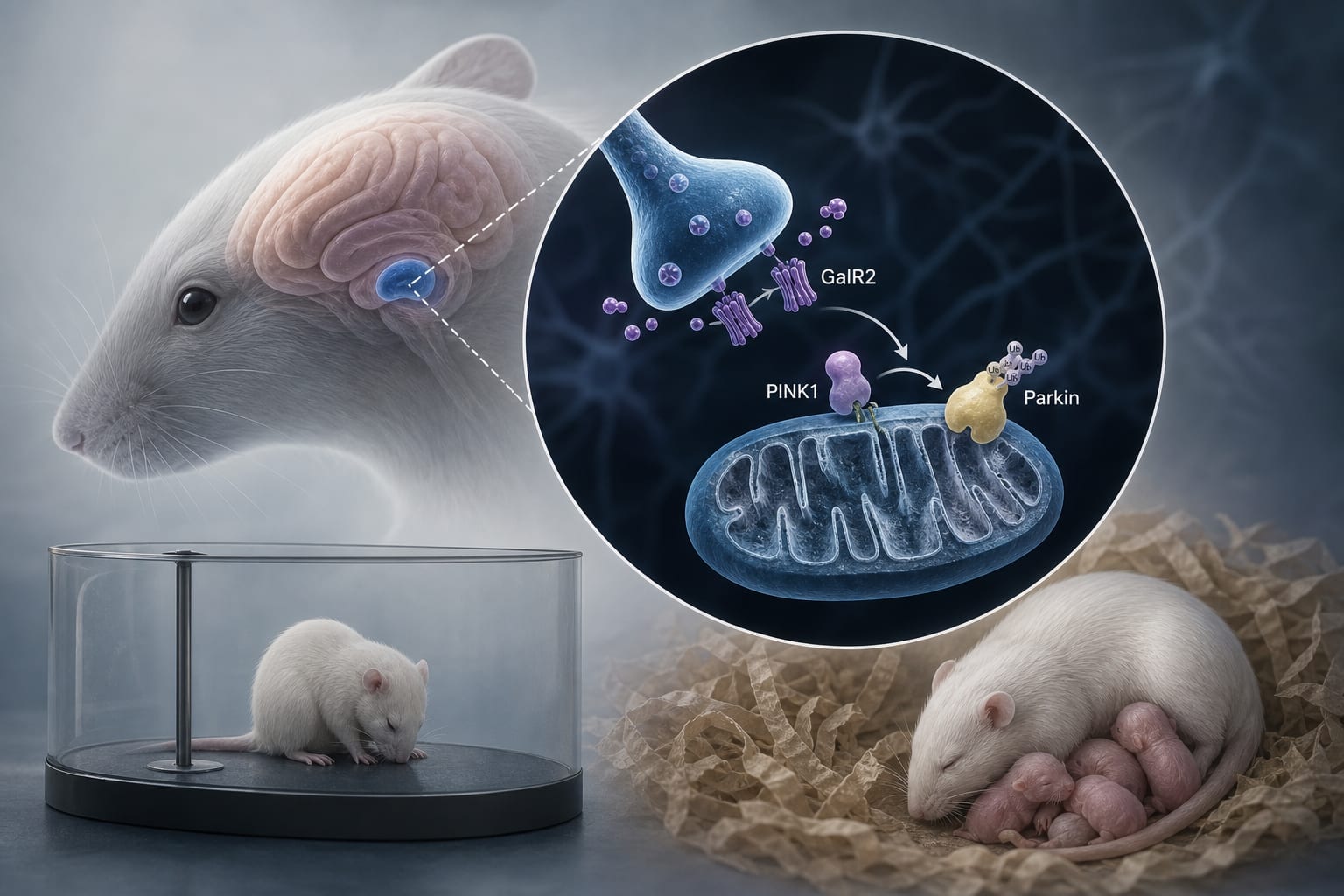
Alteration of the GalR2–mitochondrial pathway in the ventral hippocampus

Overview

Prenatal stress (PS) is linked to depression-like behaviors in adulthood, associated with mitochondrial dysfunction and altered GalR2 signaling in the ventral hippocampus (vHPC). Intranasal administration of the GalR2 agonist AR-M1896 shows potential in ameliorating these deficits.

Background

Prenatal stress is a significant risk factor for developing depression and other psychiatric disorders later in life. Understanding the cellular mechanisms that connect early-life adversity to long-term affective vulnerability is crucial for developing preventive strategies. This study investigates the role of GalR2 and mitochondrial function in the vHPC as potential mediators of these effects.

Data Highlights

ParameterFindings
Anhedonia-like behaviorInduced by PS
ATP productionReduced in PS offspring
GalR2 expressionDownregulated in PS offspring
PINK1/Parkin signalingImpaired in PS offspring
AR-M1896 effectsPartially normalized behaviors and mitochondrial function

Key Findings

  • Prenatal stress leads to persistent anhedonia-like behavior in adult offspring.
  • Mitochondrial structural abnormalities and reduced ATP production were observed in the vHPC of PS offspring.
  • Downregulation of GalR2 and PINK1/Parkin signaling was noted in PS-affected rats.
  • Intranasal AR-M1896 administration improved reward-related behaviors and mitochondrial dysfunction.
  • Direct infusion of AR-M1896 into the vHPC elevated ATP and PINK1/Parkin levels.

Clinical Implications

The findings suggest that targeting the GalR2-mitochondrial pathway may provide a novel therapeutic approach for depression linked to prenatal stress. Clinicians should consider the impact of early-life stress on long-term mental health and the potential for interventions that enhance mitochondrial function.

Conclusion

This study highlights the critical role of the GalR2-mitochondrial axis in the vHPC as a mediator of depression-like behaviors following prenatal stress. Further research may elucidate targeted therapies to mitigate these effects.

Related Resources & Content

  1. Frontiers in Neurology, 2026 -- Salvianolic acid B alleviates depression-like behaviors by reducing neuronal injury and promoting neurogenesis in a manner associated with JAK-STAT signaling pathway inhibition
  2. Brain, 2025 -- p75NTR modulation prevents cellular, cortical activity and cognitive dysfunctions caused by perinatal hypoxia
  3. Archives of Toxicology, 2015 -- Effects of Prenatal Bisphenol A Exposure on Neuronal Structure in the Hippocampal CA1 Region of Developing and Aged Mice
  4. The effect of prenatal maternal distress on offspring brain development: A systematic review - ScienceDirect
  5. Role of mitochondria-associated membranes in the hippocampus in the pathogenesis of depression - ScienceDirect
  6. Archives of Toxicology — Formation of Intracellular Fibrils, Calcification, and Accumulation of Chaperones and Cytoskeletal Proteins in the CA1 Region of the Hippocampus After Neonatal Exposure to the Nonprotein Amino Acid BMAA
  7. Epigenetics of prenatal stress in humans: the current research landscape
  8. Screening and Diagnosis of Mental Health Conditions During Pregnancy and Postpartum
  9. The effect of prenatal maternal distress on offspring brain development: A systematic review - ScienceDirect
  10. Role of mitochondria-associated membranes in the hippocampus in the pathogenesis of depression - ScienceDirect
  11. Final Recommendation Statement: Perinatal Depression: Preventive Interventions | United States Preventive Services Taskforce
  12. The efficacy of zuranolone versus placebo in postpartum depression and major depressive disorder: a systematic review and meta-analysis - PubMed
  13. Efficacy of non-pharmacological interventions for the prevention of antenatal depression: A systematic review and network meta-analysis - PubMed
  14. Enhancement of neurogenesis and cognition through intranasal co-delivery of galanin receptor 2 (GALR2) and neuropeptide Y receptor 1 (NPY1R) agonists: a potential pharmacological strategy for cognitive dysfunctions | Behavioral and Brain Functions | Springer Nature Link

Original Source(s)

Related Content