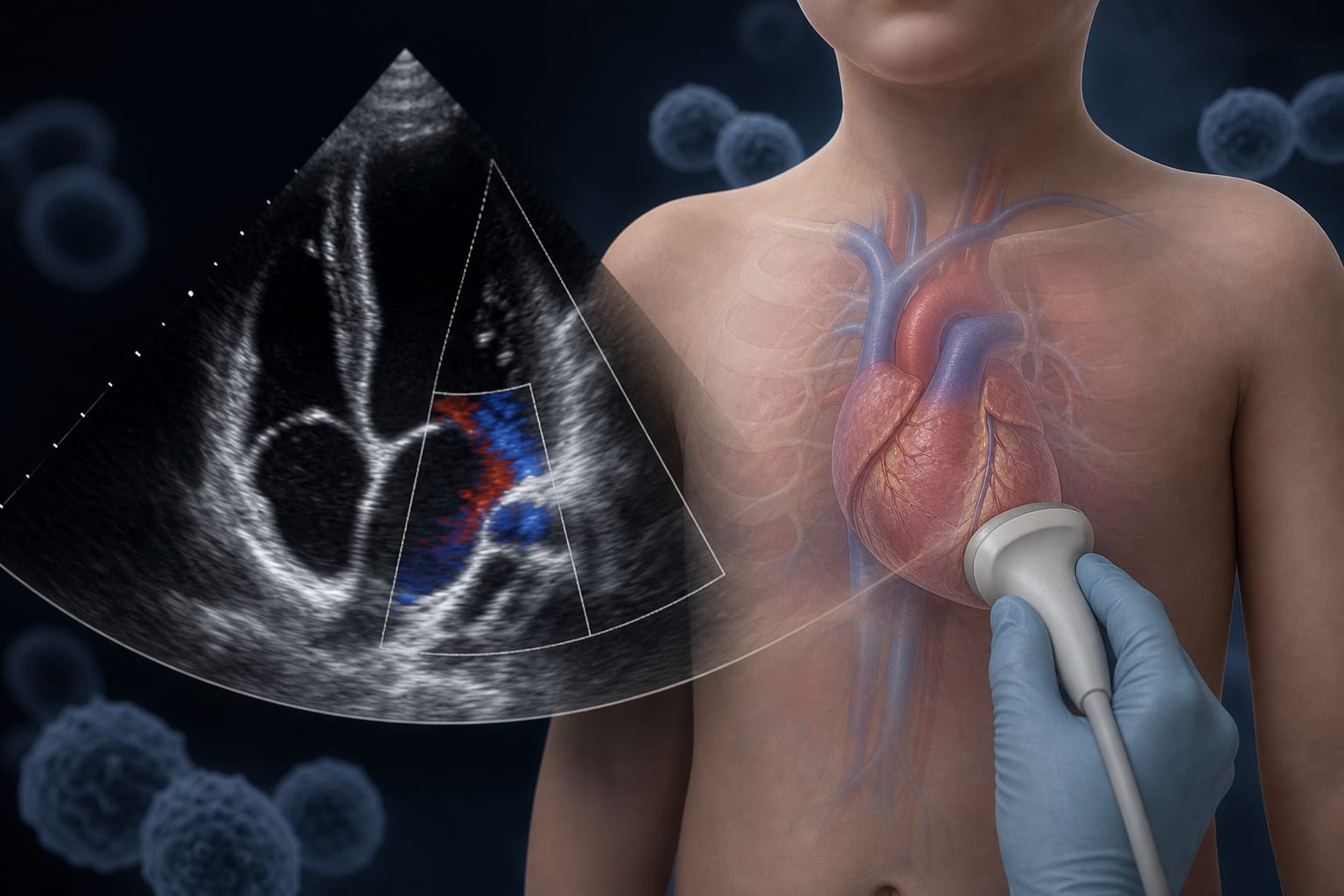
Transthoracic Echocardiography Utilization in Pediatric Patients with Staphylococcus aureus Bacteraemia: A Retrospective Study Across Multiple Centers
-
By
-
Kirsty Gray
-
Farhana Ahad
-
Aubrey Cunnington
-
June 19, 2026
Clinical Report: Transthoracic Echocardiography Utilization in Pediatric Patients
Overview
This study evaluated the utilization of transthoracic echocardiography (TTE) in pediatric patients with Staphylococcus aureus bacteraemia (SAB), finding that 5.6% of children undergoing TTE were diagnosed with infective endocarditis (IE), all with established risk factors.
Background
Staphylococcus aureus bacteraemia (SAB) poses a risk for developing infective endocarditis (IE), particularly in children with known risk factors. Understanding the appropriate use of TTE could optimize resource allocation and patient management.
Data Highlights
| Group | TTE (n=71) | No TTE (n=30) |
|---|---|---|
| IE Diagnosed | 4 (5.6%) | 0 |
| Median Hospital Stay (days) | 17 | 4 |
| Acute In-Hospital Mortality | 1 | 0 |
| Embolic Phenomena | 75% | 1.5% |
| Persistent Bacteraemia >72 hours | 67% | 4.9% |
| Polymicrobial Growth | 50% | 6% |
Key Findings
- 70% of children with SAB underwent TTE.
- IE was confirmed in 5.6% of children undergoing TTE, all with established risk factors.
- The TTE group had a significantly longer median hospital stay compared to the no-TTE group (17 vs 4 days).
- Embolic phenomena were significantly more common in the TTE group (75% vs 1.5%).
- Persistent bacteraemia at >72 hours was observed in 67% of the TTE group compared to 4.9% in the no-TTE group.
- Polymicrobial growth on blood culture was found in 50% of the TTE group versus 6% in the no-TTE group.
Clinical Implications
The findings suggest that TTE may be unnecessary in children with SAB who have no established risk factors for IE. A risk-stratified approach could help identify which patients require TTE, potentially reducing unnecessary procedures and hospital stays.
Conclusion
The study advocates for a risk-stratified approach to TTE in pediatric patients with SAB, emphasizing the need for prospective validation before routine changes in practice.
Related Resources & Content
- American Heart Association, Professional Heart Daily, 2015 -- Infective Endocarditis in Childhood: 2015 Update
- Clinical Infectious Diseases, Oxford Academic, 2024 -- Clinical Practice Guidelines by the Infectious Diseases Society of America for the Treatment of Methicillin-Resistant Staphylococcus aureus Infections in Adults and Children
- Clinical Infectious Diseases, Oxford Academic, 2023 -- 2023 Duke-International Society for Cardiovascular Infectious Diseases Criteria for Infective Endocarditis: Updating the Modified Duke Criteria
- Pediatric Cardiology — Assessment of Heart Function in Pediatric Patients Undergoing Liver Transplantation
- Pediatric Cardiology — Evaluating the Safety of Transseptal Puncture for Left Atrial Access in Pediatric Patients
- Pediatric Cardiology — Comprehensive Cardiac Assessment in Pediatric Patients with Multisystem Inflammatory Syndrome (MIS-C) Post-COVID-19 Using Conventional and Speckle-Tracking Echocardiography
- Pediatric Cardiology — Feasibility and Safety of Semi-Supine Exercise Stress Echocardiography in Pediatric and Adolescent Populations
- Infective Endocarditis in Childhood: 2015 Update - Professional Heart Daily | American Heart Association
- Clinical Practice Guidelines by the Infectious Diseases Society of America for the Treatment of Methicillin-Resistant Staphylococcus aureus Infections in Adults and Children | Clinical Infectious Diseases | Oxford Academic
- 2023 Duke-International Society for Cardiovascular Infectious Diseases Criteria for Infective Endocarditis: Updating the Modified Duke Criteria | Clinical Infectious Diseases | Oxford Academic
Based on findings from:
Transthoracic echocardiography in children with Staphylococcus aureus bacteraemia: a multi-centre retrospective analysis
Kirsty Gray, Farhana Ahad, Aubrey Cunnington. Bmj Paediatrics Open, 2026.
https://bmjpaedsopen.bmj.com/content/10/1/e004466
This content is an AI-generated, fully rewritten summary based on a published scholarly article. It does not reproduce the original text and is not a substitute for the original publication. Readers are encouraged to consult the source for full context, data, and methodology.