Predictors of early response to GnRH and gonadotropin therapy in pediatric patients with suspected dual congenital hypogonadotropic hypogonadism: a retrospective single-center study - Report - MDSpire

Predictors of early response to GnRH and gonadotropin therapy in pediatric patients with suspected dual congenital hypogonadotropic hypogonadism: a retrospective single-center study

  • By

  • Qin Zhang

  • Yi Wang

  • Bingyan Cao

  • Xinmeng Wang

  • Zheng Yuan

  • Xinyu Dou

  • Chunxiu Gong

  • May 29, 2026

  • 0 min

Share

Factors Influencing Initial Response to GnRH and Gonadotropin Treatment in Children

Overview

Expand on the implications of AMH and testosterone levels in treatment stratification.

Background

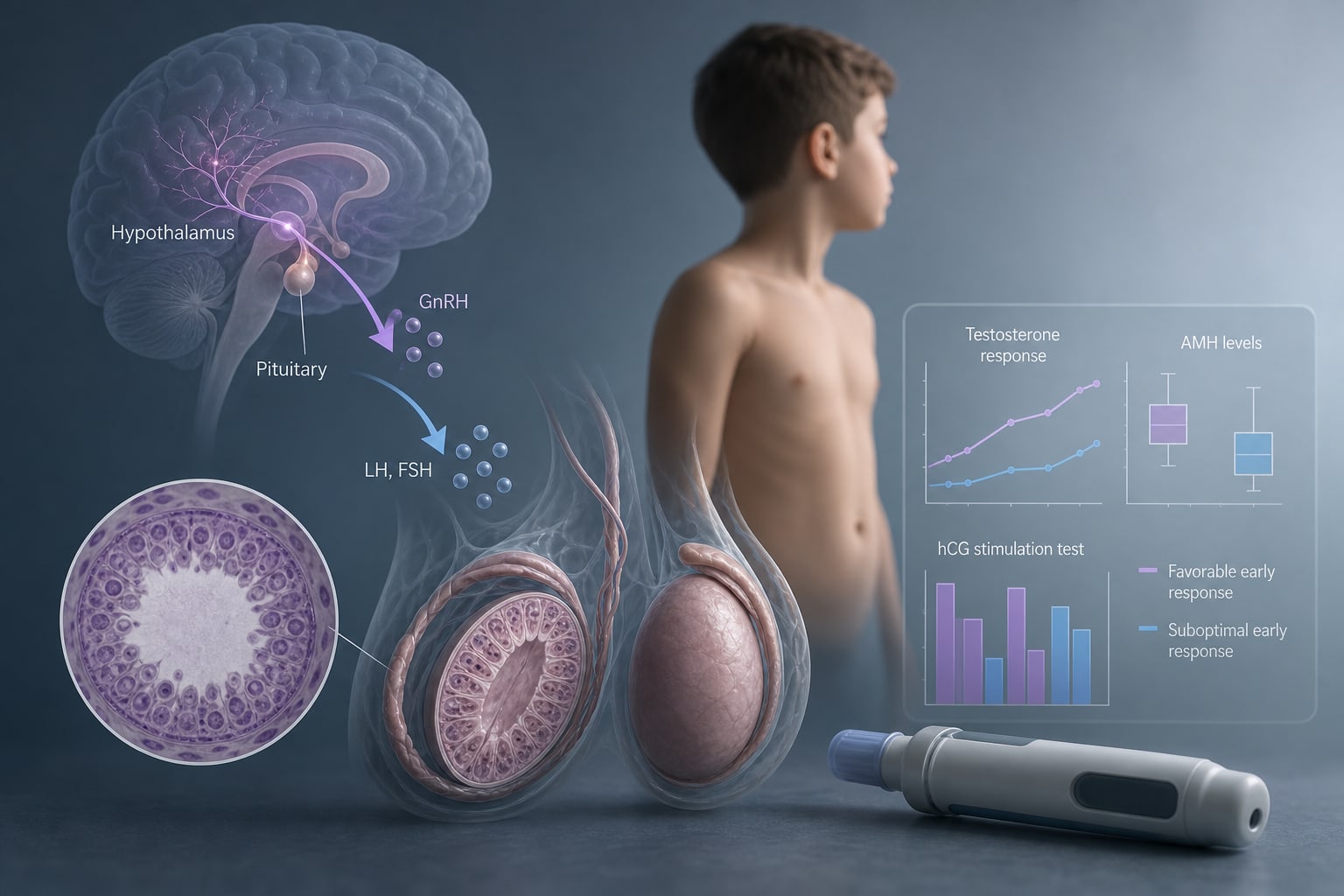
Congenital hypogonadotropic hypogonadism (CHH) is characterized by impaired gonadal activity and can lead to significant clinical issues such as delayed puberty and infertility. Understanding the factors that influence treatment response is crucial for optimizing therapeutic strategies in affected children. Identifying predictive indicators can enhance clinical decision-making and improve patient outcomes.

Data Highlights

ParameterValue
Baseline AMH Odds Ratio1.977
AMH Cut-off Value8.9 ng/ml
AMH Sensitivity88.89%
AMH Specificity93.75%
Testosterone Cut-off Value51.95 ng/dl
Testosterone Sensitivity87.5%
Testosterone Specificity88.89%

Key Findings

  • Baseline AMH levels are positively correlated with favorable early response to treatment.
  • The cut-off value for AMH was determined to be 8.9 ng/ml, with high sensitivity and specificity.
  • Testosterone levels after hCG stimulation also serve as a predictor of treatment response.
  • Patients were classified into favorable and suboptimal response groups based on specific clinical criteria.
  • The study emphasizes the need for validation in larger cohorts with standardized treatment protocols.

Clinical Implications

Clinicians should consider measuring baseline AMH and testosterone levels when assessing pediatric patients with suspected dual CHH to predict treatment response. These biomarkers may guide therapeutic decisions and improve individualized treatment plans.

Conclusion

The identification of baseline AMH and testosterone as predictive indicators of treatment response in dual CHH patients highlights the potential for improved patient stratification and management. Further validation in larger studies is necessary to confirm these findings.

Related Resources & Content

  1. The Journal of Clinical Endocrinology & Metabolism, 2023 -- Effectiveness of Gonadotropin Treatment for Stimulating Spermatogenesis and Restoring Fertility in Men with Abnormal Gonadotropin Levels
  2. The Journal of Clinical Endocrinology & Metabolism, 2023 -- Impact of GnRH Analog Treatment on Fertility and Health Outcomes in Adult Males with Central Precocious Puberty: A Comparative Study
  3. The Journal of Clinical Endocrinology & Metabolism, 2023 -- Clinical Features and Pubertal Development in Males and Females with Partial Gonadal Dysgenesis 46,XY: A Comparative Study with Complete Gonadal Dysgenesis
  4. The Journal of Clinical Endocrinology & Metabolism, 2023 -- FSH and Sertoli Cell Markers Effectively Differentiate Hypogonadotropic Hypogonadism from Self-Limited Delayed Puberty
  5. FSH and Sertoli Cell Biomarkers Accurately Distinguish Hypogonadotropic Hypogonadism From Self-limited Delayed Puberty
  6. Pubertal induction and transition to adult sex hormone replacement in patients with congenital pituitary or gonadal reproductive hormone deficiency: an Endo-ERN clinical practice guideline
  7. Therapeutic effects of a pulsatile GnRH pump on adult male patients with congenital hypogonadotropic hypogonadism (CHH): a retrospective study

Original Source(s)

Related Content