Time-restricted eating versus calorie restriction for improving biomarkers of age in adults with overweight or obesity and incipient fatty liver disease: protocol for the ENSATI randomized controlled parallel groups trial. - Report - MDSpire

Time-restricted eating versus calorie restriction for improving biomarkers of age in adults with overweight or obesity and incipient fatty liver disease: protocol for the ENSATI randomized controlled parallel groups trial.

  • By

  • Celada, José A.

  • Rubio-Gordón, Laura

  • Jiménez-Perez, Yolanda

  • López-Lora, Lorena

  • López-González, Andrés

  • Delbuono, Sara

  • Huertas, Ana

  • Martínez-Urbistondo, Diego

  • Ordovas, Jose M

  • de la O, Víctor

  • Daimiel, Lidia

  • May 28, 2026

  • 0 min

Share

Clinical Report: Comparative Study of Time-Restricted Eating and Caloric Restriction

Overview

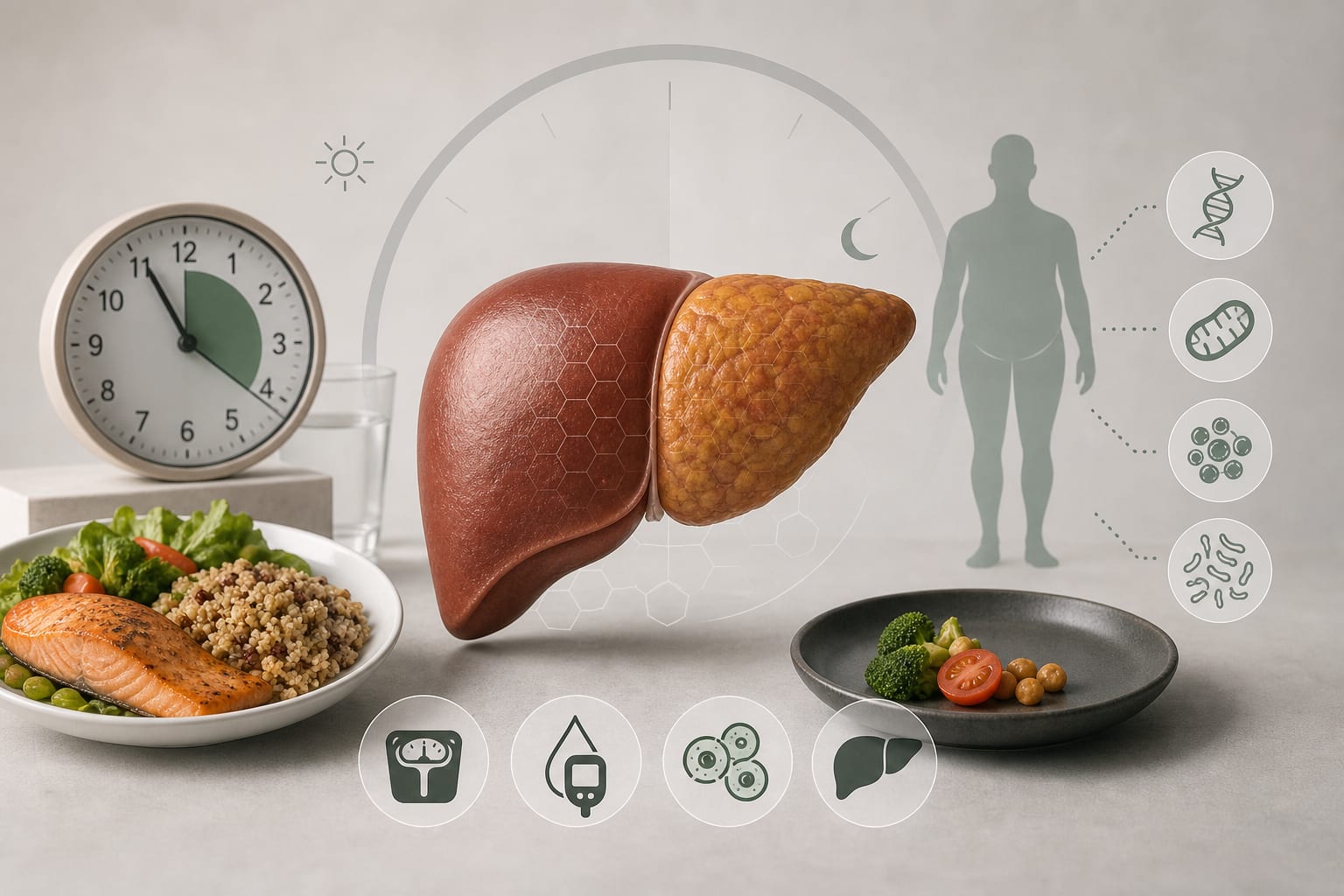
The ENSATI trial aims to compare the effects of time-restricted eating and caloric restriction on age-related biomarkers in overweight or obese adults with early fatty liver disease.

Background

As the global population ages, understanding interventions that can maximize health span is critical. This study addresses the need for comprehensive research on dietary strategies, particularly time-restricted eating and caloric restriction, in the context of aging and metabolic health.

Data Highlights

The ENSATI trial will enroll 177 adults aged 50–70 years with overweight/obesity and early fatty liver disease, comparing three dietary interventions over 12 months.

Key Findings

  • The trial includes three arms: active dietary counseling control, 25% calorie restriction, and time-restricted eating.
  • Primary outcomes will assess changes in body composition, hepatic fat, and metabolism.
  • Secondary outcomes will include glucose regulation, gut microbiome profiles, and molecular biomarkers of aging.
  • The study design aims to overcome limitations of previous short-duration studies.
  • Rigorous dietary monitoring and comprehensive profiling will be employed throughout the trial.

Clinical Implications

The findings from the ENSATI trial may inform dietary recommendations for managing early fatty liver disease and optimizing health span in older adults. Understanding the differential impacts of caloric restriction versus time-restricted eating could guide clinical practices in dietary interventions.

Conclusion

The ENSATI trial explores dietary interventions for aging and metabolic health with a comprehensive design.

Related Resources & Content

  1. The Journal of Clinical Endocrinology & Metabolism, 2023 -- Impact of Short-Term Iso- and Hypocaloric Carbohydrate Reduction on Hepatic Fat and Metabolic Responses of Glucose and Lipids
  2. the new gastroenterologist, 2026 -- Time-restricted feeding linked to improvements in Crohn’s disease activity and metabolic markers
  3. Obesity Surgery, 2022 -- Efficacy and Safety of a Two-Week Low-Calorie High-Protein Diet Before Bariatric Surgery: Results from a Prospective Randomized Study
  4. Clinical care pathway for the risk stratification and management of patients with MASLD, American Gastroenterological Association
  5. AASLD Announces Update to Metabolic Dysfunction‐Associated Steatotic Liver Disease (MASLD) Practice Guidance | AASLD
  6. Evidence-based clinical practice guidelines for metabolic dysfunction-associated steatotic liver disease (MASLD) 2026 | Journal of Gastroenterology
  7. Time‐restricted eating, caloric reduction, and unrestricted eating effects on weight and metabolism: a randomized trial - Oldenburg - 2025 - Obesity
  8. The Journal of Clinical Endocrinology & Metabolism — Impact of Time-Restricted Eating on Pancreatic β-Cell Performance in Adults with Type 2 Diabetes Mellitus
  9. Clinical care pathway for the risk stratification and management of patients with MASLD  - American Gastroenterological Association
  10. AASLD Announces Update to Metabolic Dysfunction‐Associated Steatotic Liver Disease (MASLD) Practice Guidance | AASLD
  11. Evidence-based clinical practice guidelines for metabolic dysfunction-associated steatotic liver disease (MASLD) 2026 | Journal of Gastroenterology | Springer Nature Link
  12. Time‐restricted eating, caloric reduction, and unrestricted eating effects on weight and metabolism: a randomized trial - Oldenburg - 2025 - Obesity - Wiley Online Library
  13. Efficacy and safety of time-restricted eating in metabolic dysfunction-associated steatotic liver disease - PubMed
  14. Time Restricted Hypo-caloric Diet Achieves Better Insulin Sensitivity over Hypo-caloric Diet Alone in Patients With Metabolic Dysfunction-associated Steatotic Liver Disease: A Randomized Controlled Trial - PubMed
  15. Frontiers | Intermittent fasting versus continuous energy restriction in MASLD: a systematic review and meta-analysis
  16. Effect of caloric restriction on organ-specific biological aging in a randomized clinical trial - ScienceDirect

Original Source(s)

Related Content