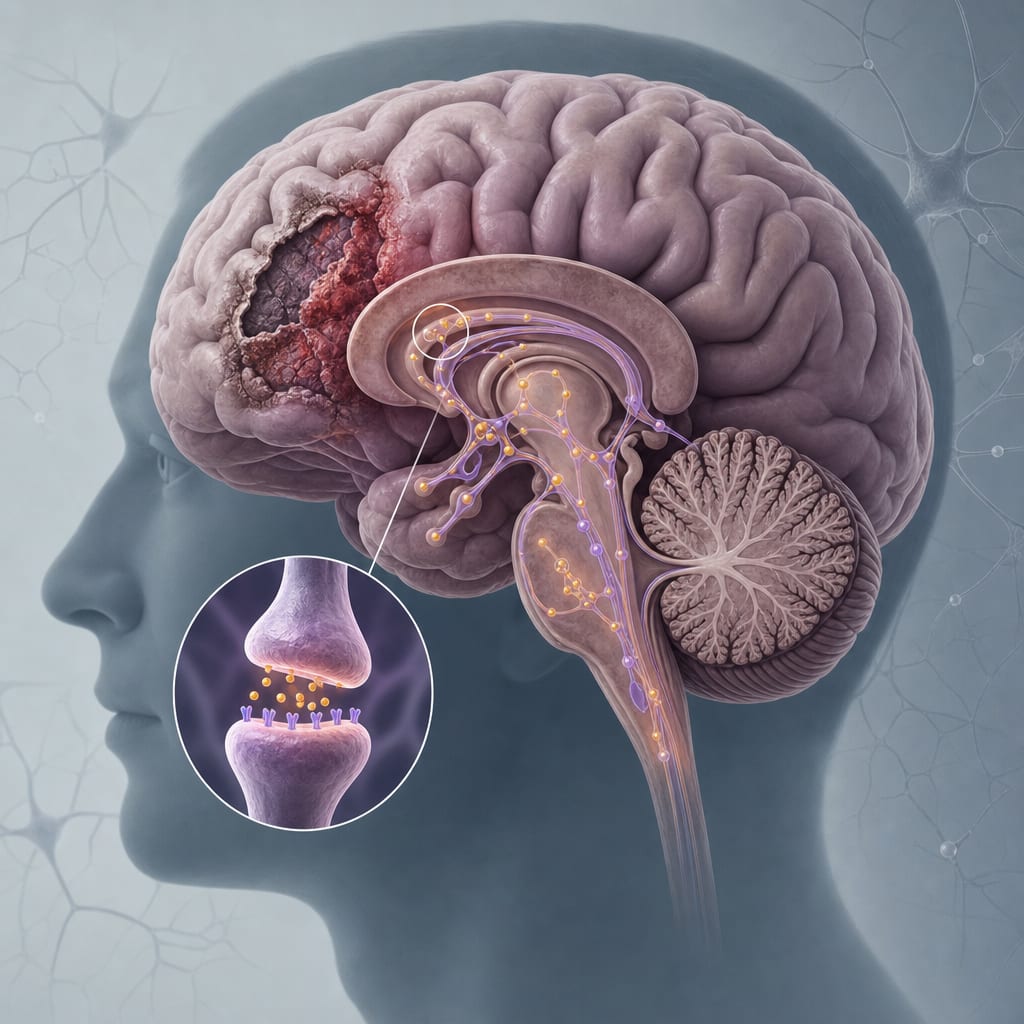
Phase 2b Study of Sonlicromanol in m.3243A>G Mitochondrial Disease Patients
Overview
This phase 2b study evaluated sonlicromanol in adults with mitochondrial disease linked to the m.3243A>G mutation. Sonlicromanol was well tolerated and showed signals of efficacy in cognitive, mood, fatigue, pain, and physical function domains, particularly in patients more affected at baseline. Long-term treatment over 52 weeks demonstrated more pronounced clinical improvements.
Background
The m.3243A>G mutation in the mitochondrial MT-TL1 gene is the most common genetic cause of primary mitochondrial disease, presenting with heterogeneous phenotypes including MELAS and MIDD syndromes. This mutation impairs oxidative phosphorylation, leading to oxidative and reductive distress and inflammation. Sonlicromanol, a chromanol piperidine, modulates redox status and inflammation by inhibiting prostaglandin E1 synthase and activating antioxidant systems. Previous studies have shown its good bioavailability, blood-brain barrier penetration, and safety profile, making it a promising therapeutic candidate for mitochondrial disease symptoms such as fatigue, pain, and cognitive decline.
Data Highlights
Outcome Measure
P Value
Effect
Beck Depression Inventory (BDI)
0.0143
Improvement over placebo
Cognitive Failure Questionnaire
0.0113
Improvement over placebo
Hospital Anxiety and Depression Scale - Depression Subscale
0.0256
Improvement over placebo
Test of Attentional Performance (TAP) with alarm
0.0102
Improvement at EXT end
Test of Attentional Performance (TAP) without alarm
0.0047
Improvement at EXT end
BDI Somatic
0.0261
Improvement at EXT end
SF12 Physical Component Score
0.0008
Improvement at EXT end
RAND SF-36 Pain Domains (7 of 9)
0.0105
Improvement at EXT end
Neuro-QoL Fatigue Scale
0.0036
Improvement at EXT end
Mini-Balance Evaluation Systems Test
0.0009
Improvement at EXT end
McGill Pain Questionnaire
0.0105
Improvement at EXT end
EuroQol EQ-5D-5L Visual Analog Scale
0.0213
Improvement at EXT end
EQ-5D-5L Index
0.0173
Improvement at EXT end
Key Findings
Sonlicromanol was well tolerated with a favorable safety profile over up to 1 year of treatment.
The primary RCT endpoint (change in attentional cognition score) did not reach statistical significance overall, but showed benefit in patients more affected at baseline (P = 0.0338).
Significant improvements over placebo were observed in mood and cognitive measures including BDI, Cognitive Failure Questionnaire, and Hospital Anxiety and Depression Scale depression subscale.
Long-term open-label extension showed statistically and clinically meaningful improvements in attention, fatigue, pain, physical function, and quality of life measures.
Seven of nine pain domains on the RAND SF-36 improved significantly, indicating pain relief benefits.
Most patients improved in physical performance tests such as the Five Times Sit-To-Stand Test.
Clinical Implications
Sonlicromanol offers a promising therapeutic option for patients with mitochondrial disease linked to the m.3243A>G mutation, particularly those with more severe baseline impairment. Its favorable safety and tolerability profile supports long-term use. Clinicians may consider sonlicromanol to address cognitive dysfunction, mood disturbances, fatigue, pain, and physical limitations in this patient population.
Conclusion
Sonlicromanol demonstrated a favorable benefit-risk ratio and clinical efficacy signals in multiple symptom domains in patients with m.3243A>G mitochondrial disease, especially with longer-term treatment. These findings support further development and potential therapeutic use in this unmet medical need.
References
Author/Source/Year -- Phase 2b Study of Sonlicromanol in Individuals with Mitochondrial Disease Linked to the m.3243A>G Mutation
by Jan Smeitink, Just van Es, Brigitte Bosman, Mirian C H Janssen, Thomas Klopstock, Grainne Gorman, John Vissing, Gerrit Ruiterkamp, Chris J Edgar, Evertine J Abbink, Rob van Maanen, Oksana Pogoryelova, Claudia Stendel, Almut Bischoff, Ivan Karin, Mahtab Munshi, Anne Kümmel, Lydia Burgert, Christianne Verhaak, Herma Renkema