Machine learning prediction of 30-day all-cause mortality risk factors in HCC rupture - Report - MDSpire

Machine learning prediction of 30-day all-cause mortality risk factors in HCC rupture

  • By

  • Shixiong Shi

  • Canbin Xie

  • Lin Long

  • June 23, 2026

  • 0 min

Share

Clinical Report: Utilizing Machine Learning to Identify 30-Day Mortality Risk Factors in Patients with Ruptured Hepatocellular Carcinoma

Overview

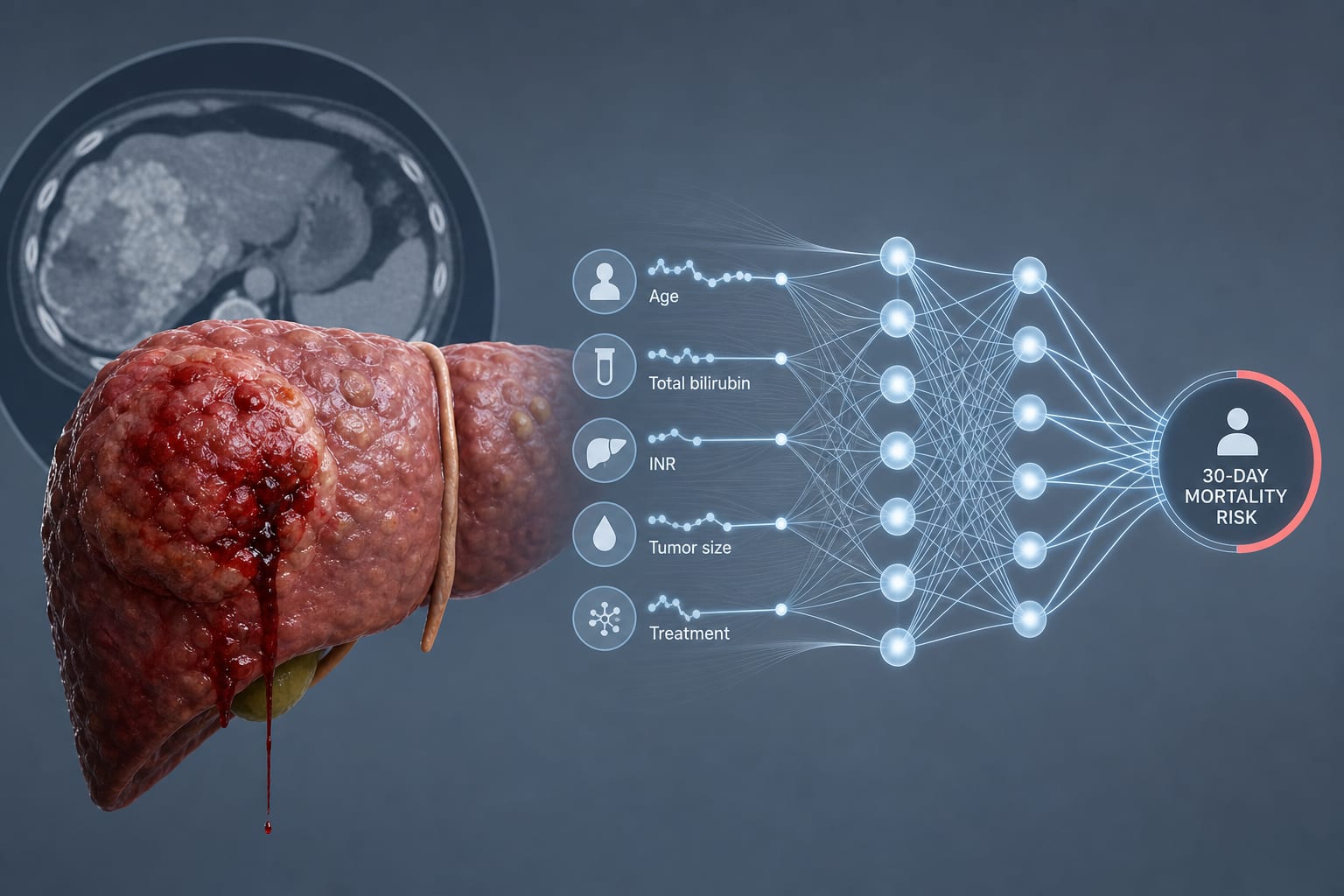
This study developed a machine learning model to predict 30-day all-cause mortality in patients with ruptured hepatocellular carcinoma (HCC). Key predictors identified include total bilirubin (TBIL) and international normalized ratio (INR), which demonstrated significant nonlinear associations with mortality risk.

Background

Ruptured hepatocellular carcinoma is a critical complication that significantly contributes to early mortality among HCC patients. The incidence of spontaneous rupture is notably high in Asia, particularly in China, where it accounts for a substantial proportion of acute-phase fatalities.

Data Highlights

ModelSensitivityAUC
Decision Tree87.5%0.7901

Key Findings

  • The decision tree model was selected for its superior sensitivity in predicting 30-day mortality.
  • TBIL and INR were identified as primary predictors of mortality risk.
  • Nonlinear threshold effects were observed for TBIL (>40 μmol/L) and INR (>2.5), significantly increasing mortality risk.
  • The combined assessment of TBIL and INR improved predictive accuracy (AUC = 0.87).
  • Machine learning techniques can elucidate nonlinear associations in clinical data.

Clinical Implications

The identification of TBIL and INR as critical predictors allows for more accurate risk stratification in patients with ruptured HCC.

Conclusion

The decision tree model effectively predicts 30-day mortality in patients with ruptured HCC.

Related Resources & Content

  1. European Radiology, 2024 -- Machine Learning-Based Automated Prognostic Evaluation for Hepatocellular Carcinoma Patients
  2. the asco post, 2026 -- Machine-Learning Model for HCC Risk Prediction May Outperform Current Methods
  3. European Radiology, 2024 -- Machine Learning-Based Assessment of Prognosis and Risk Stratification for Unresectable Hepatocellular Carcinoma Treated with Transarterial Chemoembolization or Intra-arterial Chemotherapy
  4. Management of Hepatocellular Carcinoma | AASLD
  5. Early Hemostatic Treatment Could Improve 30‐Day Survival After Spontaneous Rupture of Hepatocellular Carcinoma - Commin, 2025 - Liver International
  6. Modeling the prediction of spontaneous rupture and bleeding in hepatocellular carcinoma via machine learning algorithms | Scientific Reports, 2025
  7. Frontiers in Neurology — Machine learning model for unfavorable outcome prediction in neurosurgical patients: the potential role of liver function markers
  8. Management of Hepatocellular Carcinoma | AASLD
  9. Early Hemostatic Treatment Could Improve 30‐Day Survival After Spontaneous Rupture of Hepatocellular Carcinoma - Commin - 2025 - Liver International - Wiley Online Library
  10. Modeling the prediction of spontaneous rupture and bleeding in hepatocellular carcinoma via machine learning algorithms | Scientific Reports

Original Source(s)

Related Content