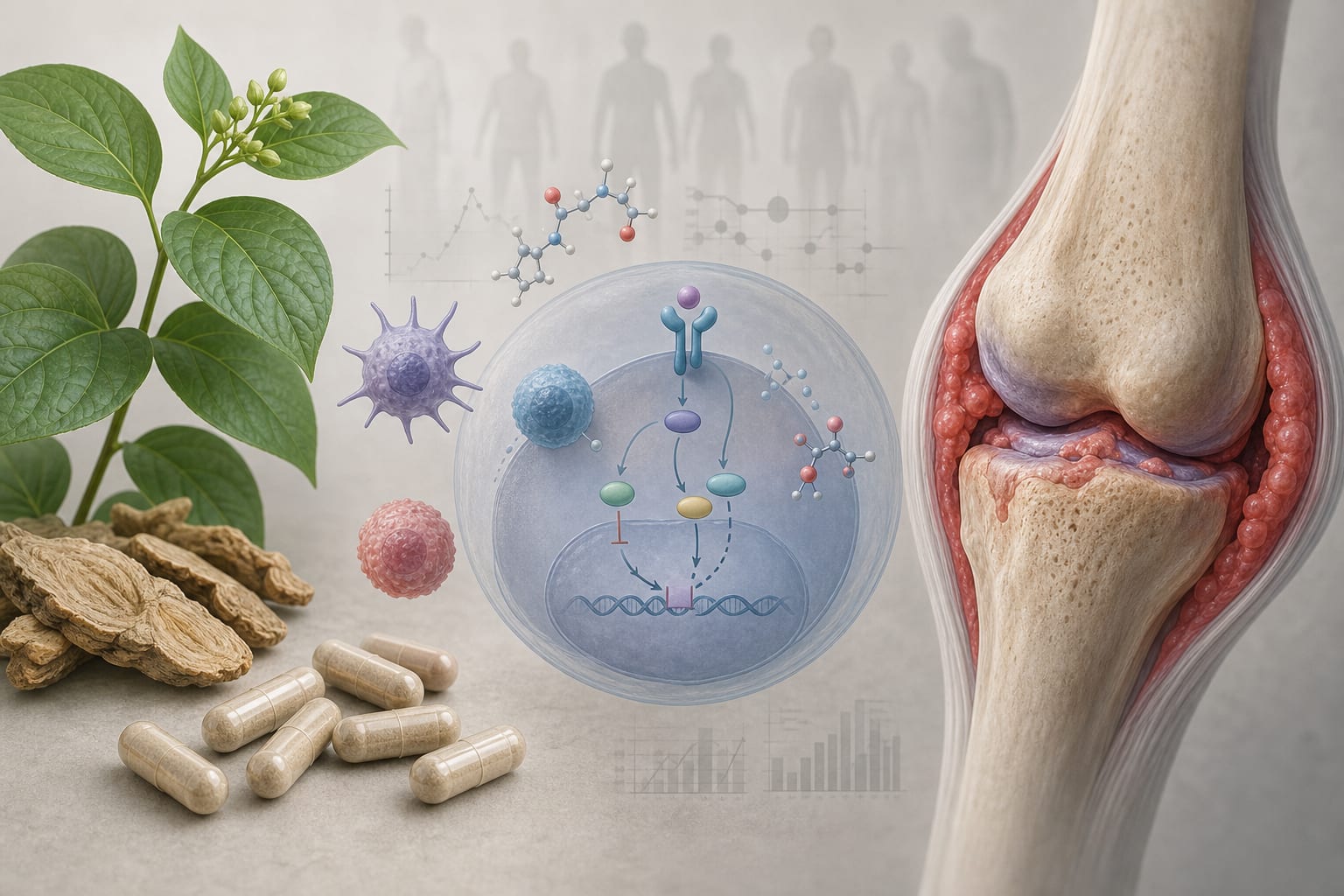
Efficacy and Mechanisms of Tripterygium wilfordii Hook. f. and Xinfeng Capsule in the Management of Rheumatoid Arthritis: A Comprehensive Review of Clinical Evidence and Translational Insights
-
By
-
Wen, Jianting
-
Liu, Jian
-
June 8, 2026
Clinical Report: Efficacy and Mechanisms of Tripterygium wilfordii in RA
Overview
This comprehensive review evaluates the efficacy and mechanisms of Tripterygium wilfordii Hook. f. (TWHf) and Xinfeng Capsule (XFC) in managing rheumatoid arthritis (RA). Clinical evidence suggests these treatments may improve disease activity and inflammatory markers, although challenges such as toxicity and the need for high-quality trials remain.
Background
Rheumatoid arthritis (RA) is a prevalent autoimmune disease characterized by joint inflammation and destruction, affecting approximately 1% of the global population. Traditional treatments primarily involve disease-modifying antirheumatic drugs (DMARDs), but the integration of herbal medicines like TWHf is gaining attention. Understanding the efficacy and safety of TWHf and its derivatives is crucial for optimizing RA management.
Data Highlights
No numerical data available in the source material.
Key Findings
- TWHf has been used in traditional medicine for RA treatment, showing potential efficacy.
- Preclinical studies indicate TWHf regulates key inflammatory pathways, including NF-κB and PI3K/AKT/mTOR.
- XFC demonstrates broader regulatory effects compared to isolated TWHf monomers.
- Clinical studies suggest TWHf preparations can improve disease activity and inflammatory markers.
- Challenges include toxicity, lack of high-quality multicenter RCTs, and insufficient standardization.
- Future research should focus on standardized formulations and biomarker-guided applications.
Clinical Implications
Clinicians should consider the potential benefits of TWHf and XFC in RA management while remaining aware of the associated risks and the need for further research. Standardization and safety monitoring are essential for integrating these treatments into clinical practice.
Conclusion
TWHf and XFC present promising options for RA management, but further rigorous clinical evaluation is necessary to establish their safety and efficacy in standard treatment protocols.
Related Resources & Content
- Clinical Rheumatology, 2010 -- Case Series of 12 Patients with Ankylosing Spondylitis Treated Using Tripterygium wilfordii
- Clinical Rheumatology, 2017 -- A Comprehensive Review and Meta-Analysis on the Efficacy and Safety of Total Glucosides of Peony in Combination with Methotrexate for Treating Rheumatoid Arthritis
- Frontiers in Immunology, 2026 -- Mechanistic study on the reduction of TNF-α and β-CTX levels in RA patients by moxibustion combined with western medication through regulation of the Wnt/β-catenin pathway
- 2021 American College of Rheumatology Guideline for the Treatment of Rheumatoid Arthritis - PMC
- Chinese guidelines for the diagnosis and treatment of rheumatoid arthritis: 2024 update - PMC
- Frontiers in Immunology — Efficacy and safety of upadacitinib in the treatment of rheumatoid arthritis: a systematic review and meta-analysis
- Thunder God Vine: Usefulness and Safety | NCCIH
- https://www.eular.org/document/download/1406/ec021a77-cdf3-4de3-ae72-57c1757db549/1325
- 2021 American College of Rheumatology Guideline for the Treatment of Rheumatoid Arthritis - PMC
- Chinese guidelines for the diagnosis and treatment of rheumatoid arthritis: 2024 update - PMC
- Comparison of Tripterygium wilfordii Hook F Versus Sulfasalazine in the Treatment of Rheumatoid Arthritis: A Randomized Trial - PMC
- Efficacy and safety of tripterygium wilfordii Hook F plus TNF inhibitor for active rheumatoid arthritis: A multicentre, randomized, double-blind, triple-dummy controlled trial - ScienceDirect
- Efficacy and safety of Xinfeng capsule in patients with rheumatoid arthritis: a multi-center parallel-group double-blind randomized controlled trial - ScienceDirect
Based on findings from:
Tripterygium wilfordii Hook. f. and Xinfeng Capsule in Rheumatoid Arthritis: A Review of Clinical Evidence, Molecular Mechanisms, and Translational Perspectives
Wen, Jianting , Liu, Jian . Frontiers In Immunology, 2026.
https://www.frontiersin.org/journals/immunology/articles/10.3389/fimmu.2026.1814416/full
This content is an AI-generated, fully rewritten summary based on a published scholarly article. It does not reproduce the original text and is not a substitute for the original publication. Readers are encouraged to consult the source for full context, data, and methodology.