Case Report: A rare stop-gained MYZAP mutation is associated with atrioventricular septal defects in an Arabian family - Report - MDSpire

Case Study: An Uncommon Stop-Gained MYZAP Mutation Linked to Atrioventricular Septal Defects in an Arabian Family

  • By

  • Zaher Zaher

  • Gaser Abdelmohsen

  • Saud Bahaidarah

  • Faris Baamer

  • Angham Abdulrhman Abdulkareem

  • Abdulmajeed F. Alrefaei

  • Muhammad Imran Naseer

  • Muhammad Abu-Elmagd

  • July 20, 2026

Share

Clinical Report: An Uncommon Stop-Gained MYZAP Mutation Linked to AVSD

Overview

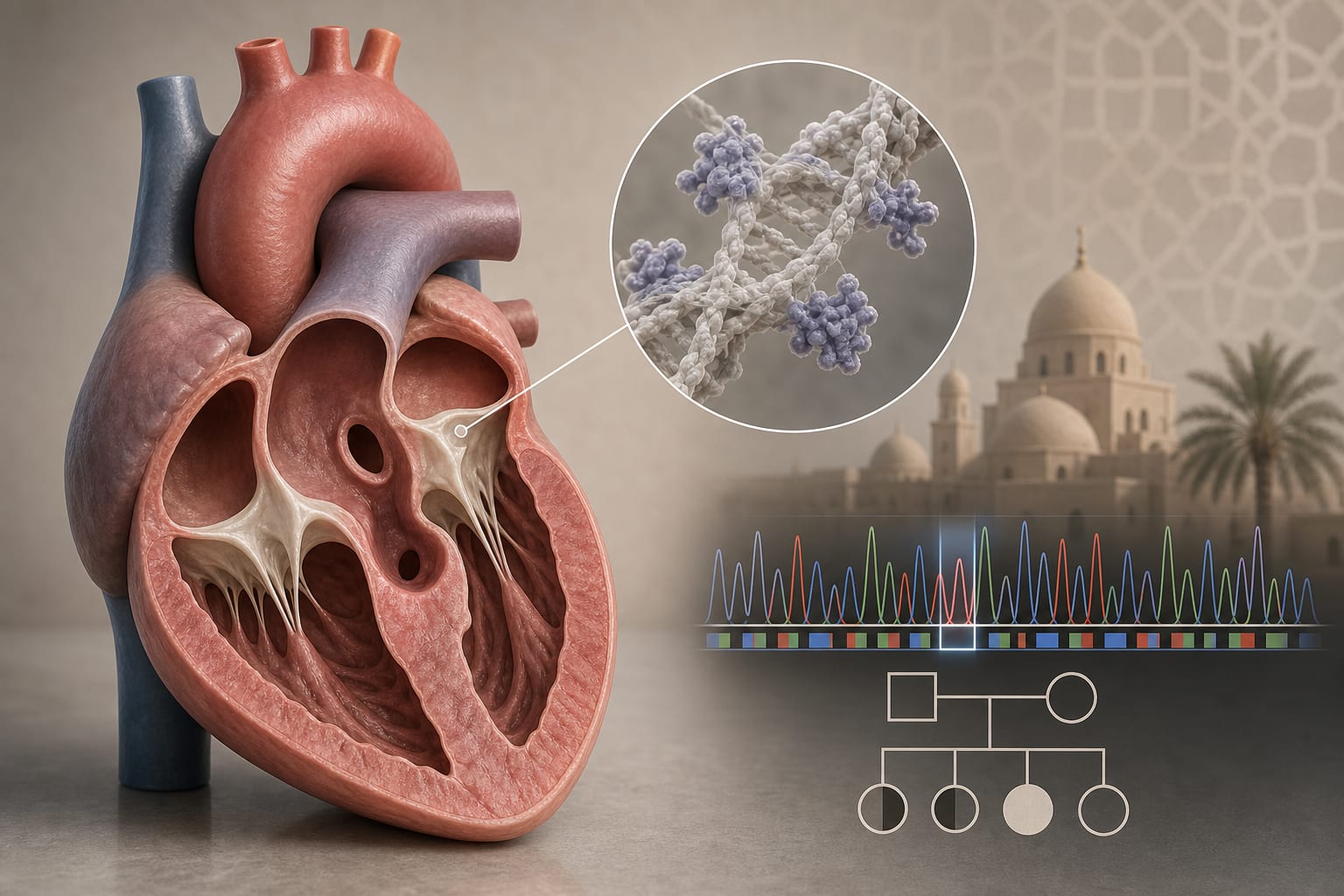
This case study identifies a novel homozygous stop-gain variant in the MYZAP gene associated with atrioventricular septal defects (AVSD) in an Arabian family.

Background

Atrioventricular septal defects (AVSDs) are significant congenital heart anomalies often linked to trisomy 21, with an incidence of 4 to 5 per 10,000 live births. The identification of genetic variants associated with AVSD is important for understanding its pathophysiology.

Data Highlights

Whole-exome sequencing revealed a novel homozygous stop-gain variant in the MYZAP gene (NM_001018100.5:c.229C > T; p.Arg77Ter) in two affected siblings, with segregation analysis confirming heterozygous carriage in the father.

Key Findings

  • A novel homozygous stop-gain variant in MYZAP was identified in two siblings with AVSD.
  • The variant meets ACMG criteria for likely pathogenicity and is extremely rare in population databases.
  • The family presented with a spectrum of AVSD phenotypes, including complete AVSD and isolated cleft of the anterior mitral leaflet.
  • MYZAP is primarily associated with cardiomyopathy but may also play a role in congenital cardiac malformations.
  • Further functional studies are needed to validate the association of MYZAP with AVSD.

Clinical Implications

Understanding the genetic basis of AVSD can aid in management strategies for affected families.

Conclusion

This case study presents a novel MYZAP variant associated with AVSD, warranting further investigation.

Related Resources & Content

  1. Frontiers in Cardiovascular Medicine, 2026 -- Novel compound heterozygous mutations in KLHL24-induced recessive inherited hypertrophic cardiomyopathy: a case report
  2. Frontiers in Cardiovascular Medicine, 2026 -- Case Report: A novel MYBPC3 gene variant in a Chinese patient with hypertrophic cardiomyopathy and apical ventricular aneurysm, with a concurrent novel KCNJ5 gene variant
  3. 2025 ACC/AHA/HRS/ISACHD/SCAI Guideline for the Management of Adults With Congenital Heart Disease | Circulation
  4. Clinical Practice Algorithm For the Follow-Up of Repaired and Unrepaired Atrioventricular Septal Defects - American College of Cardiology
  5. Basic Research in Cardiology — Variants in the Coding and Non-coding Regions of the SHOX2 Gene Associated with Early-Onset Atrial Fibrillation
  6. Clinical Research in Cardiology — Identification of a new desmoplakin mutation linked to juvenile biventricular cardiomyopathy, left ventricular non-compaction, and acantholytic palmoplantar keratoderma
  7. 2025 ACC/AHA/HRS/ISACHD/SCAI Guideline for the Management of Adults With Congenital Heart Disease: A Report of the American College of Cardiology/American Heart Association Joint Committee on Clinical Practice Guidelines | Circulation
  8. Clinical Practice Algorithm For the Follow-Up of Repaired and Unrepaired Atrioventricular Septal Defects - American College of Cardiology
  9. Recessive genetic contribution to congenital heart disease in 5,424 probands - PubMed

Original Source(s)

Related Content