Clinical Report: Creation of bispecific antibodies against SARS-CoV-2 Omicron
Overview
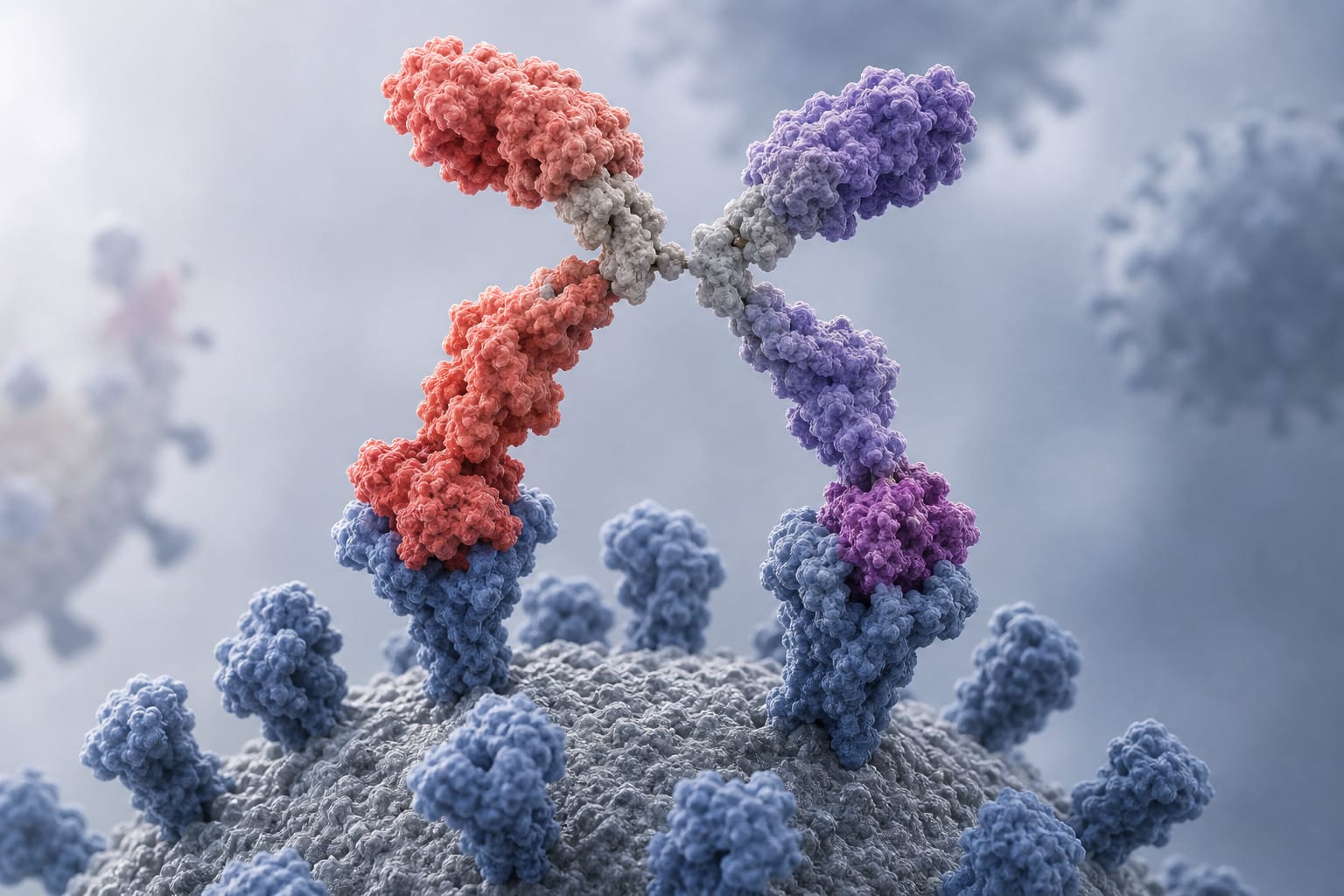
This study identifies bispecific antibodies (bsAbs) that exhibit improved neutralization efficacy against various SARS-CoV-2 Omicron subvariants compared to traditional monoclonal antibodies. The lead bsAbs, R3-1a-1/R4-1a-10 and R4-21/R4-1a-51, demonstrated enhanced binding activity and lower IC50 values.
Background
The emergence of the Omicron variant of SARS-CoV-2 has significantly challenged existing antibody therapies due to its high mutation rate and immune evasion capabilities. Bispecific antibodies (bsAbs) offer a promising alternative by targeting multiple epitopes, potentially improving neutralization efficacy against evolving variants. This study explores the development of bsAbs as a response to the limitations of current monoclonal antibody therapies.
Data Highlights
Antibody
Binding Affinity (M)
IC50 Values
Parental mAbs
5.71 x 10⁻¹⁰ to 2.53 x 10⁻⁴
Varied
R3-1a-1/R4-1a-10
Enhanced
Lower than controls
R4-21/R4-1a-51
Enhanced
Lower than controls
Key Findings
Bispecific antibodies (bsAbs) were engineered from a fully human antibody phage-display library.
Lead bsAbs showed improved binding activity against Omicron subvariants compared to traditional monoclonal antibodies.
IC50 values for the lead bsAbs were lower than those of control antibodies and mAb cocktails.
Selected parental mAbs exhibited a wide range of binding affinities across tested Omicron subvariants.
bsAbs retained neutralizing activity against selected non-Omicron pseudovirus strains.
Clinical Implications
The development of bispecific antibodies represents a significant advancement in the fight against SARS-CoV-2, particularly in the context of emerging variants. Clinicians may consider these bsAbs as a viable therapeutic option, potentially offering broader protection and reduced risk of viral escape compared to existing monoclonal antibody therapies.
Conclusion
The study highlights the potential of bispecific antibodies as a next-generation therapeutic strategy against SARS-CoV-2, particularly in light of the challenges posed by the Omicron variant. Continued exploration and development of these antibodies may enhance treatment efficacy in the evolving landscape of COVID-19.